



Why historian Romila Thapar’s memoir, Just Being, offers the possibility of a way of living life
Thapar belongs to a generation that imagined India in a particular way. Today that imagination can feel distant to younger people. But there is something to learn from it. Thapar’s importance lies not only in the histories she has written, but in the kind of intellectual life she has lived. Curious, rigorous, unwilling to be confined by labels and always open to questioning herself.

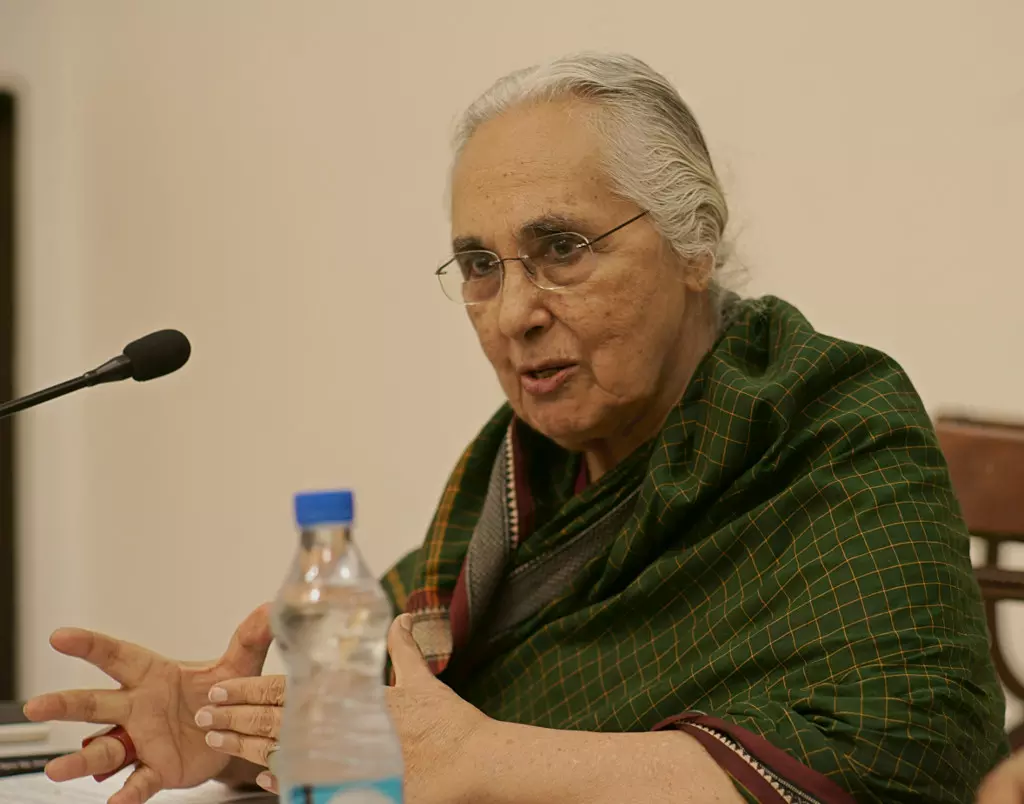
File photo of historian Romila Thapar. Photo: Wikimedia Commons
“Time present and time past
Are both perhaps present in time future
And time future contained in time past.”
Historian Romila Thapar, 94, ends the prologue of her 2026 memoir with these lines of TS Elliot. Reading the memoir, titled ‘Just Being’, many readers would perhaps keep returning to these lines, not because they sound profound but because they capture what she is trying to do. Thapar is not simply narrating her life. She is trying to understand, as a historian, how memory works, and how she looks back at her life that stretched across more than ninety years, objectively.
The history of memoir writing is fascinating. The human urge to record and document one’s life and to make sense of their times is not new. From Constantine’s Confessions to the writings of Jean-Jacques Rousseau and Jawaharlal Nehru, these works are not just intimate explorations of their lives but also attempt to place the individual within history. But when a historian writes a memoir, it is slightly more nuanced. Historians are trained to distrust memory, to question sources, to focus on available evidence and to remain objective. It is not easy to look at one’s own life from a distance when the gaze has to turn inward. Would that subjectivity then overshadow the historian’s craft, in what possibly will be the most personal work?
Most of the memoirs arrive with a promise of a revelation and very few with a doubt. This is a paradox where people who are experts underestimate their abilities and those who know very little overestimate theirs; it is called the Dunning-Kruger effect.
Just Being opens with an awareness that to recollect and narrate a life is already shaping it and giving it an order which in real life does not exist. Thapar starts with acknowledging the problems of writing a memoir. She says that most of one’s life is spent talking to oneself and that these memoirs are in some ways those conversations, which at times were affectionate and at times marked by frustration. She casts a doubt on memory and defines the terms of her project; what follows is recollections. Memory is always shaped by selection, recalling and forgetting and the memoir opens with talking about this tension between memory and history.
These are some of the questions with which she starts narrating her life. She looks at her own life from a distance. The places she has lived, the people she has known, the various activities she has been part of, and asks what impact they had on her. Was her life solitary, or marked and influenced by people she met. Did she, in turn, influence people, and how. These are the inquiries the historian is making at the beginning of her recollections.
'A many splendoured life'
As for the reasons for writing a memoir, at one point, she says that perhaps she has lived a “many splendoured life” and had experiences she now wishes to recall; to understand the world she lived in and the world she tried to create around herself.
The book is set chronologically, as a historian would naturally do. These days, there are many debates around chronology, but it remains essential to arrange the vastness of the past that becomes history.
However, the memoir does not begin with childhood. It opens in her garden, where she is sitting and writing, during the pandemic. She describes her solitary confines with utmost beauty and serenity. Her garden, which she built with the help of friends like Pradip Krishen, has a Zen-like quality, filled with trees and greenery, where squirrels, bulbuls and other birds come and go. She often has her breakfast or lunch there, alone. It is from here that the narrative goes back in time, as a flashback.
She writes about her childhood in cantonment areas, about her earliest years spent in Lahore, and then in North Western Frontier Province, now Khyber Pakhtunkhwa (both now in Pakistan). She talks of the Qissa Khwani Bazaar (in Peshawar, Pakistan) — that famous area to which so many film personalities Dilip Kumar, the Kapoor family and Shah Rukh Khan trace their histories. It can be translated as the bazaar of stories, which gave us many storytellers and in that space, there was also a young Romila Thapar growing up.
Her father and her mother are fascinating presences in these chapters. Her father, Daya Ram Thapar, went to the United Kingdom to study medicine, came back, did not want to practice and then decided to join the Army Medical Corps, eventually heading it. He also had other interests, photography, for instance. During his posting at the Thal Fort, where there were not many avenues to pass time, he made a silent film called Kidnapped, essentially a period piece. She writes about Thal Fort, about how it was structured, officers on one side and other ranks on the other, about picnics to the Khyber pass. She poetically writes about movements, observations and small details that build a world.
Cover of Romila Thapar's memoir, Just Being. Photo: seagullbooks.org
History keeps entering the narrative after every few paragraphs, as context. When the family moved to Rawalpindi in 1939, she remembers it because September that year the Second World War broke out. She writes about sitting with her family around the radio, listening to King George VI explaining why Britain was at war. When Thapar is writing these anecdotes from her childhood, it is not an abstract form of historical writing but lived experience.
Thapar does not shy away from dealing with moments of discomfort. In the chapter where she writes about her early views on Israel, she says quite openly that she had initially been enthusiastic, that she had arguments with friends who opposed it, and that over time she became disillusioned as she saw developments more closely. She mentions a minor diplomatic issue that involved her and the creation of the Friends of Israel Society. Humans are complex beings, our ideas and thoughts constantly evolve. She brings out the complexity of her personality openly in this instance to highlight how her beliefs have evolved.
In the chapters that follow, she reflects critically on her own engagement with public history. She writes that the popular understanding of history continued to focus on political and dynastic narratives, but some of them were trying to introduce new perspectives. She decided to give public lectures when asked, even though she says she is not someone who would jump up and stand before a mic at every opportunity. This chapter provides an important prologue to the many conversations and tensions on X (formerly Twitter) between ‘academic historians’ and ‘popular historians’. She writes, “This distinction between the historian who uses the historical method and the person who does not is a distinction that has to be constantly pointed out so that the fake is not mistaken for the real.”
Her travels come in as well. From childhood travels across the subcontinent, to later, when she moved to London for her studies. In the late 1950s, Thapar, with Anil De Silva, a Sri Lankan historian, travelled to China, at Maijishan, to explore the history of Buddhism in the country. She had taken interest in pottery and archaeology during her time at SOAS (University of London), which in a way came handy when she assisted Silva in China. It was on this trip that she ‘shook hands with history’; met Chairman Mao Zedong and Zhou Enlai. In Chicago, just before what would become the student revolt of 1968, she met Studs Terkel, who did pioneering work on the history of jazz. It was soon after the assasination of Martin Luther King Jr. She writes about how that evening with Terkel was not just about music but also an encounter with race in America, in an inverted way.
Back in India, she first joined the Kurukshetra University and later left it for Delhi University. The ‘60s were the era when the Naxalite movement was taking shape. She writes about the student movements and the enthusiasm of students to join the movement, but her concern was that the students did not fully understand rural realities. She further says that they could only try to dissuade them, on the insistence of the parents, but her view was that of discussing the intentions seriously in order to dissuade them. Though she maintains that student protests at one level sharpen perceptions of the university scene, filling in a grey area of contact with students and their problems.
Engaging with the past
She then turns to the writing of history itself. From her earliest serious engagement with the past, she has been an advocate of wide readings, awareness of evidence and regular engagement with other disciplines, what we now fashionably call inter-disciplinary. For Thapar, history is not about quick answers. She is critical of what she calls quackery, people who give easy answers without depth. She writes in detail about her work with NCERT textbooks, which is again under attack today, which she did initially on the invitation of the nationalist historian RC Majumdar.
She fondly recollects the early days of the Centre for Historical Studies at Jawaharlal Nehru University. Her relations with other faculty members and some encounters with students. She talks of people who made JNU what it became. For Thapar, the label of JNU being a ‘Marxist university’ is misplaced.
Beyond all the rich and voluminous material that Thapar is dealing with in her memoir, what makes it interesting is that it is not just a dry academic’s narrative of life. She is a Renaissance person who has eclectic interests across fields. Poetry, pottery, philosophy, botany, travelling, food and music. She was one of the founding members of the Dhrupad Society in Delhi (Dhrupad is a form of Indian classical music). She has travelled across the world, still travels. She reads Elliot (TS Elliot) and Faiz (Urdu poet and author Faiz Ahmed Faiz); and all of this in turn reflects in her writing.
There is a sense of someone who is constantly engaging with the world in different ways. Thapar has lived a long life, more than ninety years, and what the readers are reading in the memoir is only a selection. This is one version of memory and it is only fair to believe that there must be many things left out, many people not mentioned, as it is humanly impossible to capture a life like this completely. That is the discipline of memoir writing. It is something that the historian honestly shared on the first page of her prologue.
Thapar belongs to a generation that imagined India in a particular way and helped shape how India thought of itself. Today, that imagination can feel distant, even strange, to younger people. But there is something to learn from it. Romila Thapar’s importance lies not only in the histories she has written, but in the kind of intellectual life she has lived. Curious, rigorous, unwilling to be confined by labels and always open to questioning herself. That is not easy to sustain across decades and certainly not in the face of the kind of public scrutiny she has faced. To read her now is to be reminded that thinking itself requires discipline, patience, and a certain courage. And that perhaps is what Just Being leaves behind, not just the memory of a life, but the possibility of a way of being in the world.
(The reviewer is working on a documentary on Romila Thapar and appears briefly in her memoir.)

Next Story