Why, despite criticism, Bashir Badr remains one of Urdu poetry’s most beloved voices
Serious literary circles have raised the objection that Badr, who passed away last month, had become primarily a poet of the mushaira platform and not sustained that grand literary tradition which transcends the boundaries of time and place. While there may be a measure of truth in this, it is also true that few other Urdu poets have had their verses quoted by so many people across generations.

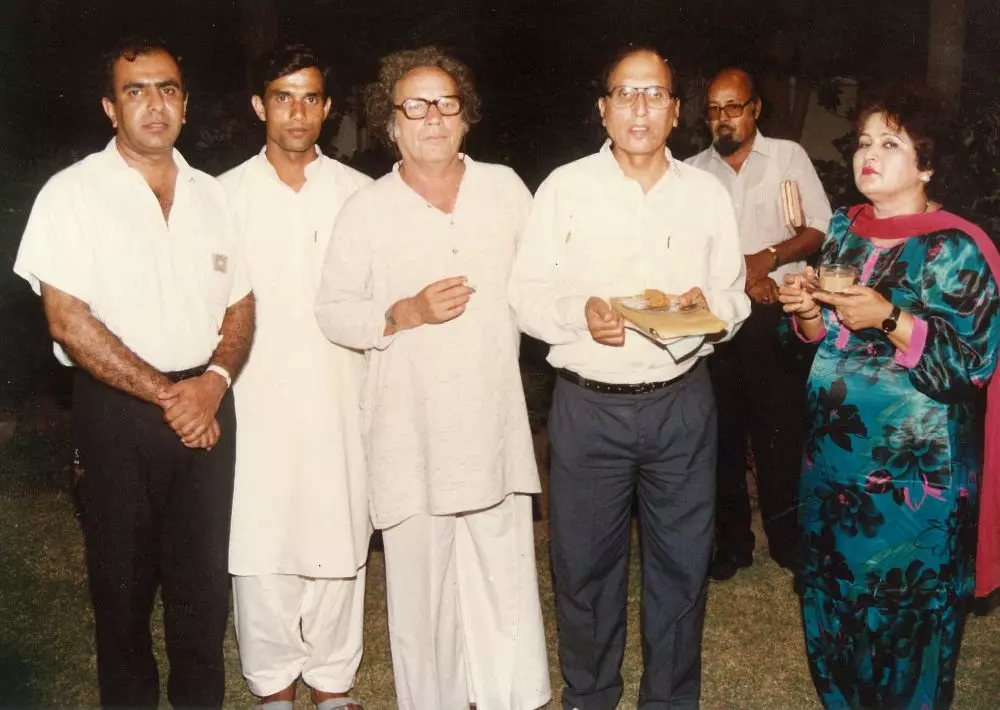
File photo of Bashir Badr (fourth from left) at an event. Photo: Wikimedia Commons
Urdu poet Bashir Badr once counselled those accustomed to greeting others with warmth and affection that, in a city of changing sensibilities, it is wise to keep a measure of distance from everyone.
The exact lines of his poetry went something like this: “Koi hath bhi na milaiga jo gale miloge tapaak se/Yeh naye mizaaj ka shaher hai yahan faasle se mila karo” (Do not greet people with unguarded warmth, for none may even offer a hand in return/This is a city of altered sensibilities—here, relationships are best maintained at a distance.”
Perhaps the observation was born of his experience of having his house burnt down during a riot in his hometown, Meerut, in the ‘80s — he later settled in Bhopal. But it is also true that few have received the love and acclaim that Badr enjoyed for his writings.
The poet, who passed away on May 28, had been reportedly suffering from dementia for the past 15 years, which kept him away from mushairas. But despite his prolonged absence from the public eye, he was never forgotten, as the outpouring of tributes following his death proved.
A fresh voice in Urdu poety
Badr occupied a place that transcended the usual boundaries of literary fame. Was it the mushaira circuit that accounted for his remarkable popularity or his early collections of poetry, such as Ikai and Image, which, by virtue of their distinctly modern idiom, fresh poetic cadence, and acute contemporary sensibility, swiftly became the focus of attention among readers and connoisseurs of Urdu literature?
Take, for example, this couplet by the poet. “Sānp ke bose meṅ kaisā pyār thā ki fākhtah/ Pharpharā kar ek ṣadā-e-āsmānī ho gaʾī” (What strange tenderness dwelt in the serpent's kiss/ That the dove, with a flutter of wings/ was transformed into a celestial cry).
Or, “Khūbsūrat, udās, khauf-zadah/ Woh bhī hai bīsvīṅ ṣadī kī tarah” (Radiant in beauty, yet steeped in sadness and fear/She is like the twentieth century incarnate).
This was perhaps the first occasion in Urdu poetry when the lover and the beloved — traditionally represented through the familiar imagery of the moth and the candle — were reimagined through the striking metaphor of the serpent and the dove. Likewise, the beloved, who had for centuries been conventionally likened to the moon, was portrayed instead as the twentieth century itself: beautiful, melancholy, and haunted by fear. The comparison was, in itself, a fresh and arresting metaphor — original, unconventional, and brilliantly evocative, opening up new imaginative possibilities for poetic expression.
Toast of mushairas
It is true that certain serious literary circles raised the objection that Bashir Badr had become primarily a poet of the mushaira platform and had not sustained that grand literary tradition which transcends the boundaries of time and place.
If examined closely, this criticism does contain a measure of truth. Yet it must also be acknowledged that Badr was mindful of the distinctive atmosphere of the mushaira and the tastes of its general audience, for without doing so, he could scarcely have achieved the remarkable success that he did on that platform. At the same time, it is equally true that he never wholly abandoned the demands of serious poetry. Rather, aided by his uniquely melodious style of recitation, he succeeded in winning the audience’s admiration even for verses of a kind that are not ordinarily heard — or appreciated — in mushairas.
File photo of Bashir Badr. Photo: Wikimedia Commons
Consider, for instance, the following couplet. “Hans paṛī shām kī udās fazā/Is tarah chāy kī piyālī hansī” (The melancholy air of evening suddenly broke into a smile/Such was the radiance with which the teacup laughed in my hands).
Or, “Bikhre shīshoṅ pe gir ke ṭūṭ gae/Nīnd meṅ nange pāṅv chalte ḳhvāb” (Dreams, wandering barefoot through the realm of sleep/Fell upon shattered glass and broke into fragments).
Such verses are seldom mentioned when people recall Bashir Badr. Most discussions of his poetry tend to revolve around a few other couplets in which, more often than not, one can hear an echo of social consciousness and awareness.
As in, “Log ṭūṭ jāte haiñ ek ghar banāne meñ/ Tum taras nahīñ khāte bastiyāñ jalāne meñ” (People wear themselves out building a single home/ Yet you feel no pity in setting whole settlements ablaze).
Whether Badr should be remembered chiefly as a custodian of the finest traditions of Urdu literature or as the most enduring phenomenon of popular acclaim ever produced by the mushaira stage is a question that may continue to invite debate. What lies beyond debate, however, is his indispensable place in the landscape of Urdu poetry. He is one of those rare poets who transcend critical categories and become part of the collective memory of a language.
Perhaps after Mirza Ghalib, no other Urdu poet has had his verses quoted, cherished, and woven into everyday speech by so many people across generations. His contribution to extending the reach of Urdu poetry — particularly the ghazal — far beyond literary circles and into the hearts of ordinary readers and listeners remains unparalleled.
With his passing, Urdu poetry has lost one of its most beloved voices. And perhaps there can be no more fitting way to remember him than through his own unforgettable verse: “Ujāle apnī yādoñ ke hamāre sāth rahne do/Na jāne kis galī meñ zindagī kī shām ho jā e” (Leave me the light of your memories to walk by/ For who can tell where life's long journey will meet its dusk?).