







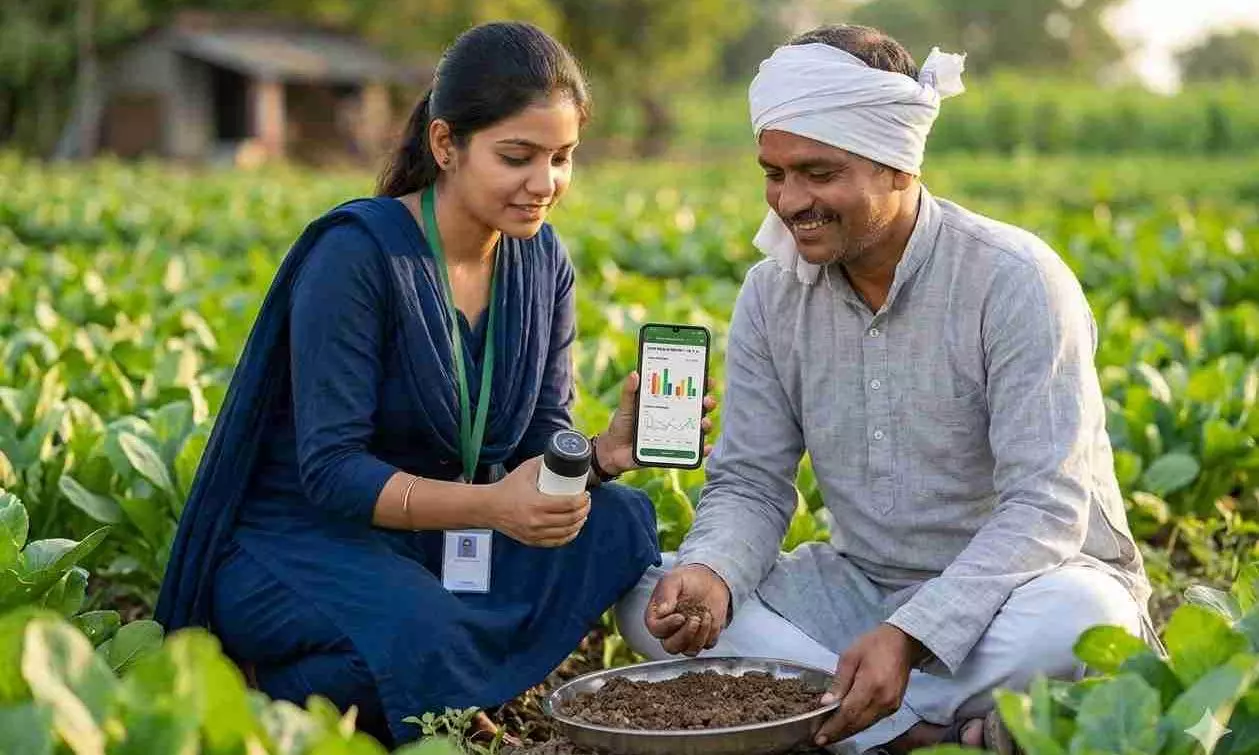
Farmers cannot simply place soil on a smartphone screen and expect it to analyse the sample. The process involves a separate testing device fitted with sensors. AI-generated image for representative purpose.
Can farmers really test soil with a mobile phone? Decoding Modi’s claim
PM Modi says farmers can use mobile-based devices to test soil. The technology exists, but it relies on sensors and apps, not smartphones alone

Prime Minister Narendra Modi's recent claim of testing soil with mobile phones has gone viral on social media for all the wrong reasons. Speaking at an event at Bharat Mandapam on Thursday (November 12), Modi said arrangements were being developed to allow farmers to test soil using mobile-based devices.
“You simply place a little soil on the mobile-based device, and your phone immediately provides a report identifying which crop your soil is suitable for, how much fertiliser is required, and what type of fertiliser is needed,” he said.
The claim prompted ridicule and questions on social media about whether soil testing could really be that simple and what damage it could do to smartphones. But what exactly did Modi mean? Can a farmer really test soil using a mobile phone and find out which crop is best suited to the land, or how much fertiliser it needs?
The idea may sound ridiculous, but portable soil-testing technologies that connect to smartphones are already being developed in India, though they do not work exactly as Modi described. So, how do these mobile-enabled devices work? What exactly do they test, and what indigenous technologies are already available?
Also read: NITI Aayog 'knows' what no one else does: Farmers’ income doubled in 7 years
For starters, farmers cannot simply place soil on a smartphone screen and expect it to analyse the sample. The process involves a separate testing device fitted with sensors. The device analyses the soil and sends the readings to a smartphone, where an application processes the data and presents the results.
How does mobile-based soil testing work?
The process involves three things: A soil sample, a sensor-based testing device, and a mobile application.
The farmer first collects a soil sample and prepares it according to the device's requirements. Depending on the technology, this could involve drying the soil or mixing it with a chemical solution.
The sample is then placed inside the testing device. Sensors examine its physical or chemical properties and convert the readings into digital signals. These are transmitted to a smartphone, usually through Bluetooth, where an application processes the information using calibration models and, in some cases, machine-learning algorithms.
The app then generates a report showing nutrient levels and other soil properties. Some systems also offer recommendations on suitable crops and fertiliser requirements.
Infrared light or chemical reactions?
Portable soil-testing devices broadly use two approaches: Optical sensing and chemical analysis.
Devices such as Bhu-Parikshak, developed by IIT Kanpur and commercialised by AgroNxt/ScaNxt, use near-infrared (NIR) spectroscopy. The user places around five grams of dry soil inside a small cylindrical scanner. The device shines infrared light on the sample and measures how different components absorb or reflect specific wavelengths.
Also read: Agriculture crisis: Why the next six-month period is critical for India
The resulting pattern acts like a chemical fingerprint. Software analyses the readings using calibrated models to estimate six parameters: nitrogen, phosphorus, potassium, organic carbon, clay content and cation exchange capacity. The results are sent to a mobile application through Bluetooth, with a report generated in about 90 seconds.
Another example is Soil Spectra, developed by Neoperk Technologies, incubated at IIT Bombay. It uses reflected light and machine-learning models to estimate soil nutrients and organic carbon, with the readings available through a smartphone application.
A different approach is used by Pune-based Proximal Soilsens Technologies, founded by IIT Bombay alumna Dr Rajul Patkar. Its portable testing system relies on chemical reactions. Farmers mix around one gram of soil with a reagent solution, place a drop on a disposable paper-based sensor strip and insert it into a handheld reader. The device measures pH, electrical conductivity, nitrate, phosphate, potassium and organic carbon, generating a mobile soil health report in under five minutes.
What can the readings tell farmers?
The parameters measured by these devices help farmers understand the condition of their soil. Nitrogen, phosphorus and potassium are essential nutrients for plant growth, while organic carbon indicates the presence of organic matter. Soil pH determines how acidic or alkaline the soil is, affecting nutrient availability. Electrical conductivity indicates soluble salt levels.
Also read: How India ‘subsidises’ the poisoning of air and water through fertilisers
Based on these readings, applications can suggest suitable crops and fertiliser requirements. However, not all devices measure the same parameters, and their recommendations depend on the accuracy of the underlying models.
Can they replace laboratory tests?
Portable devices can make soil testing quicker and more accessible, but their readings need to be properly calibrated and validated against conventional laboratory methods. Soil moisture, texture and composition can influence results, particularly in optical testing. Proper sample collection is equally important, as one handful of soil may not represent an entire field.
The technology could help address indiscriminate fertiliser use, an issue Modi also highlighted in his speech. He pointed out that some farmers follow the practices of their neighbours rather than assessing what their own fields need.
Mobile-based soil testing could help change that by giving farmers quicker access to information about their land. But affordable devices, reliable readings and guidance on interpreting the results will be essential to making the technology useful on the ground.