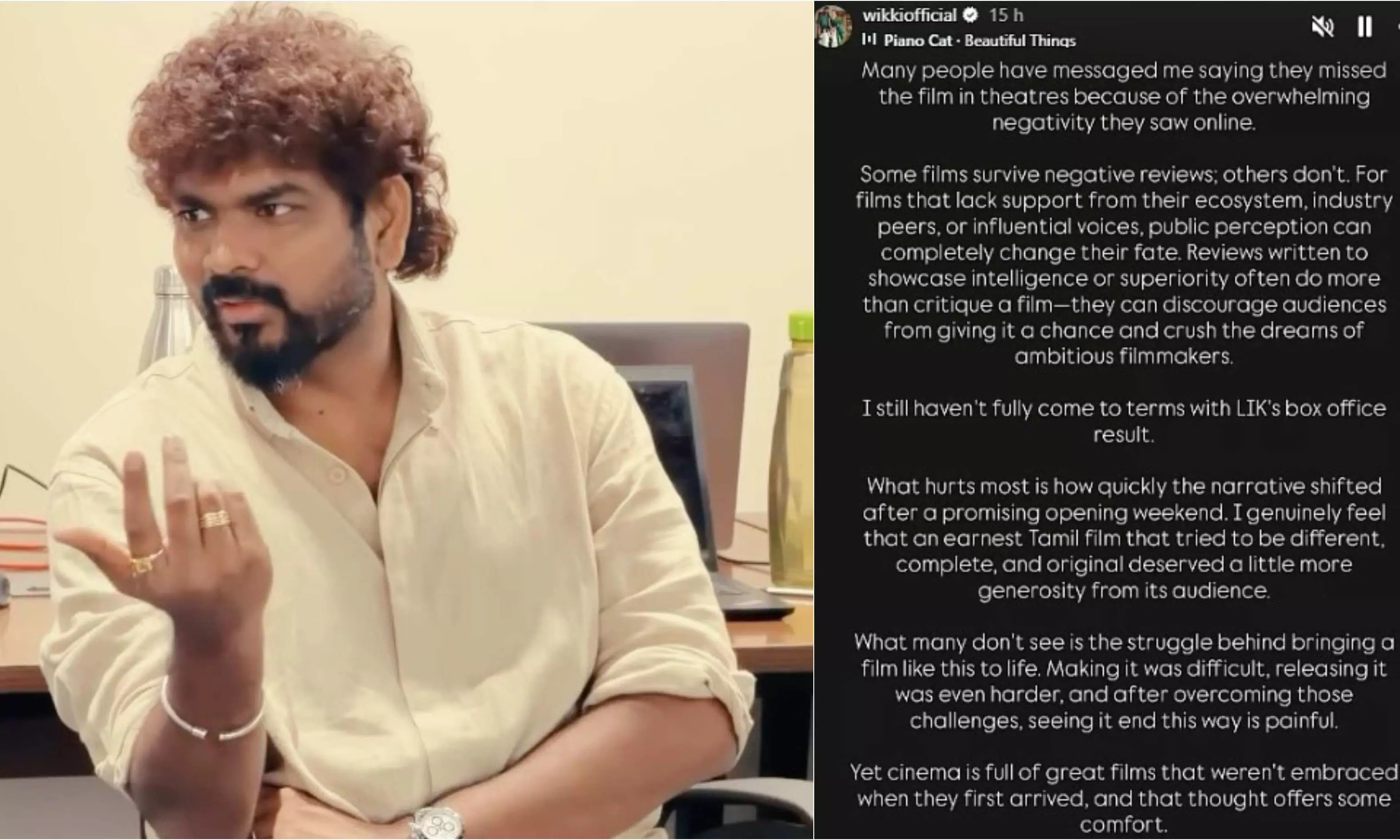
Vignesh Shivan took to Instagram to express his grief over Love Insurance Kompany's box office performance, calling out critics for what he believes was an unfair reception. Photo: Instagram/Vignesh Shivan
After Love Insurance Kompany's dismal run at the box office, the director has hit out at critics — and reopened a debate Tamil cinema keeps having but never resolves
Director Vignesh Shivan, shaken by the underwhelming box-office run of his latest sci-fi film, Love Insurance Kompany, took to Instagram to share a series of fan messages lamenting that the film was unfairly snubbed. He then followed it up with a lengthy post of his own, claiming that reviews written to assert intellectual superiority do more than critique a film — they actively discourage audiences and crush the ambitions of filmmakers who dared to dream big.
"Making it was difficult, releasing it was even harder, and after overcoming those challenges, seeing it end this way is painful," he wrote.
Here's his full statement:
A complaint that has been made before
This is a familiar sentiment in Tamil cinema. When Varisu was released in 2023, director Vamshi Paidipally went after critics in an interview, asking: "Do you know how tough it is to make a film these days? Do you know how much hard work people are putting in? It's not a joke, brother." He then pointed to Vijay's dedication — rehearsing every song, practising every dialogue — before declaring that Vijay alone was his critic and his audience.
Also Read: Bird droppings to bad sound: Ilaiyaraaja’s Chennai concert marred by glaring lapses
Both directors are essentially making the same argument: that critics watch a film while remaining blind to the sweat behind it.
The failure of a film is never just personal
There is truth in that. Filmmaking is gruelling work, and mounting a sci-fi film like Love Insurance Kompany makes it doubly so. When a film fails, the damage isn't limited to its creators — it ripples outward to distributors, theatre owners, floor workers, and even the tea shop outside the multiplex. A flopped film doesn't just hurt feelings; it quietly destabilises an entire ecosystem. It is partly why filmmakers have repeatedly pushed for reviews to be held back until a film has had at least its opening weekend.
But cinema is not a public service
And yet, asking critics to weigh a film's labour before writing their review is a stretch. The moment a filmmaker asks for that consideration, they are placing cinema on the same pedestal as public service — and cinema, for all its cultural worth, is not that. Love Insurance Kompany was mounted on a substantial budget, cast with bankable stars, and pushed by a marketing machine that worked around the clock. The audience, in turn, paid only for what appeared on screen. Hardship in the making does not automatically translate into value in the watching.
Also Read: Don't have courage to tell the truth: Jana Nayagan director on film's 5-month delay
A painter who spent a lifetime studying the craft cannot demand that the world call his work brilliant out of respect for his sacrifice. Van Gogh didn't lament the ingratitude of critics. He simply kept painting.
Vignesh Shivan's other grouse: critics are just showing off
Vignesh Shivan's frustration doesn't stop at box-office numbers. He also takes aim at the nature of film criticism itself, claiming that most reviews are written as an exercise in intellectual gloating rather than genuine engagement with a film. This argument does two damaging things at once. It reduces film criticism to a vain and pretentious pursuit, which conveniently erases its historical weight — criticism wasn't always a sideshow. It was central to some of cinema's most transformative movements. The French New Wave, for instance, was not born in a studio but in the pages of Cahiers du Cinéma, where critics like Godard and Truffaut wrote with such ferocity and precision that they eventually picked up cameras themselves. To dismiss criticism as intellectual posturing is to dismiss the very tradition that gave world cinema some of its greatest films.
Also Read: Love Insurance Kompany review | Vignesh Shivan’s rom-com is high on feeling, low on thought
The second problem with Shivan's argument is subtler but just as telling. If critics are guilty of asserting superiority through their reviews, what are audiences doing when they stay away from a film in droves? A box-office verdict is not a neutral act. It is also a judgment — collective, blunt, and, by Shivan's own logic, equally capable of being read as a dismissal. He cannot ask critics to check their intelligence at the door while simultaneously holding up the audience as the ultimate arbiter of a film's worth.
What Mani Ratnam understood that others don't
Perhaps the better counsel comes from Mani Ratnam, who, ahead of the release of Ponniyin Selvan, was asked if the pandemic had cost him a better film. His answer was characteristically clear-eyed: "I can't use the pandemic as an excuse. The pandemic hit everyone, not just me. Our job is to deliver against all odds."
He wasn't going to walk into theatres and tell audiences the film was the way it was because of circumstances.