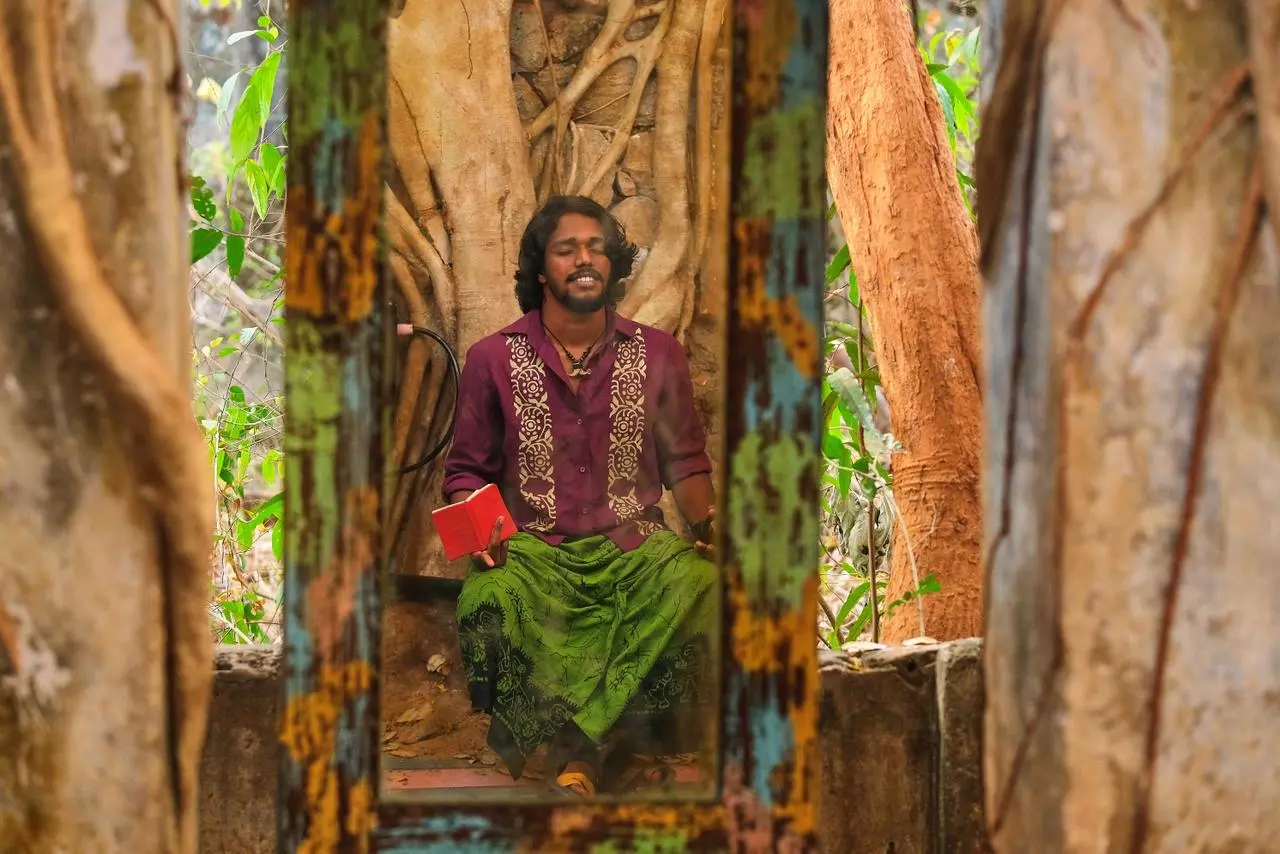
Pennum Porattum: Rajesh Madhavan’s audacious rural comedy speaks radical truth
'Pennum Porattum' is far more than a chaotic comedy, it explores misogyny and moral policing in rural Kerala through stories of a bold woman and a misunderstood dog

A dalmatian voiced by Tovino Thomas opens the Malayalam film, Pennum Porattum, with a monologue on captivity.
Chained in the filthy front yard of a rural house, the dog speaks of its helplessness, of recognising the thief it is meant to catch, and yet being unable to act. The thief, it tells us calmly, is no outsider but a revered village figure, a teacher and moral authority whose respectability conceals wickedness.
Moments later, the abstraction turns chillingly real. Suseelan Master, a well-regarded leader among the local youth, glances at the same dog and, with a cutesy smile masking his sleaziness, casually suggests that when the animal inevitably catches rabies, he should be informed so he can come and beat it to death.
The line lands as a joke. Laughter follows. In that uneasy collision between wit and brutality, Pennum Porattum reveals the world it is about to dissect, where malice that does not shout slips quietly into everyday conversation, gathering force through gossip and slander.
Drawing on traditions of absurd theatre, Rajesh Madhavan, along with writer Ravisankar, employs chaos as a deliberate method rather than unchecked excess, shaping a narrative in which farce becomes a sharp instrument to expose the social mechanics of violence and entrenched misogyny.
The film captures the anxieties, contradictions and performative morality of contemporary life through deliberate disorder.
A girl and the prurient
Pennum Porattum, despite its official translation as The Girl and the Fool’s Parade, is closer in spirit to The Girl and the Prurient, gesturing toward a cultural vocabulary of ridicule and public shaming, aligning the film with traditions of satire with verbal excess rather than procession or spectacle.
In North Malabar, (Saliya) Porattu is a satirical ritual performance associated with temple traditions in Kasaragod, marked by mockery and obscenity.
Also Read: Cinema yearender 2025: Low-budget, small regional films scored big at the box office
The story is set in Pattada, a village nestled in the foothills of the Western Ghats. The name Pattada refers to a pyre, a meaning that quietly anchors the place in a history of violence and arson.
At its heart stands the statue of Kumaran Gopalan Master, the former leader who once brokered peace between two warring rival factions by renouncing violence. Over time, Gopalan Master has become a symbolic father figure, revered as the moral conscience of the village, his statue a reminder of restraint and order.
Suttu is being chased by villagers after it was falsely labeled as a rabid dog. Photo: Special arrangement
Yet, Pennum Porattum is not interested in peace as an achieved condition.
In the film’s prelude, even as weapons are publicly surrendered, a boy discreetly slips a knife into his waistline. The image passes almost unnoticed, but it establishes the film’s central insight that violence is not eliminated, only buried.
Years later, that boy grows into the respected Suseelan Master, whose casual endorsement of the killing of the dog exposes how dormant aggression survives beneath moral posturing, masked by a plastered cutesy smile that often slips into the prurient.
Parallel chases
The leaked slander about Charulatha, a bold, self-made young woman who tinkers with improvised technology, building gadgets out of whatever is available, begins almost simultaneously with rumours about Suttu, the dog falsely branded as rabid.
From this point, the film intercuts between the two crises, a physical mob chasing Suttu across the village, and a moral mob pursuing Charulatha’s conduct. The trigger is Kumar (charmingly played by Dinesh, a rookie actor), a young man who openly rejects marriage and prefers casual sex, and who propositions Charulatha and then becomes central to the village’s prurient judgement of her character.
A village-wide chase for the dog and a pack of moral busybodies marching toward Kumar’s house, swelling at every step with curious villagers inflamed by gossip about Charulatha, run in parallel, hardening into moral judgement and collective action.
Also Read: Avatar: Fire and Ash review: James Cameron’s big strokes leave little room for nuance
Groups of youths pursue the dog falsely labelled as rabid in a lynch-thirsty frenzy, the chase unfolding across the village landscape, from fenced rural compounds to a granite quarry.
The elaborate death traps laid to bring the animal down expose the cruelty embedded in the collective psyche of the community. Yet all of this is staged through satirical comedy, layered with the textures of rural subaltern cultural life, where humour, ritual and spectacle soften brutality even as they make it socially acceptable.
Charulatha. Photo: Special Arrangement
Newcomers
The film features an ensemble of nearly 100 actors, predominantly newcomers drawn from the Palakkad villages where the shooting took place.
Among the standout performers is Varsha, a theatre graduate, who plays Suma, the chief spreader of gossip about Charulatha. Shanooj Ariyanalloor delivers a chilling turn as Suseelan Master, while Sumitra, Jayanthi and Vijayalakshmi, local newcomers from working-class backgrounds, also leave a strong impression. Director Rajesh Madhavan has spoken in detail about the unusual casting process, which involved a street-theatre-style parade of performances that encouraged local villagers to participate.
The film’s most lucid rupture comes through refusal rather than revolt. Suttu chooses to leave Pattada, walking away alongside other animals (Some of them voice-acted by the likes of Basil Joseph, Divya Prabha, Ananad Manmadhan and Darshana Rajendran).
Also Read: How Rob Reiner turned classic romcom When Harry Met Sally… into his most personal film
“If a place doesn’t fit, the world is vast enough to run away,” he says. It is a moment of clarity denied to the human characters, as Charulatha remains caught undecided between her love for Baburaj, Suttu’s owner, and her emancipation.
The film features at least 100 actors, predominantly newcomers from villages in Palakkad distric. Photo: Special Arrangement
Redefined rural satire
Pennum Porattum arrives at a moment when rural comedies are finally shedding lazy stereotypes and reclaiming the form as a space for layered, disruptive humour.
(The 30th edition of IFFK, where Pennum Porattum was met with strong critical appreciation, also featured DJ Ahmet, a Macedonian film directed by Georgi M Unkovski, another notable example that can be situated within the emerging, globally resonant tradition of rural comedy.)
Rajesh Madhavan’s film does not laugh at the village but laughs from within it, drawing its strength from lived textures, everyday bodies and subaltern performance traditions. Its satire is sharp, not nostalgic, using authenticity in casting and cultural detail as a political choice rather than aesthetic garnish.
Also Read: Padayappa re-release: When Rajini's punchlines bring down women
In a time when urban and rural divides are routinely flattened into caricature, Pennum Porattum insists on complexity, showing how small communities carry both intimacy and cruelty in equal measure. It belongs to a new wave of rural comedies that treat the countryside not as a punchline, but as the site where humour, power and social truth collide.