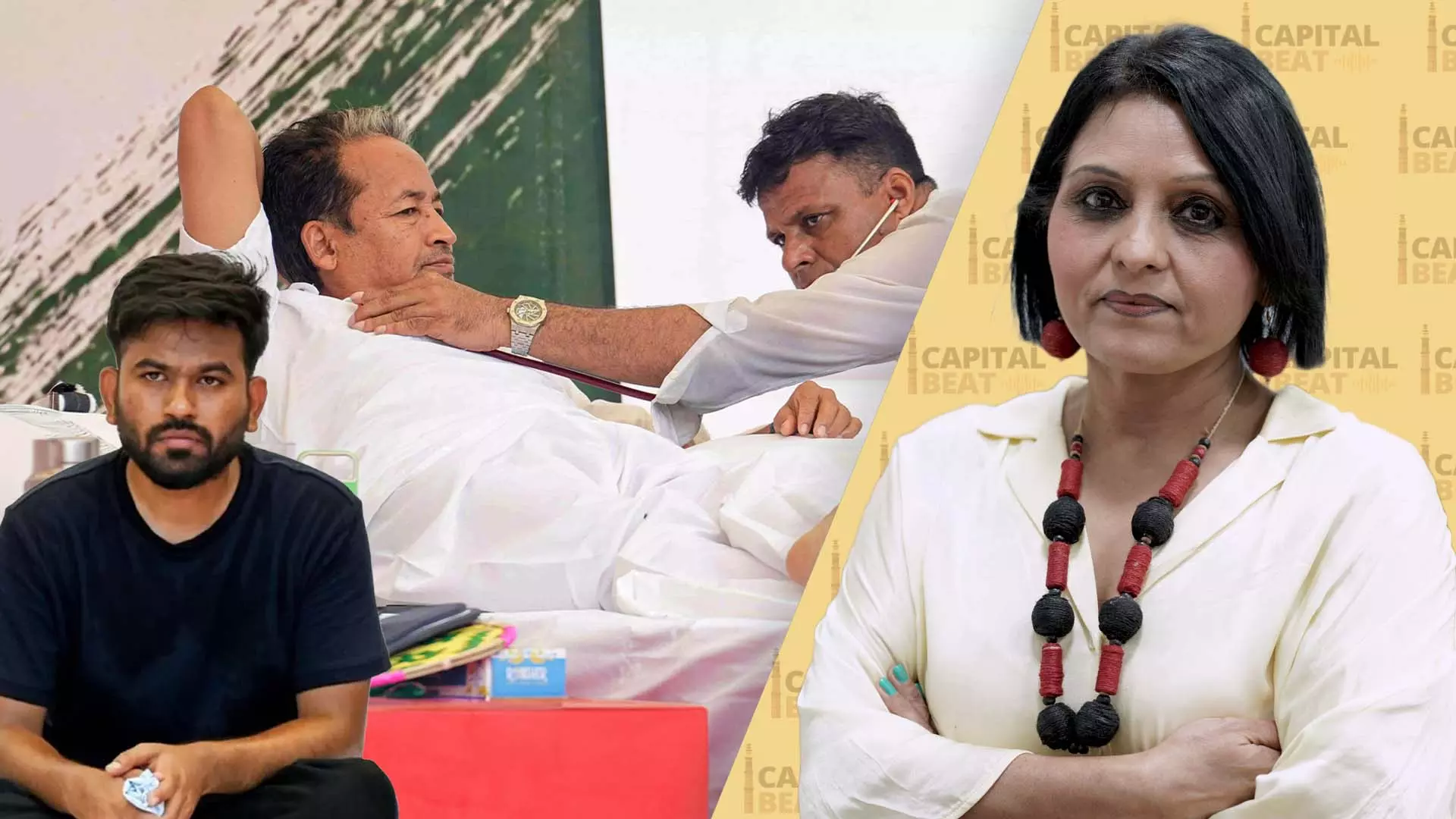
Can Wangchuk’s hunger strike evolve into education reforms movement? | Capital Beat
Experts debate whether Sonam Wangchuk-led protests can trigger education reforms or remain limited to demanding Dharmendra Pradhan's resignation

As climate activist Sonam Wangchuk continues his hunger strike in support of the anti-paper-leak protests, questions have emerged over whether the movement can compel the Centre to act or whether it risks becoming yet another symbolic campaign.
The Federal spoke to Prof. Ajay Gudavarthy of JNU, Prof. Tanvir Aeijaz of Ramjas College, and senior journalist TK Rajalakshmi on whether the protest can evolve into a broader movement on education reforms or remain focused on the demand for Education Minister Dharmendra Pradhan's resignation.
As Prof. Gudavarthy argued, "The real crisis is not just whether the education minister resigns, but whether the movement addresses the structural collapse of India's education system."
Political response
Rajalakshmi said Left parties were among the earliest political formations to extend support to the protest, arguing that the issues being raised go far beyond a single examination.
She noted that repeated paper leaks, recruitment scams and student suicides have exposed deep concerns over accountability in India's education system. According to her, student organisations affiliated with the Left had also joined the protests, strengthening the movement's credibility.
Also read: Sonam Wangchuk loses 2 kg, reports low BP on day 4 of hunger strike over NEET row
Rajalakshmi said the Congress initially took time before extending support, while mainstream media coverage remained limited. She argued that sections of the media portrayed the protest with suspicion instead of focusing on the issues being raised.
Credibility questions
Rajalakshmi acknowledged that questions had initially been raised over the organisers and their funding but said those concerns gradually subsided as established student organisations joined the campaign.
She also dismissed attempts on social media to question Sonam Wangchuk's hunger strike by circulating images from his previous protests. According to her, such campaigns were aimed at discrediting genuine public movements.
She argued that if Wangchuk's health deteriorated significantly, the government could intervene medically, but would likely avoid allowing the situation to escalate because of the wider public attention surrounding him.
Anna Hazare comparison
Prof. Gudavarthy said the protest bears several similarities to the Anna Hazare-led anti-corruption movement, particularly in terms of optics, media attention and reliance on symbolic leadership.
Also read: NEET protest: Funding row overshadows CJP's demands as Wangchuk begins fast
He said this could explain why several mainstream political parties have adopted a cautious approach despite agreeing with the broad concerns surrounding education.
Gudavarthy maintained that while the issues being raised are genuine, political parties may remain wary of movements that emerge rapidly through media visibility rather than sustained grassroots mobilisation.
Structural concerns
According to Prof. Gudavarthy, the movement risks reducing a complex education crisis to a single demand for the resignation of Dharmendra Pradhan.
He argued that India's education crisis is rooted in broader structural issues, including privatisation, institutional decline, inequalities and policy direction, none of which can be addressed simply by replacing one minister.
He also questioned whether the movement was adequately addressing larger issues such as the role of private capital in education, caste inequalities, declining academic standards and repeated concerns surrounding national examinations.
Also read: Sonam Wangchuk's blood sugar dips as CJP protest hits day 11
Referring to alleged errors in examination papers, Prof. Gudavarthy said the discussion should focus on the quality of higher education rather than limiting itself to demands for ministerial accountability.
Beyond resignation
Prof. Aeijaz disagreed with the view that the movement was confined to seeking Pradhan's resignation. He argued that while the resignation demand serves as an immediate political objective, the protest has also opened space for wider public discussions on India's education system.
According to him, speeches delivered during the protests increasingly focus on the deterioration of educational institutions rather than only targeting the minister.
Prof. Aeijaz also said the movement has encouraged greater cooperation among opposition groups and social organisations, potentially laying the groundwork for broader campaigns on unemployment and other public issues.
Building alliances
Prof. Aeijaz described the protest as a citizen-led political movement that is attempting to forge alliances rather than function as a conventional party campaign.
Also read: CJP alleges Delhi police cut water supply after Wangchuk joins Jantar Mantar protest
He expressed confidence that even if the minister were replaced, the campaign would continue to raise larger concerns linked to unemployment, education policy and governance.
In his view, social movements often evolve into larger political mobilisations over time, making it premature to dismiss the current protests as a short-term agitation.
Wangchuk's role
Returning to the discussion, Rajalakshmi described Wangchuk as a moral symbol who has brought greater visibility to issues that teachers' unions and student organisations have been raising for years.
She cautioned against judging the movement solely through the success or failure of Wangchuk's hunger strike, arguing that concerns over education would remain regardless of the protest's immediate outcome.
According to her, Wangchuk's presence has helped draw national attention to education in a way that previous campaigns often struggled to achieve.
The larger challenge
Prof. Gudavarthy concluded by reiterating that the movement's long-term success would depend on whether it expands beyond symbolic leadership and develops deeper grassroots connections.
Also read: Maharashtra TET paper leak: Dipke renews attack on govt; Wangchuk to begin fast
He argued that unless broader sections of society—including workers, farmers and other social groups—become part of the campaign, it risks becoming another middle-class movement driven largely by media narratives.
While recognising the sincerity of many activists involved, he warned that good intentions alone may not be sufficient to sustain a lasting movement capable of reshaping India's education debate.
(The content above has been transcribed from video using a fine-tuned AI model. To ensure accuracy, quality, and editorial integrity, we employ a Human-In-The-Loop (HITL) process. While AI assists in creating the initial draft, our experienced editorial team carefully reviews, edits, and refines the content before publication. At The Federal, we combine the efficiency of AI with the expertise of human editors to deliver reliable and insightful journalism.)