



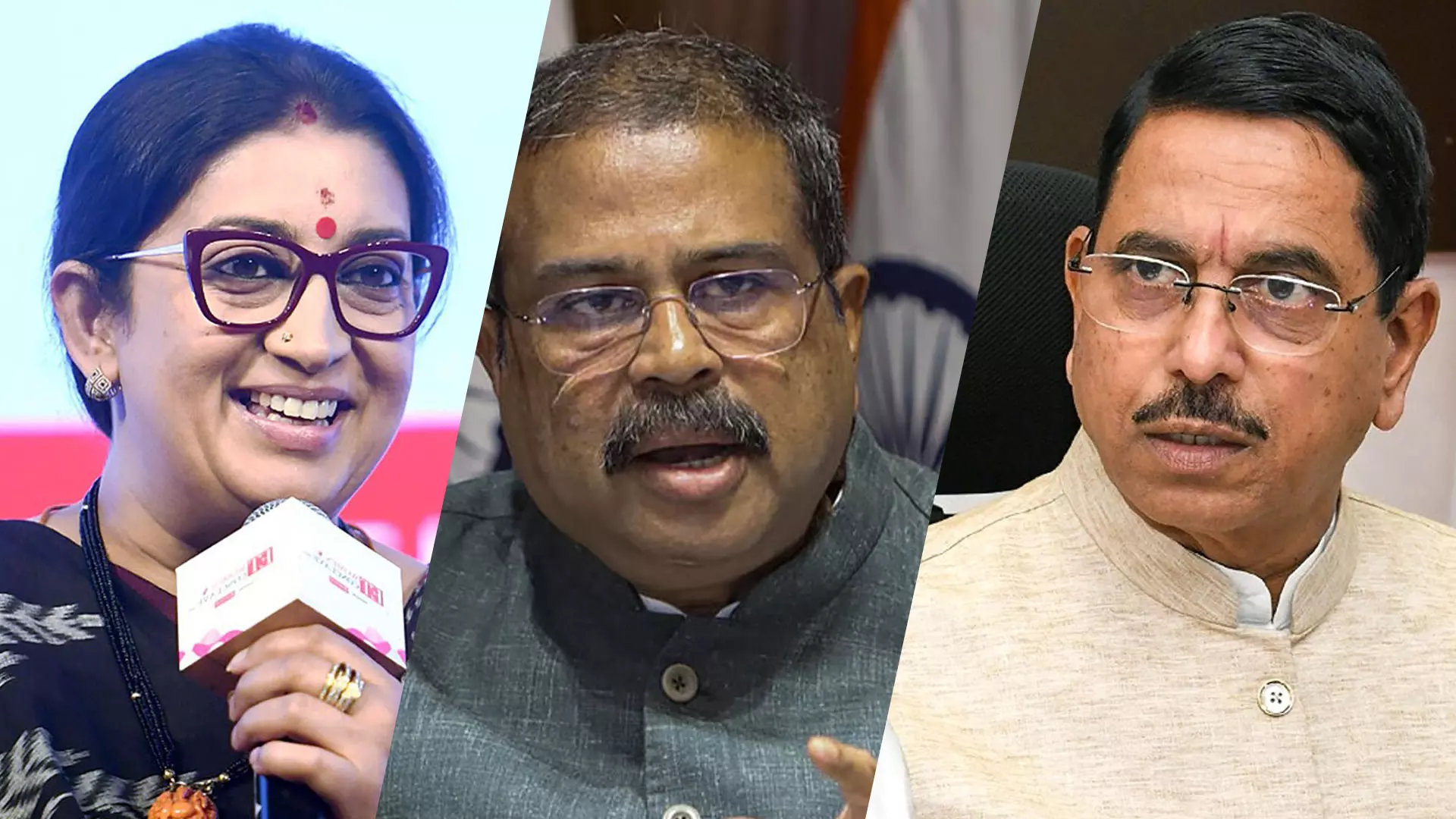
From Smriti Irani's tenure marked by intense student protests at JNU and suicide of scholar Rohith Vemula at Hyderabad University to Dharmendra Pradhan's time with paper leaks in competitive exams, Pralhad Joshi, the new minister has a tough task ahead of him
From Smriti Irani to Pralhad Joshi: 5 NDA education ministers in 12 years, feats, challenges
The Federal also looks at what the new education minister Pralhad Joshi inherits and the tasks ahead of him

Union Education Minister Dharmendra Pradhan’s exit concludes his tenure as the fourth full-time education minister to serve under Prime Minister Narendra Modi since the National Democratic Alliance (NDA) assumed office in 2014.
Over the last 12 years, the ministry has steered massive transitions in the education sector —most notably, the rollout of the landmark National Education Policy (NEP) 2020, key structural curriculum changes, and a massive push for digital learning infrastructure. However, this transformative period has also been contested, frequently punctuated by intense public scrutiny over structural changes in board exams and high-stakes university entrance formats, and above all, paper leaks in competitive exams.
Over the past 12 years (2014–2026) under the NDA government, India’s education sector has undergone massive structural reforms—transitioning from the Ministry of Human Resource Development (HRD) back to its original moniker, the Ministry of Education.
Here is the breakdown of the five education ministers who have held the portfolio during this period, what they achieved, and the key moments that defined their tenures.
Smriti Irani (May 2014 – July 2016)
Appointed at the start of the first Modi government, Smriti Irani was one of the youngest leaders to take charge of the HRD Ministry.
She is known for overseeing the rollback of Delhi University’s controversial four-year undergraduate programme. This rollback came in the backdrop of protests due to lack of adequate infrastructure and clarity on the programme. It was in Irani's term, the drafting of the National Education Policy (NEP) too was flagged off.
Key Achievements
- NIRF Launch: She introduced the National Institutional Ranking Framework (NIRF) to systematically rank higher education institutions across India for the first time. She initiated the grassroots consultation process for the new National Education Policy (NEP).
- FYUP Rollback: Under her oversight, Delhi University's controversial Four-Year Undergraduate Programme (FYUP) was rolled back.
Setbacks: Her term, however, faced severe political headwinds, marked by intense student protests at JNU and the national outcry following the suicide of scholar Rohith Vemula at Hyderabad University. Both issues dominated national discourse.
Irani faced backlash over the HRD ministry's handling of the JNU campus protests and arrest of student union president Kanhaiya Kumar.
Also read: NEET dreams break families, while GST revenues shoot up
In July 2016, she was shifted to the textiles Ministry during the first major cabinet reshuffle under the Modi government.
Prakash Javadekar (July 2016 – May 2019)
Prakash Javadekar took over with a mandate to stabilise the ministry and bring a more consultative, bureaucratic focus to the structural reforms already underway.
His tenure focused on improving school learning outcomes, promoting digital education platforms such as SWAYAM, expanding online teacher training, and streamlining higher education regulations.
Key Achievements
- IIM Autonomy: He spearheaded the historic Indian Institutes of Management (IIM) Act of 2017, which granted unprecedented autonomy to IIMs and declared them institutions of national importance.
- Founding of the NTA: Javadekar oversaw the creation of the National Testing Agency (NTA) to centralize and conduct higher education entrance examinations in an independent, digital-first format.
- Digital Initiatives: He aggressively pushed digital learning platforms, significantly expanding the SWAYAM portal for online courses and massive open online teacher training.
Setbacks: While he steered the majority of the draft work for the upcoming NEP, his term faced a minor controversy over granting the "Institution of Eminence" tag to the then yet-to-be-built Jio Institute.
During his tenure, the CBSE was hit by a major paper leak controversy in March 2018. It involved the Class 10 Mathematics and Class 12 Economics board examinations. After reports that both question papers had been circulated on WhatsApp before the exams, CBSE announced a nationwide re-examination for the Class 12 Economics paper.Javadekar remained HRD Minister until the end of the Modi government's first term in 2019.
Ramesh Pokhriyal (May 2019 – July 2021)
The former Uttarakhand Chief Minister took the reins of this ministry when the second NDA term kicked off in May 2019. His tenure became synonymous with an absolute overhaul of Indian education policy, said experts.
Also read: NEET-UG results under scrutiny over alleged marks discrepancies
His tenure is remembered primarily for two landmark developments. In July 2020, the Union Cabinet approved the National Education Policy (NEP) 2020, replacing the 34-year-old National Policy on Education of 1986. The ministry was simultaneously renamed from the Ministry of Human Resource Development to the Ministry of Education, restoring its pre-1985 name.
Key Achievements:
- Pandemic Management: Pokhriyal steered the country's massive shift to online schooling, alternative digital learning infrastructure, and revised CBSE board exam criteria during the peak of the COVID-19 pandemic.
Setbacks: Despite the landmark policy rollout, actual ground implementation slowed down during the pandemic, and university leadership appointments hit bottlenecks. Citing health issues, he resigned during the July 2021 Cabinet reshuffle.
Dharmendra Pradhan (July 2021 – July 2026)
Dharmendra Pradhan held the office for nearly five years, making his tenure the longest and structurally most active among the NDA education ministers.
He operationalised the National Curriculum Framework (NCF) and heavily advocated for mother-tongue and multilingual instruction at the school level. Schools gradually adopted the NEP's emphasis on multilingual education, Indian knowledge systems and skill-based learning.
Introduces new NCERT textbooks aligned with the NEP. The ministry also promoted competency-based learning and assessment reforms, including the proposal to conduct Class 10 and 12 board examinations twice a year to reduce the pressure of a single high-stakes examination.
Key Achievements
Skill Integration: He explicitly tied primary and higher education frameworks to formal skill-development metrics and vocational training.
Higher education: In higher education, the government expanded IITs, IIMs and central universities, while many institutions introduced the four-year undergraduate programme, Academic Bank of Credits, multiple entry and exit provisions and other reforms aimed at increasing institutional flexibility and autonomy were introduced.
Setbacks: Pradhan’s final months in office were plagued by massive national controversies involving the National Testing Agency (NTA), culminating in severe scrutiny over paper leaks and structural irregularities in the NEET-UG and UGC-NET competitive exams.
It started with the NEET-UG and UGC-NET examinations in 2024, when allegations of question paper leaks and compromised exam integrity prompted the Centre to cancel the UGC-NET exam, order a CBI probe and announce reforms in the NTA's functioning.
Also read: Rahul says education system needs to be rebuilt, urges consensus on paper leaks
In 2026, fresh controversies erupted after the NEET-UG paper leak led to the cancellation of the examination, termination of 47 NTA officials and criminal proceedings against those allegedly involved. Soon after, allegations of a UGC-NET 2026 paper leak further intensified criticism of the ministry, with opposition parties demanding accountability and reforms in the examination system. Affecting more than 20 lakh aspirants, the unprecedented decision led to a CBI investigation and a fresh examination.
Pradhan took moral responsibility after weeks of student protests led by the Cockroach Janta Party, and resigned from the cabinet on July 25, 2026.
Pralhad Joshi (July 2026...)
After Pradhan's abrupt exit, veteran BJP leader and five-time MP Pralhad Joshi was handed the additional charge of the Ministry of Education.
Joshi, who has made news in the past, when he supported the release of Bilkis Bano’s rapists, has entered the ministry at an incredibly turbulent time. His immediate mandate is bringing stability to the national examination framework, pushing ahead with delayed university appointments, restoring public and student faith in the NTA, and maintaining the momentum of the NEP 2020 execution.
Also read: Centre undertakes major exam system overhaul as NTA sacks 47 officials
Joshi has been serving as the Union Minister of Consumer Affairs, Food and Public Distribution & New and Renewable Energy (MNRE).
Challenges facing new minister
The leadership change comes at a crucial juncture for India's education sector.
In addition to overhauling the country's examination system following repeated paper leak controversies and allegations of irregularities in competitive exams, the Centre is in the middle of implementing the National Education Policy (NEP) 2020 and rolling out a new school curriculum. So, the new minister inherits an ambitious reform agenda alongside the challenge of restoring public confidence in India's high-stakes entrance and recruitment examinations.
To fortify national entrance tests against future leaks, the Centre has proposed:
- Tightening the supervision of live examination processes.
- Overhauling external outsourcing practices.
- Implementing robust technological safeguards and advanced encryption.
Additionally, the government is laying the groundwork to gradually transition major entrance examinations—including NEET-UG—from traditional pen-and-paper to a secure, computer-based testing format.
With structural changes already underway within both the Ministry of Education and the NTA, the focus will now shift from announcing reforms to ensuring their effective implementation. Whether the next phase succeeds will largely depend on the new minister's ability to build stronger institutions, improve accountability and deliver examinations that students can trust.