RSS-linked members in NCERT panel: 'School education must come out of govt control'
On the AI With Sanket show, experts stressed that academic merit should take precedence over political affiliation in appointments to educational bodies

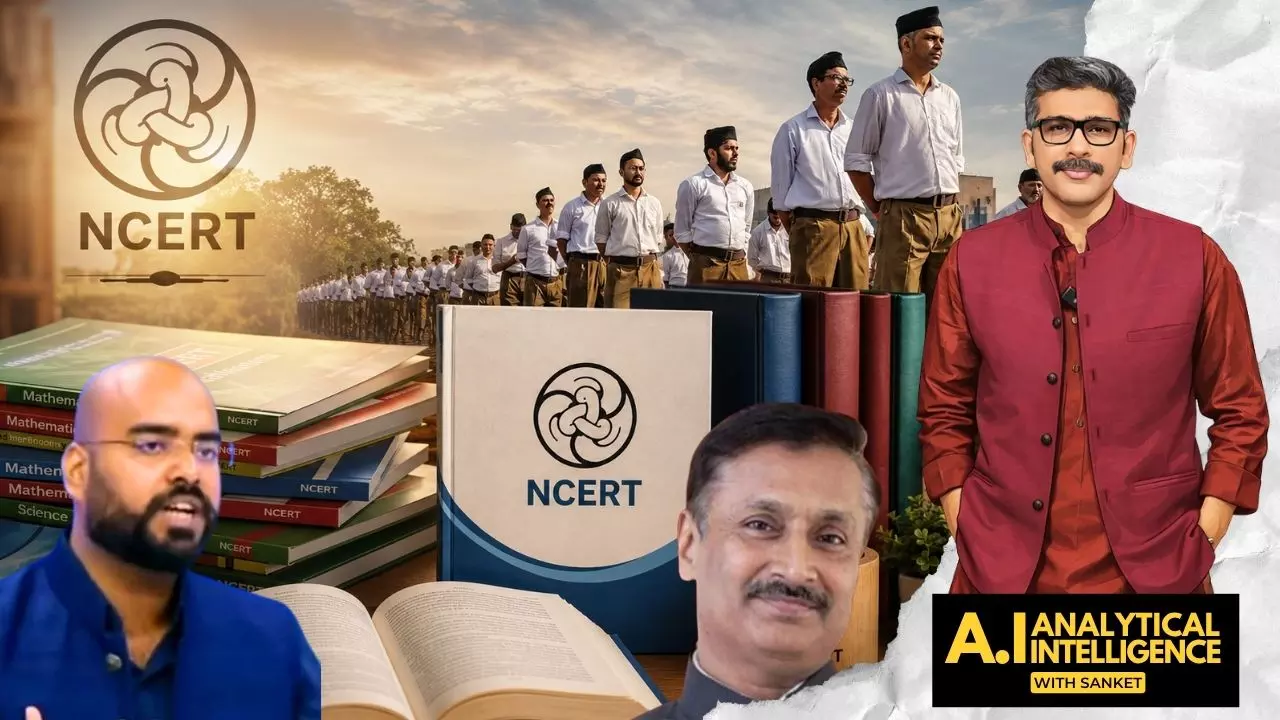
Amid controversy over the inclusion of four members with direct ties to the Rashtriya Swayamsevak Sangh (RSS) on NCERT's textbook development team tasked with shaping school curricula, experts have called for insulating school education from direct government control.
Speaking on The Federal’s AI With Sanket show, former National Institute of Open Schooling (NIOS) chairperson Prof. CV Sharma and political analyst and advocate Nikhil Jain said an independent statutory body should oversee school education and curriculum development.
Also read: In this small TN town, twins weave a NEET success story
“Education, especially school education, must come out of government control. The central government as well as the States should not have control over it. You should have an independent regulatory statutory body outside the government,” the experts said.
‘Curriculum can never be neutral’
Prof. Sharma said complete neutrality in curriculum development was difficult to achieve as decisions on what is taught in schools inevitably reflect certain ideas about society and citizenship.
“Curriculum can never be neutral. It has never been neutral,” he said.
According to him, choices ranging from stories included in textbooks to historical events highlighted in lessons are influenced by the values and perspectives of those involved in curriculum design. Textbook writers, he said, inevitably bring their own understanding and worldview to the process.
Also read: NEET paper leak, UGC-NET errors: 'NTA has lost trust, should be dissolved'
Citing history textbooks from countries such as the United Kingdom, Pakistan and India, Prof. Sharma said national narratives often reflected the perspectives and interests of individual countries, with some historical figures and events receiving greater emphasis than others.
Focus on qualifications
On whether people with ideological affiliations should be part of committees deciding what schoolchildren learn, Jain said the focus should instead be on the qualifications and expertise of those appointed.
The concern, he said, was whether individuals were chosen for their academic expertise or because of their political or ideological proximity to those in power.
He said the appointment of people without adequate academic credentials to influential positions could raise questions about the objectives behind such appointments and fuel concerns over political influence on textbooks.
Also read: Supreme Court seeks NTA report on steps to implement NEET exam reforms
Jain also cautioned against reducing complex historical subjects to simplistic or binary interpretations, citing debates surrounding the Mughal period as an example.
‘Education bodies need autonomy’
Prof. Sharma said the issue extended beyond the current controversy and was linked to the broader structure of educational governance.
He pointed to the government oversight of institutions such as the National Council of Educational Research and Training (NCERT), the Central Board of Secondary Education (CBSE) and the Kendriya Vidyalayas, and questioned the continued presence of Ministers in leadership positions in educational institutions and councils.
Academic institutions, he argued, should be headed by academics rather than politicians or bureaucrats.
“A Minister happens to be the chair of the council of NCERT, which is wrong,” he said.
Prof. Sharma said school education lacked an independent statutory regulatory body comparable to the University Grants Commission (UGC) in higher education, leaving it vulnerable to political influence.
Need to present multiple perspectives
Jain said educational institutions needed safeguards against political interference and that students should be exposed to multiple perspectives rather than a single ideological narrative.
“Education has to be neutral. It has to teach different points of view,” he said.
He also questioned the role of bureaucrats in heading academic institutions, arguing that administrative experience alone did not necessarily qualify a person to oversee academic policy or curriculum development.
Questions over committee composition
Prof. Sharma said the debate should not be restricted to the alleged RSS links of some committee members but should also examine whether the committee had adequate academic and pedagogical expertise.
He questioned the absence of specialists in school pedagogy, social science education, school principals and experienced teachers who understood classroom realities.
“I was trying to look for a person who is an educationist and is an expert of social science who understands pedagogy,” he said.
He said curriculum development required expertise not only in individual subjects but also in educational psychology and pedagogy, and that practising teachers and educators should have a greater role in shaping school curricula.
Both experts stressed that academic merit should take precedence over political affiliation in appointments to educational bodies. Prof. Sharma said individuals could hold political preferences and still discharge academic responsibilities professionally, provided they possessed the requisite qualifications and adhered to academic standards.
Jain, meanwhile, reiterated the need for safeguards against political influence and said school education should expose students to a range of viewpoints rather than a single officially sanctioned narrative.