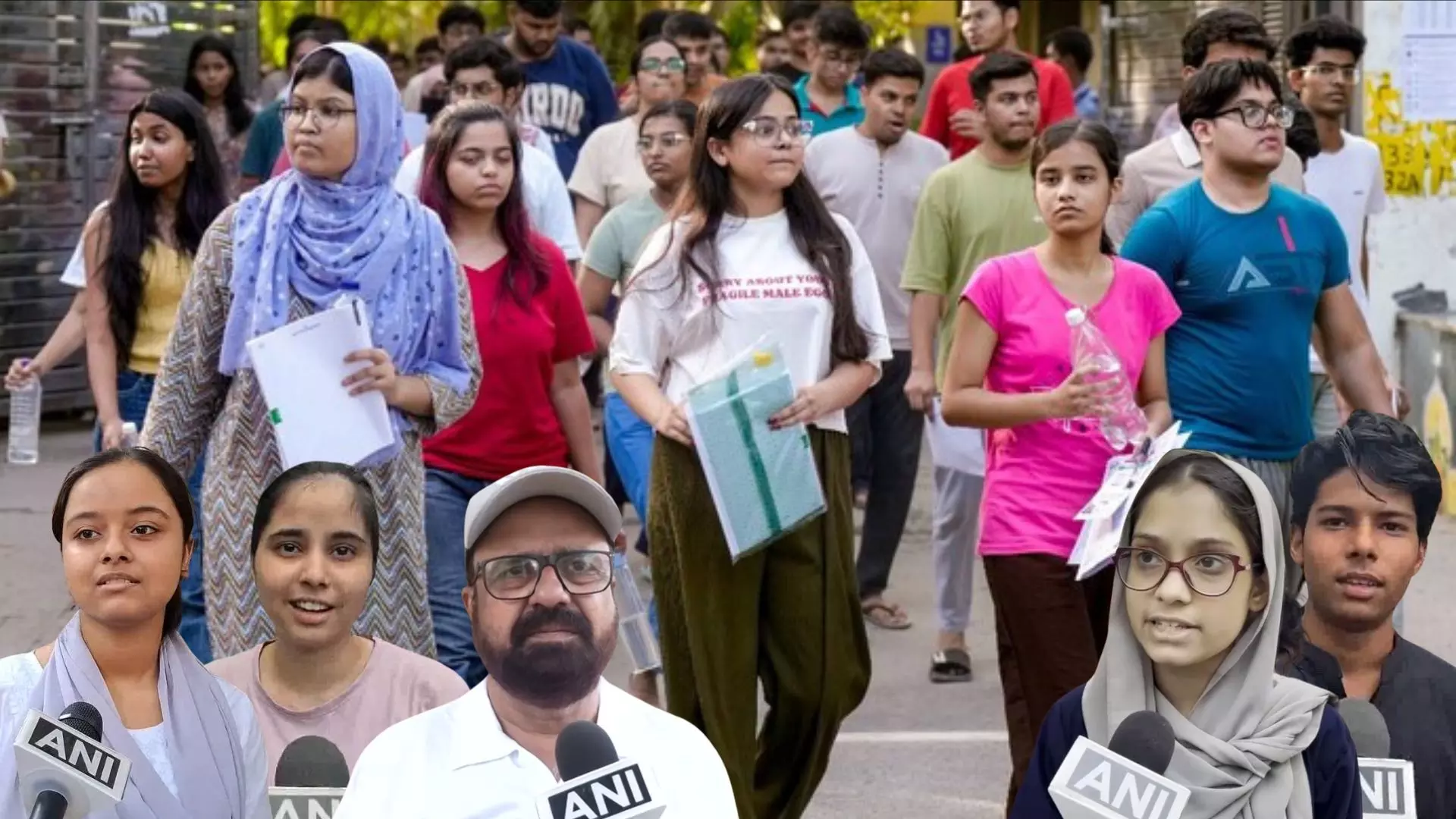
NEET re-exam sparks fresh row; what students said
The NEET-UG re-test saw complaints of a tougher paper, a burqa controversy, and more. Is the controversy far from over?

The NEET-UG re-test concluded on Sunday (June 21), with nearly 22.75 lakh students appearing for the examination. While many candidates described the paper as tougher than the cancelled May 3 exam, the re-test was overshadowed by controversies ranging from a burqa row in Ajmer and an exam centre glitch in Nagpur to protests at Delhi's Jantar Mantar.
Students across cities, including Delhi, Chennai, Chandigarh, Mumbai and Hyderabad, reported that the Physics section was lengthy, formula-heavy and more difficult than expected. Biology was widely described as easy and largely based on NCERT content, while Chemistry was considered moderate.
Also read: Students miss NEET re-test amid Bengaluru gridlock, BJP-Congress trade jibes
The overall feedback from candidates suggested that the re-test was more challenging than the paper that was cancelled earlier.
Student reactions
One student said, "Biology was easy, Physics was difficult, Chemistry was moderate. The previous paper felt easy."
Another candidate said, "Physics was quite difficult, and Chemistry was moderate. It wasn't as good as before. I didn't feel as motivated to study for NEET again, and I don't have the same pace or momentum as before."
Also read: NTA dismisses video claiming paper leak as 'fake', says NEET re-exam successfully held
A third student highlighted the impact of the controversy surrounding the original exam. "I took the NEET exam on May 3, but the paper was leaked, which left us quite upset and demotivated. Because of that demotivation, we were unable to prepare properly during the following month. We hope the NTA has taken the necessary measures to ensure that such incidents do not happen again."
Burqa controversy
The examination also witnessed a controversy in Ajmer, Rajasthan.
Eighteen-year-old Kulsum Bano alleged that she was stopped from entering her examination centre because she was wearing a burqa. She claimed her request for a female staff member to conduct the security check was denied. Police later said the confusion was resolved, but the incident drew widespread attention after videos circulated online.
Speaking about the incident, Kulsum Bano said, "They should be ashamed of themselves. They are playing with the future of 18-year-old students."
She added, "Rule No. 8 clearly states that we are allowed to wear religious attire. Then why are they not allowing it? If the NTA says it is permitted, they should allow it."
Jantar Mantar protest
Meanwhile, the protest led by the Cockroach Janta Party (CJP) entered its second day at Jantar Mantar in New Delhi.
CJP founder Abhijeet Dipke and his supporters staged an overnight sit-in, demanding the resignation of Union Education Minister Dharmendra Pradhan. Dipke also called on NEET aspirants to join the protest after completing their examination.
Addressing students, Dipke said, "Don't worry. Your elder brothers and sisters are fighting for your rights and will continue to do so."
The protest continued even as organisers alleged restrictions on access to food and water at the site.
Political heat
The political debate around the examination extended beyond protest sites.
Prime Minister Narendra Modi reportedly waited for about 45 minutes at Delhi airport after landing on June 21 so that his convoy would not affect traffic movement for students travelling to examination centres.
The issue is expected to remain politically charged, with Congress leader Rahul Gandhi scheduled to address the "Chhatron Ki Goonj" rally in Rajasthan's Kota, a city that has frequently been at the centre of discussions on student stress and competitive examinations.
With a tougher paper, a dress-code controversy, an international examination-centre mix-up, protests and political mobilisation, the NEET-UG re-test may be over, but the debate surrounding it appears far from settled.
(The content above has been transcribed from video using a fine-tuned AI model. To ensure accuracy, quality, and editorial integrity, we employ a Human-In-The-Loop (HITL) process. While AI assists in creating the initial draft, our experienced editorial team carefully reviews, edits, and refines the content before publication. At The Federal, we combine the efficiency of AI with the expertise of human editors to deliver reliable and insightful journalism.)