







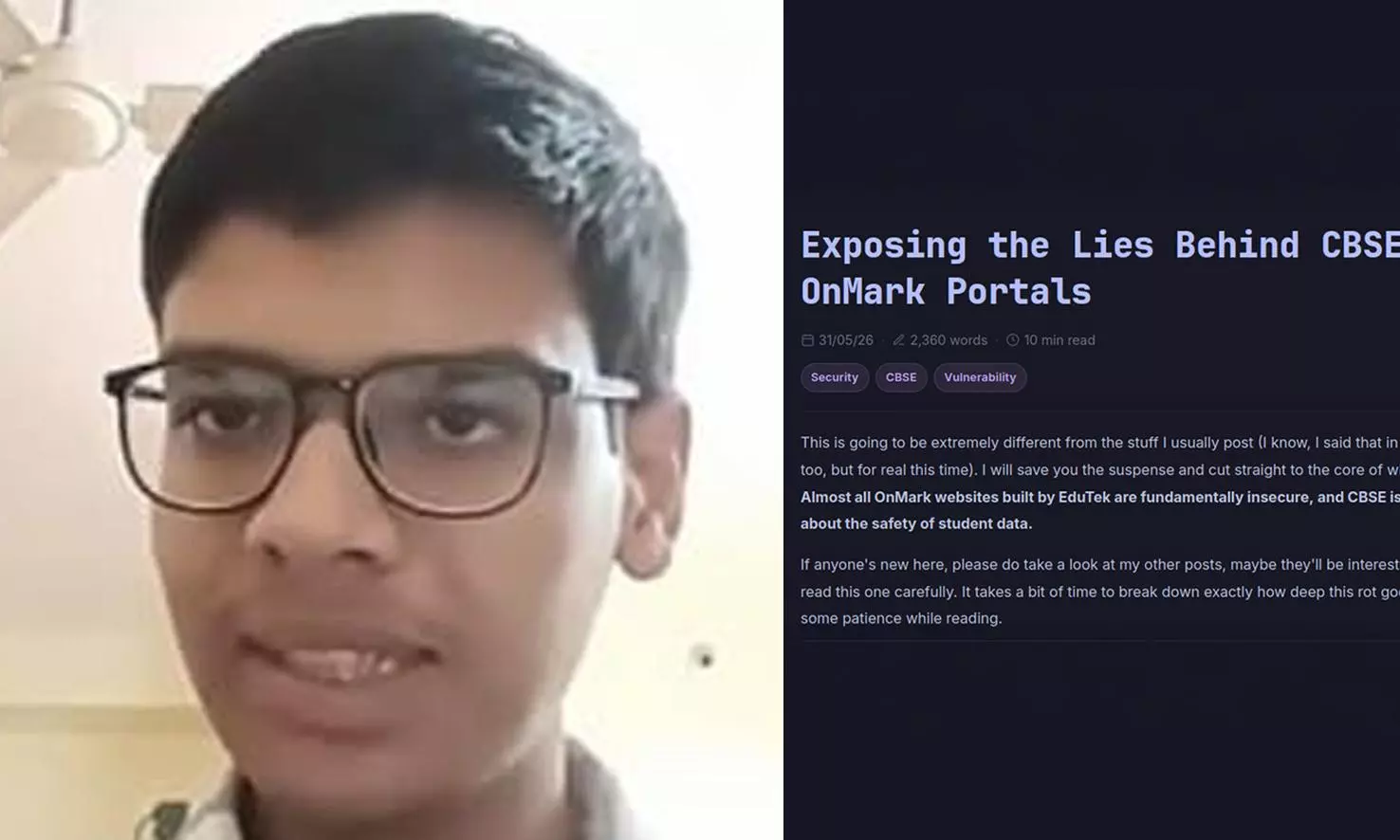
Gen Z student from Jharkhand has taken on the CBSE publishing his data analysis on their tender process in a blog, which has gained traction nation-wide and sparking of public anger and a political row
CBSE OSM row: Student alleges rule changes in tender to favour Coempt over TCS
CBSE OSM row has now moved from blurry answer sheets to a serious showdown, after Jharkhand student combed through 576 public records to allege tender manipulation

The ongoing controversy over Central Board of Secondary Education (CBSE)'s On-Screen Marking system took another serious turn as a 17-year-old Jharkhand student’s investigation alleged that tender norms were diluted and security safeguards scaled back, to give a Hyderabad-based firm, Coempt Eduteck the (OSM) contract.
What Sidhant alleges
Both the CBSE and Coempt EduTeck have strongly denied any wrongdoing in rebuttals to Hindustan Times.
There were at least 15 discrepancies, as per my blog.”
Three key discrepancies
Thirdly, Sidhant further alleged that the board systematically altered the project criteria to disadvantage larger, established vendors. It shows a pattern that the industry giant TCS was not preferred, but Coempt was preferred, which works as a very fragmented group of institutions,” he told news agency ANI, pointing to what he claims was a deliberate bias against major IT firms.
Coempt EduTech under focus
Sidhant’s findings focus heavily on the winning vendor, Hyderabad-based Coempt EduTeck. His blog alleges that Coempt was previously known as Globarena Technologies—the controversial firm at the center of the 2019 Telangana Intermediate Examination disaster, where major software and evaluation glitches derailed the results of thousands of students and triggered widespread public outrage.
Also read: CBSE OSM row takes new turn amid claims of students being pressured to defend it online
Sidhant claims that after the Telangana crisis, Globarena rebranded as Coempt EduTeck, and that CBSE has alleedly progressively diluted its tender requirements across successive bidding rounds to accommodate this specific firm's profile.
Flagging other issues
Further, Sidhant also raised why the mandatory Capability Maturity Model Integration (CMMI) certification requirement was reportedly reduced from Level 5 to Level 3.
The cooling-off period for engaging retired CBSE officials was reduced from two years to one year
Experience requirements were modified from handling projects involving at least five lakh students to broader cumulative project experience criteria.
Ownership requirements for data centres were replaced with provisions allowing third-party cloud infrastructure.
Penalty provisions shifted focus from scanning errors and quality issues towards delays in project execution.
The previously stated maximum error rate of 0.5 per cent was removed.
Technical specifications for scanning infrastructure were reportedly relaxed.
Certain cybersecurity and testing requirements, including vulnerability assessment and penetration testing certifications, were allegedly altered or removed.
Three tenders
According to Sidhant's digital footprint analysis, the procurement process unfolded in three distinct stages over 2025:
First Round (February 2025): The initial tender was issued but later mysteriously vanished from the public Government e-Marketplace (GeM) records, leaving no official archive. Second Round (May 2025): A second tender attracted four major bidders, including tech giant Tata Consultancy Services (TCS) and Coempt. However, all four failed the technical evaluation, forcing CBSE to scrap the round entirely.
Third Round (August 2025): The board issued a final, revised tender. It was in this round that Coempt EduTeck successfully emerged as the winning bidder, following several critical alterations to the bidding criteria.
Also read: CBSE OSM row debate | ‘Students are losing trust in the government’
A third tender was subsequently issued in August 2025, with Coempt Eduteck eventually emerging as the successful bidder.