







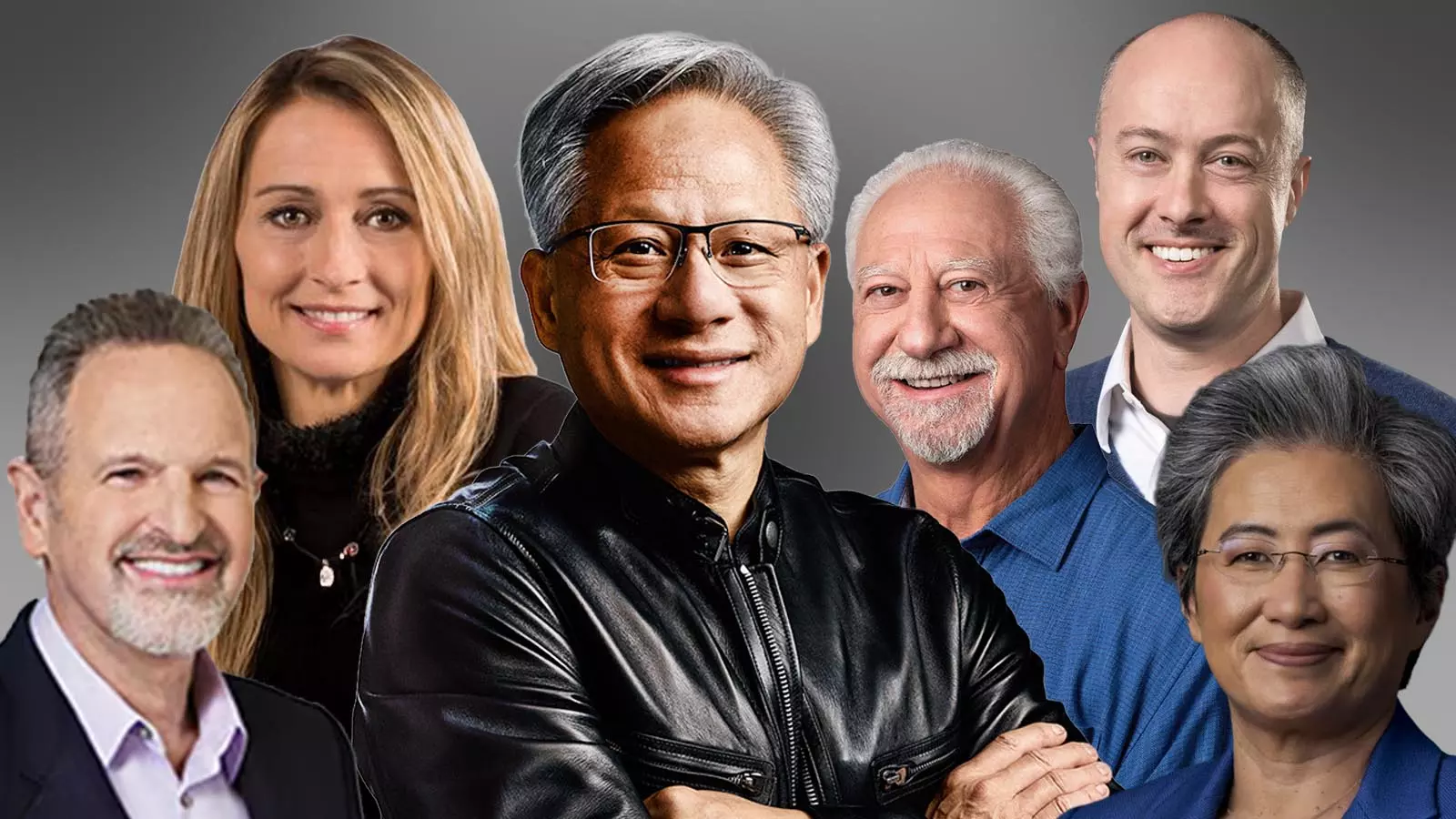
Who could replace Jensen Huang as Nvidia CEO? The names in the frame
With Nvidia board facing mounting pressure over Huang's future, names of long-time execs, industry leaders, and even family members have emerged in succession speculation

The Nvidia board had initially expressed confidence in its beleaguered CEO Jensen Huang, even as it launched an independent investigation into allegations that the company’s co-founder had been honey-trapped by a foreign intelligence operation.
“The Board has confidence in Jensen and his leadership team and will provide further updates as appropriate,” the board said in a statement on November 8.
It also said it had no reason to believe that US national security or Nvidia’s corporate secrets had been compromised. The investigation, overseen by a committee of independent directors and outside legal counsel, was intended to examine the available information.
A new revelation
But the situation took another turn on Wednesday (November 11), when The New York Times reported that before his alleged extramarital relationship with Alice Huang, who is suspected to be a Chinese spy, Jensen had another affair with Kimberly Powell, Nvidia’s vice-president of healthcare, who reportedly reported directly to him. The report cited five people who had worked at the company.
On top of concerns over national security, these developments added to concerns over corporate governance. Finally, on Wednesday, Wall Street Journal, citing unnamed people familiar with the matter, reported that the board was preparing to meet and possibly remove Huang. Nvidia shares fell more than 8% in after-hours trading on November 11.
Also read: Alice Huang used ties to Jensen Huang to divert $7.5 bn Nvidia chips to China: Report
The possibility of Huang’s departure has also triggered speculation over succession. On prediction market Polymarket, the probability of Huang announcing his resignation or being removed by December 31, 2026, climbed to around 88% on November 11, according to market data.
Who could take over from within Nvidia?
Nvidia has not publicly identified a successor. However, several names have emerged in media reports and among analysts:
1. Ian Buck
Ian Buck is among the names attracting the most attention as a potential long-term successor. He joined Nvidia in 2004 and has spent more than two decades in the company. He currently serves as vice-president of hyperscale and high-performance computing.
Buck played a key role in developing CUDA, Nvidia’s software platform that allows developers to use the parallel-processing capabilities of its graphics processing units (GPUs) for general-purpose computing.
CUDA has become central to Nvidia’s dominance in artificial intelligence. It allows researchers and developers to build and run applications on Nvidia hardware, creating an ecosystem that has been difficult for competitors to replicate.
Buck currently oversees Nvidia’s hyperscale AI products, managing its hardware and software offerings and working with major technology companies, including Microsoft, Google, Amazon, Meta and OpenAI.
A detail that receives less attention is his involvement in US technology policy. Nvidia’s official biography says Buck has testified before the US Congress on artificial intelligence, advised the White House and worked with governments on national AI supercomputing initiatives.
News agency Reuters identified Buck as one of the two leading internal possibilities, alongside CFO Colette Kress. Business Insider also cited a former Nvidia employee who said Buck was already running the business responsible for virtually all of the company’s revenue.
2. Colette Kress
If Nvidia needs an immediate replacement, its chief financial officer Colette Kress could be an option.
Kress joined Nvidia in September 2013 and has overseen its finances through a period of extraordinary expansion. She is also one of the company’s most recognisable executives apart from Huang, regularly representing Nvidia in investor interactions.
Before joining Nvidia, Kress held senior financial positions at Cisco and Microsoft. She spent 13 years at Microsoft, including four years as CFO of its Server and Tools division. She subsequently served as senior vice-president and CFO of Cisco’s Business Technology and Operations Finance organisation.
Her experience makes her a potential choice for an interim leadership arrangement. DA Davidson analyst Gil Luria, speaking to Business Insider, identified Kress as someone who could step in if Huang were to leave.
3. Madison Huang
A more unconventional possibility is Jensen Huang’s daughter, Madison Huang.
She is Nvidia’s senior director of product and technical marketing for physical AI platforms. Her responsibilities include marketing and go-to-market strategies for technologies such as Nvidia Omniverse, Cosmos and Isaac, which support industrial simulation, robotics and physical AI development.
Madison joined Nvidia in 2020 after working in marketing and development at luxury goods group LVMH. She holds an MBA from London Business School.
Business Insider, citing a former Nvidia employee, reported that she had been taking on greater authority across the company’s businesses. This has fuelled speculation about whether she could eventually assume a larger leadership role.
Her brother Spencer Huang also works at Nvidia, overseeing product management in robotics. Her husband, Nico Caprez, is the company’s vice-president of global AI infrastructure growth.
A family-centred succession, however, could invite questions about corporate governance, given the concentration of family members in senior positions. Nvidia has not announced any plan to transfer leadership to a member of the Huang family.
4. Bryan Catanzaro
Another internal name identified by Inc. magazine is Bryan Catanzaro, Nvidia’s vice-president of applied deep learning research.
Catanzaro leads a research team working on applications of deep learning across areas such as language understanding, computer graphics and chip design.
His research at Nvidia led to the development of cuDNN, a widely used library that accelerates deep learning operations on Nvidia GPUs. He holds a PhD in electrical engineering and computer sciences from the University of California, Berkeley, and previously worked at Baidu.
5. Chris Malachowsky
Nvidia could also look closer home, at one of its own co-founders.
Chris Malachowsky, who founded Nvidia alongside Huang and Curtis Priem in 1993, remains a senior technology executive and Nvidia Fellow. He has more than four decades of industry experience and has overseen several important functions at the company, including product engineering, operations and research.
Reuters identified him as a possible figure in a leadership transition.
Curtis Priem, the third co-founder, left his executive position in 2003 and is no longer part of Nvidia’s operational leadership.
Could Nvidia look outside?
While internal candidates may have an advantage because of their familiarity with the company’s technology and culture, several external names have also surfaced.
1. Thomas Kurian
Business Insider identified Thomas Kurian, CEO of Google Cloud, as one possible external candidate.
Kurian joined Google in 2018 after spending 22 years at Oracle, where he rose to become president of product development. At Google, he has overseen the expansion of its cloud business, which serves enterprises, governments and startups with computing and AI infrastructure.
His experience managing a large technology business could make him an interesting proposition. However, there is no indication that he has been approached by Nvidia.
2. Matt Garman
Another name mentioned by Business Insider is Matt Garman, CEO of Amazon Web Services (AWS).
Garman has been with Amazon since 2006 and helped launch some of the company’s earliest cloud services. Before becoming AWS CEO in June 2024, he held several leadership positions across its product management, engineering, operations and sales divisions.
AWS is one of Nvidia’s largest customers and a major provider of AI computing infrastructure. Garman’s familiarity with the cloud ecosystem could be relevant to Nvidia’s next phase of growth.
3. Eric Schmidt
Former Google CEO Eric Schmidt is another name floated by leadership experts.
Jeffrey Sonnenfeld, senior associate dean for leadership studies at Yale School of Management, told Axios that he had heard Schmidt’s name being discussed as a possible replacement.
Schmidt led Google from 2001 to 2011, overseeing its transformation into one of the world’s largest technology companies. He subsequently served as executive chairman of Alphabet and has remained involved in technology and AI initiatives. He currently chairs and leads space technology company Relativity Space.
Sonnenfeld also suggested that Schmidt could step into the role quickly if required.
4. Lip-Bu Tan
TechCrunch’s Connie Loizos also included Intel CEO Lip-Bu Tan in her list of possible replacements.
Tan has decades of experience in the semiconductor industry. Before taking over Intel in March 2025, he served as CEO of Cadence Design Systems from 2009 to 2021. He is also an established technology investor and founded venture capital firm Walden International.
Also read: Nvidia stock slides on CEO probe while Wall Street rallies on without it
His experience in chip design and the semiconductor ecosystem makes him a relevant name. However, this remains speculation, with no reported indication that Nvidia has approached him.
5. Lisa Su
The Information’s Martin Peers also floated Lisa Su, CEO of Advanced Micro Devices (AMD), as a potential candidate.
Su has led AMD since 2014 and overseen its transformation into one of Nvidia’s most formidable competitors in the semiconductor industry. Interestingly, she and Huang are distant cousins.
However, the prospect of Su moving to Nvidia presents an obvious complication: AMD competes directly with Nvidia in AI chips and data-centre computing. As Peers pointed out, it is difficult to see why she would leave a company that stands to benefit from any disruption at its biggest rival.
6. Rene Haas
Another name suggested by The Information is Rene Haas, CEO of British semiconductor design company Arm.
Haas previously spent seven years at Nvidia before joining Arm. He became its CEO in 2022 and has overseen its expansion into the AI and data-centre markets.
His familiarity with Nvidia, coupled with his experience leading a semiconductor company, makes him an interesting possibility. However, this too is speculation. The Information’s report discussed names that executive search specialists might pitch to Nvidia’s board, rather than a confirmed shortlist.
Why an internal successor could be the answer
Despite the growing list of names, Nvidia has not publicly identified a successor or announced a formal succession plan.
An internal appointment could offer continuity at a company where Huang has been deeply involved in product development, long-term strategy and relationships with customers and partners.
Also read: Nvidia board preparing to remove CEO Jensen Huang over affairs: Report
Reuters reported that some investors had even suggested a co-CEO arrangement, with Kress overseeing financial and corporate matters while Buck handles technology and product strategy.
But replacing Huang is not simply a question of filling the CEO’s chair. More than 60 executives reportedly report directly to him, and his influence extends well beyond Nvidia’s organisational structure.
November 17 (18th in India) will be another date to watch. Nvidia is scheduled to announce its third-quarter fiscal 2027 results, followed by an earnings call at 2 pm Pacific time (3.30 am IST). The event will give investors an opportunity to hear from the company’s leadership. Whether Huang will be the person addressing them remains an open question.