



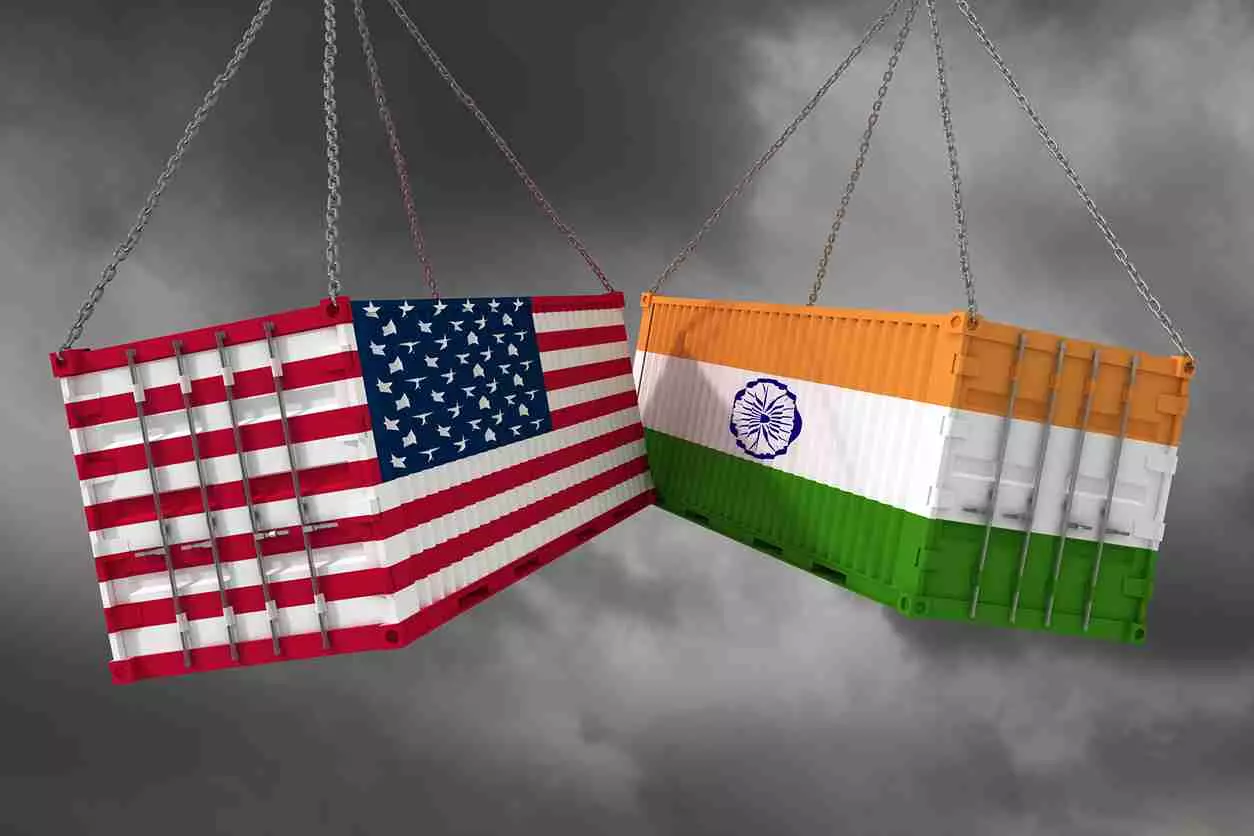
New Delhi has loudly opposed the unilateral Section 301 route, arguing that supply chain and labour disputes belong at the bilateral negotiating table rather than being handled via trade penalties. Representative photo
Why the US imposed a 10 pc forced-labour tariff on India and what it means
New Delhi evades maximum 12.5 per cent penalty via policy shift, but permanent trade hurdle threatens key export sectors and clouds crucial free trade pact talks

The Trump-led US administration has hit India with a 10 per cent forced-labour tariff on Indian imports, signalling an aggressive shift in Washington’s trade enforcement.
The move is part of a sweeping Section 301 action in the US targeting 60 economies accused of failing to eliminate forced labour from their global supply chains.
The new penalty replaces the temporary worldwide import levies that expired on July 24. While India managed to dodge the harsher 12.5 per cent bracket slapped on several other nations, the open-ended Section 301 tariff threatens to disrupt billions in bilateral trade and complicate ongoing trade pact negotiations.
What is forced labour tariff?
Essentially, under the International Labour Organization definition, with this tariff the US penalises goods linked to non-voluntary work extracted under threat.
Enacted under Section 301 of the Trade Act of 1974, this tariff has no expiration date and remains active until the US Trade Representative (USTR) determines compliance targets have been met.
India escapes larger penalty
India is among 17 countries facing a 10 per cent tariff, rather than the higher 12.5 per cent rate imposed on many others.
Initially, India was expected to attract the maximum 12.5 per cent penalty. However, New Delhi secured the lower 10 per cent tier after a last-minute June 14 amendment to its Foreign Trade Policy that explicitly banned forced-labour imports. India amended its Foreign Trade Policy to prohibit imports produced using forced labour after the US began its Section 301 investigation.
The USTR, however, noted that policy writing alone is not enough, and that boot-on-the-ground enforcement of these rules are necessary.
Sector Impact: Winners and Losers
The US stands as India's largest export destination, which means the tariff will directly squeeze margins for American importers and dent the price competitiveness of Indian goods.
The friction will be felt most acutely across labour-intensive sectors such as textiles, apparel, gems, jewellery, leather goods, footwear, engineering components, and handicrafts.
Conversely, the US has carved out exemptions for critical commodities to protect its domestic supply chains. Products remaining safe from the new levies include oil, natural gas, fertilisers, and goods already covered under pre-existing, distinct US tariffs.
The Bottom Line
New Delhi has loudly opposed the unilateral Section 301 route, arguing that supply chain and labour disputes belong at the bilateral negotiating table rather than being handled via trade penalties.
With a temporary tax now converted into a permanent trade hurdle, Indian exporters face prolonged uncertainty.
As both nations try to hammer out a broader free trade agreement, Washington has made it clear that supply-chain compliance is no longer a footnote—it is a dealbreaker.
Next Story