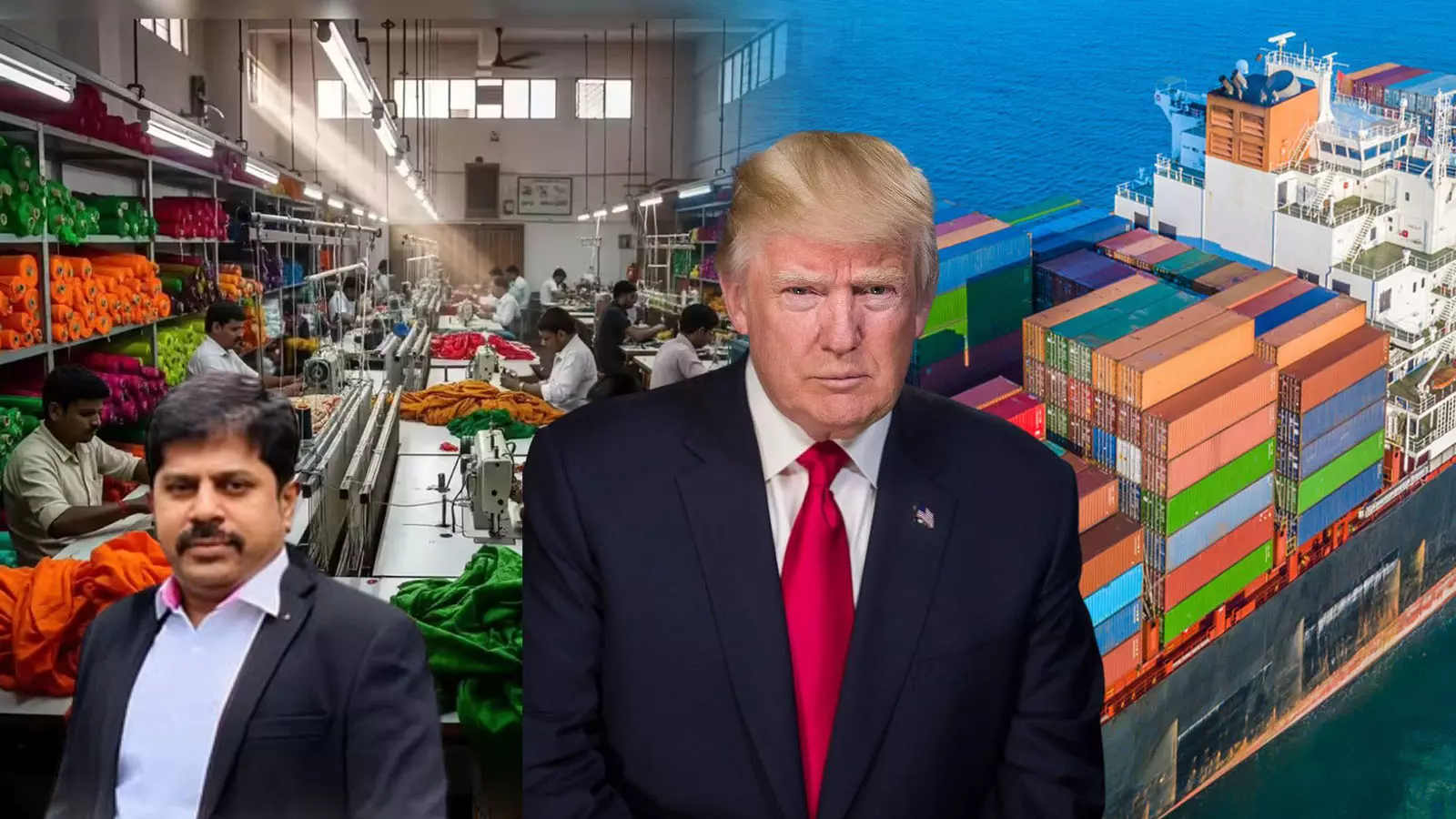
Why Tirupur exporters are upbeat on US market despite tariff confusion
Tirupur Exporters Association’s Kumar Duraisamy says 15 pc surcharge levels the playing field for India, even as the industry looks to diversification for growth

"We are still in the competition. A uniform 15% tariff across countries keeps the playing field level," says Kumar Duraisamy, Joint Secretary of the Tirupur Exporters Association, amid fresh confusion over tariff moves under US President Donald Trump.
Tirupur, known as India’s ‘Dollar City’, accounts for nearly 90% of the country’s cotton knitwear exports, with the United States as one of its largest markets. Amid shifting tariff announcements and legal battles in the US, The Federal spoke to Kumar Duraisamy to understand the ground reality for exporters.
Edited excerpts:
What is the current situation on US tariffs, and how is it impacting Tirupur exporters?
The Supreme Court of the United States withheld the tariffs imposed by Trump on various countries. Two weeks before that, our tariff had been fixed at 18%. Then their Supreme Court ruling slashed the entire tariff for all countries.
But the very next day, Trump imposed a new surcharge of 10% on all importing goods, and later added another 5%. So now, effectively, it is 15% across all countries.
At this point, as we speak, it is 15%. We do not yet have full clarity or a formal notification from US Customs on the latest changes. We expect clarity in a day or two. Whatever the nomenclature, surcharge or tariff, it stands at 15% for now.
Will this raise costs beyond earlier reciprocal tariff levels?
Definitely not. Earlier, when tariffs were revised, India had a 1% advantage over competitive countries like Vietnam, Bangladesh, Pakistan and Sri Lanka. That gave us an edge.
Now, at 15% uniformly across all countries, it becomes a level playing field. When it is uniform, we are still in competition. We don’t see a major disadvantage at the moment.’
Will this affect Tirupur’s competitiveness against countries like Bangladesh and Vietnam?
‘No. During Trump’s first term, when the US-China trade war happened, many buyers shifted sourcing from China to India due to tariffs. Tirupur benefited significantly. New customers came in and built strong relationships with us.
Even after these recent tariff disruptions, US buyers do not want to change their sourcing destination. They value our compliance standards, delivery schedules, communication, competitive pricing and lead times. These strengths keep us competitive.
When tariffs were reduced from 25% to 18% earlier, the same day the announcement came, buyers started sending inquiries and planning to lift goods that were on hold. That was a positive sign not only for India but also for Tirupur. That sentiment continues.
Were factories forced to shut down or lay off workers during the uncertainty?
To be very honest, when the tariff hit, the industry was already facing a shortage of nearly one lakh workers. So even when some factories operated at 50% capacity or slowed down, workers were absorbed by units catering to Europe and UAE markets.
No factories have shut down in Tirupur because of US tariffs. There was a pessimistic feeling among labour, management and owners. Units that were exclusively dependent on the US were under stress. But we cannot shut down and rebuild the ecosystem overnight. We have bank loans, compliance systems, and a labour base.
The government also supported with loans covering up to 20% of US exposure. That helped units sustain operations. As per data from the Tirupur Exporters Association, no factory has shut down due to US tariff disruptions.’
Are exporters diversifying away from the US market?
‘Yes, this episode has been a lesson. The US market gives volumes that cannot be easily replaced by any single other market. But one large US importer’s volume can be compensated by two or three importers from Europe or other regions.
Exporters are not looking to completely exit the US. But they want to de-risk to a certain extent. They are exploring Europe, the UK, and emerging markets. It is an alarm bell for units that were exclusively dependent on the US.’
Can exporters expect tariff refunds after the US court ruling?
I don’t think exporters will get tariffs back. However, some ethically driven importers may compensate by increasing volumes or adjusting prices in future orders. Many factories are running with idle capacities and need orders. We are in the receiving position, not the dictating position.
In a week or two, we may get clarity on whether buyers will support us through higher volumes or better pricing.
Has the Indian government provided clarity or support on the new tariff system?
This is primarily an issue to be clarified by the US government and US Customs. It is being closely monitored by exporters and logistics teams. Buyers are also communicating developments directly.
The Indian government is not directly responsible for clarifying US tariff notifications. But earlier support measures, including financial assistance, helped units manage the disruption.
How do you see the next five years for Tirupur and India’s textile exports?
So far, India has signed 18 Free Trade Agreements with various countries. The FTA with Europe is like the mother of all deals — a 20-year dream. The FTA with the UK is also significant. A bilateral framework with the US is expected by March. Trade talks with Canada are also progressing.
This is going to be India’s growth story. Textiles will add great value to achieving the Prime Minister’s vision of $40 billion in textile exports by 2030.
Tirupur currently does business worth around Rs 44,470 crore. By 2030, we aim to reach Rs 1 lakh crore. With initiatives like PM Mitra Park in Virudhunagar, textile parks in backward districts, skill development programmes, and a proposed skill university in Tamil Nadu — possibly in the Tirupur-Coimbatore region — the ecosystem is strengthening.
With the youngest population in the world, India is poised to lead textile exports in the next 20 years. We will grow in leaps and bounds.
The content above has been transcribed from video using a fine-tuned AI model. To ensure accuracy, quality, and editorial integrity, we employ a Human-In-The-Loop (HITL) process. While AI assists in creating the initial draft, our experienced editorial team carefully reviews, edits, and refines the content before publication. At The Federal, we combine the efficiency of AI with the expertise of human editors to deliver reliable and insightful journalism.