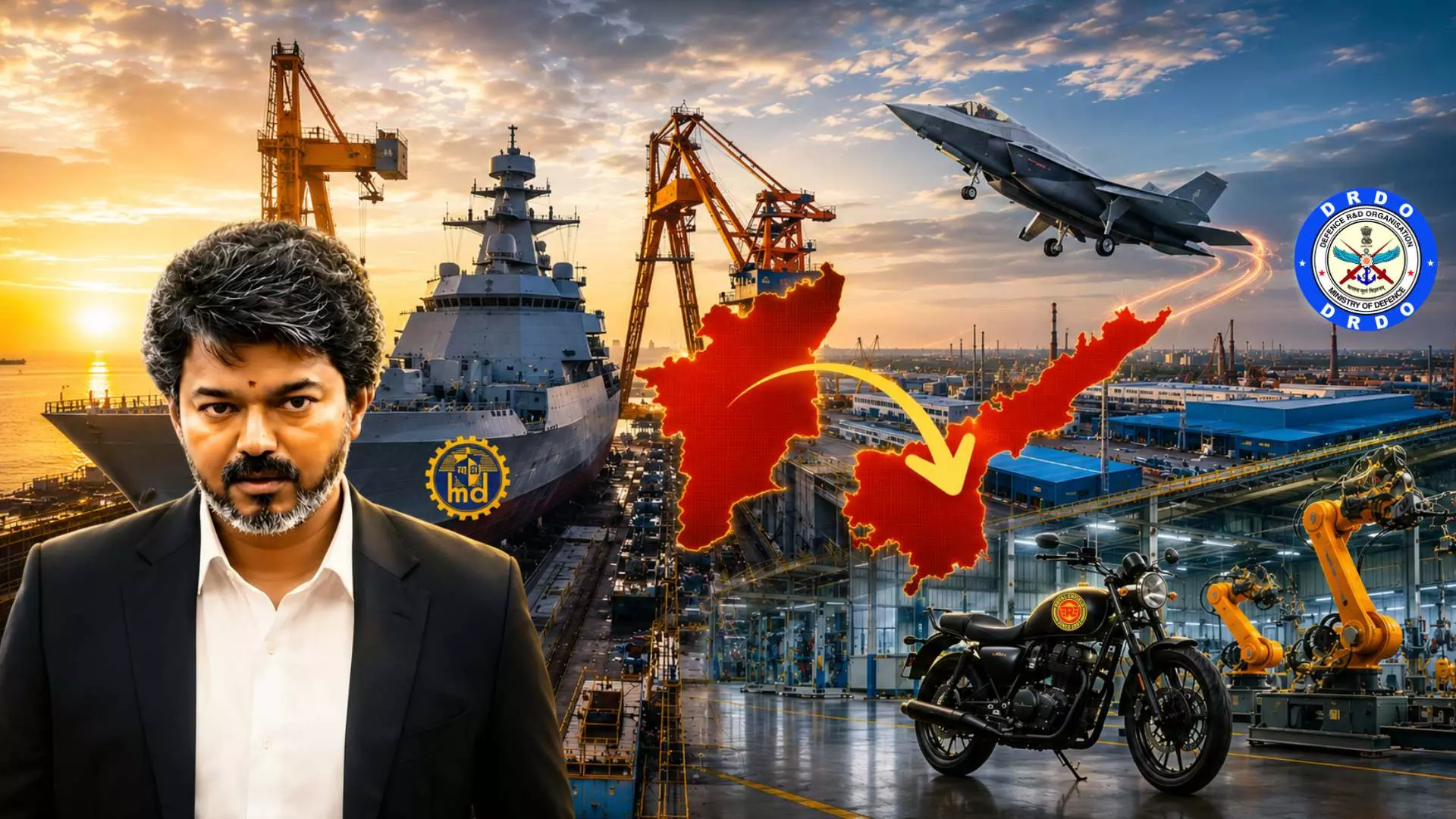
TN loses to Andhra again: Rs 30k-cr Mazagon Dock project shift sparks policy debate
A Rs 30,000-crore shipbuilding cluster involving Mazagon Dock shifts to Andhra Pradesh, sparking debate over Tamil Nadu’s industrial retention strategy

A Rs 30,000-crore mega shipbuilding cluster involving Mazagon Dock Shipbuilders has reportedly moved away from Tamil Nadu to Andhra Pradesh, triggering a wider debate on how major industrial investment decisions are made, especially in strategic sectors like defence manufacturing and shipbuilding, where both central and state governments play a key role.
Government-backed projects
Speaking on the issue, KER Raghunathan, National Chairman, Association of Indian Entrepreneurs, said investments can broadly be divided into government-backed projects and private investments.
“One, investments which are made by the Government of India through subsidies, incentives or programmes. Second, private investments where companies choose a state based on their requirements,” the expert said.
He added that in recent cases, Tamil Nadu has seen movement of major government-backed projects.
Key project shifts
The first was a DRDO-linked defence manufacturing project worth around Rs 5,200 crore. The second was the Mazagon Dock shipbuilding cluster, estimated at nearly Rs 30,000 crore.
Both projects are now associated with Andhra Pradesh, triggering political and policy debate in Tamil Nadu over investment conversion and execution readiness.
Also read: How Andhra is carving itself out as a major defence hub amid stiff southern competition
“We are talking about two government-backed projects that were earlier discussed in Tamil Nadu but have now gone to Andhra Pradesh,” Raghunathan said.
“In such cases, these are not purely private investment decisions. They involve central government agencies, PSUs, and state governments working together,” he explained.
“Often, location outcomes depend on multiple factors like land availability, infrastructure readiness, logistics connectivity, and how quickly a state can convert proposals into execution-ready projects,” he said.
“So what is seen as a ‘shift’ is usually the result of execution speed and ecosystem alignment at the final stage, rather than a single political factor,” he added.
Wider debate
The discussion has also expanded to other industrial proposals, including sectors such as electronics, aerospace, and defence manufacturing.
Also read: Royal Enfield’s Andhra investment sparks debate over TN’s industrial strength
Projects like Royal Enfield expansion discussions, Reliance-linked investments, Adani solar battery plans, and Foxconn-related developments have also been cited in the broader debate on investment retention.
Raghunathan also highlighted challenges related to continuity in industrial engagement and investor confidence. “There is no continuity for the entrepreneurs,” he said, referring to changes in administrative structures and industrial facilitation systems.
He stressed that industrial growth depends on consistent policy engagement, infrastructure readiness, and coordination between departments and industry stakeholders.
Infrastructure factor
Infrastructure development, including proposals like the Parandur airport, was also highlighted as a key factor for industrial expansion.
“It is not about word of assurance, it is about documentation of assurances,” Raghunathan said.
He added that industrialisation is essential for job creation, revenue growth, and overall state development.
Also read: Favouritism or just a better deal? AMCA hub shift sparks debate on TN’s competitiveness
The Mazagon Dock case has brought renewed focus on how India’s largest industrial projects are allocated and executed.
As competition between states intensifies, execution speed, land readiness, and ecosystem alignment are increasingly becoming decisive factors in where mega investments finally take shape.
(The content above has been transcribed from video using a fine-tuned AI model. To ensure accuracy, quality, and editorial integrity, we employ a Human-In-The-Loop (HITL) process. While AI assists in creating the initial draft, our experienced editorial team carefully reviews, edits, and refines the content before publication. At The Federal, we combine the efficiency of AI with the expertise of human editors to deliver reliable and insightful journalism.)