







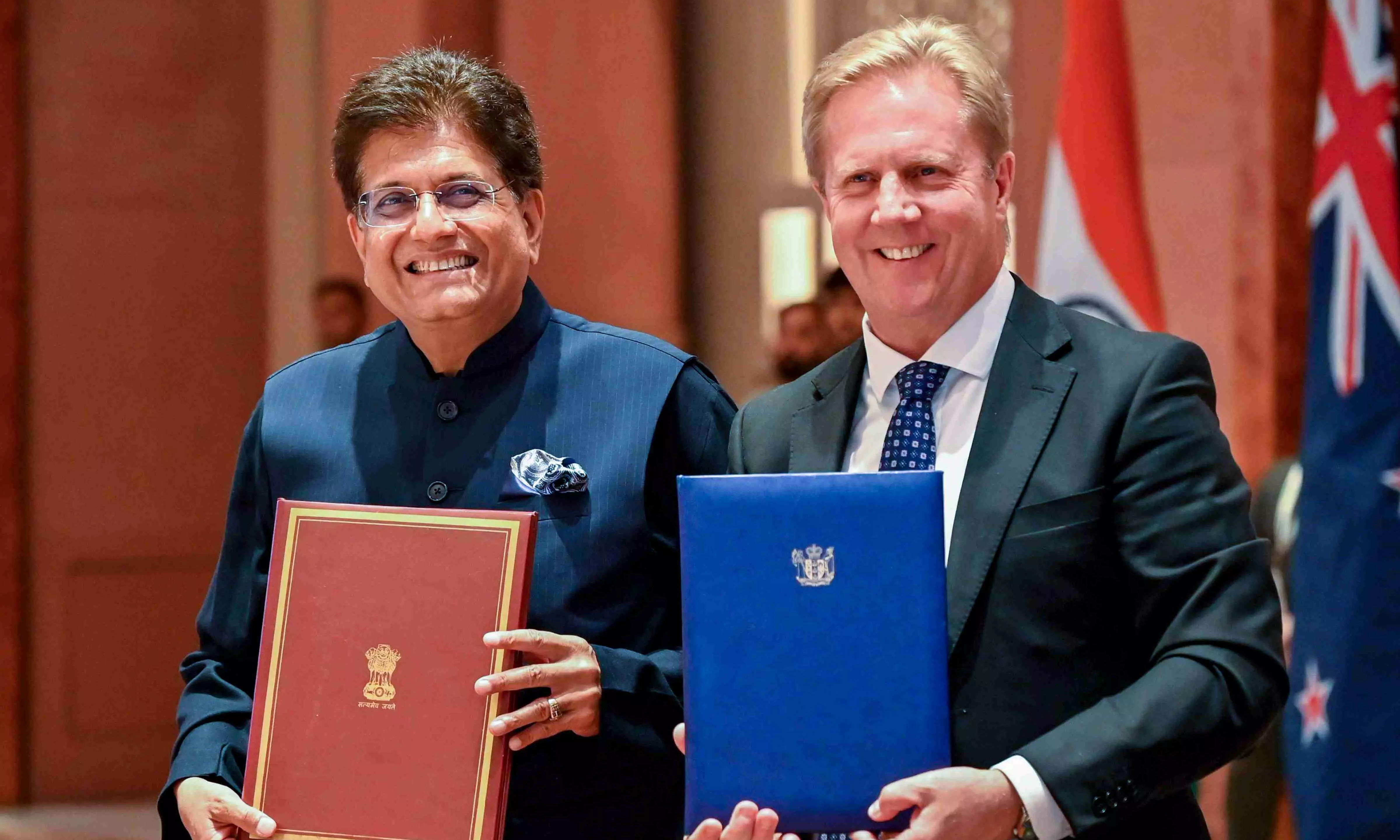
Union Commerce Minister Piyush Goyal with New Zealand Minister of Trade and Investment Todd McClay at the signing of the India-New Zealand FTA, in New Delhi, in April 2026. PTI Photo
New Zealand FTA takes off: What changes for Indian exporters, importers
Landmark free trade agreement offers immediate duty-free market access, $20 billion FDI commitment, expanded opportunities across goods, services, and mobility

The India-New Zealand Free Trade Agreement (FTA), signed on April 27, 2026, officially came into effect on Tuesday (October 20), marking India's 17th operational FTA and its seventh in the last five years.
Following negotiations initially launched in 2010, stalled in 2015, and revived in March 2025, the historic pact completes India's preferential market access across all major countries of the Asia-Pacific region while strengthening its strategic position in the Indo-Pacific.
Also read | India-EU FTA: Good beginning, but don’t count the chickens yet
Here is a quick recap of what the FTA means for Indian businesses.
What changes with the deal: 5 takeaways
100% duty-free access for Indian goods: Indian exports gain zero-duty access to New Zealand from day one. Labour-intensive sectors and MSMEs—including textiles, apparel, leather, footwear, engineering goods, auto components, gems and jewellery, pharmaceuticals, and agriculture—receive an immediate competitive edge.
$20 billion investment boost: New Zealand has committed $20 billion in FDI over 15 years. Deloitte India Partner Gulzar Didwania notes that provisions on duty-free inputs, bilateral cumulation, customs facilitation, and investment promotion will support deeper value-chain integration.
Services and mobility gains: The pact extends beyond goods to encompass services, investment, skills, and mobility. Hi-Tech Gears Chairman Deep Kapuria highlights secured market access for services like Ayush, yoga instructors, and student mobility, including post-study work visas.
Target to double bilateral trade by 2030: After bilateral trade fell 11 per cent to $1.15 billion in 2025–26 (with India recording $22.59 million trade deficit), the pact sets an ambitious agenda to double trade while offering predictable rules amid global trade uncertainty.
Broader economic cooperation: Chintan Research Foundation President Shishir Priyadarshi and Indian-origin New Zealander Rani Singh emphasise that the agreement creates fresh opportunities across education, tourism, technology, and professional services, bringing both nations closer together.
What changes for Indian exporters
Immediate cost advantage: Gain zero-duty market access on 100% of export tariff lines starting day one, making Indian goods significantly more competitive against foreign rivals in New Zealand.
Major win for MSMEs and key sectors: Labour-intensive industries—textiles, leather, footwear, auto components, pharmaceuticals, and processed foods—receive an immediate boost to expand order volumes.
Service sector expansion: Service exporters, specialised instructors (yoga, Ayush), and skill-based professionals gain recognized, preferential access to New Zealand's market.
What changes for Indian importers and businesses
Duty-free inputs, easier supply chains: Streamlined customs procedures and duty-free access for critical input goods simplify supply chain logistics for domestic manufacturers.
Inflow of foreign capital: Increased access to $20 billion in foreign direct investment (FDI) over 15 years opens joint venture opportunities and deeper value-chain integration.
Enhanced bilateral stability: Predictable trade rules lower operational risk, helping offset recent declines in trade volumes and encouraging long-term business partnerships.