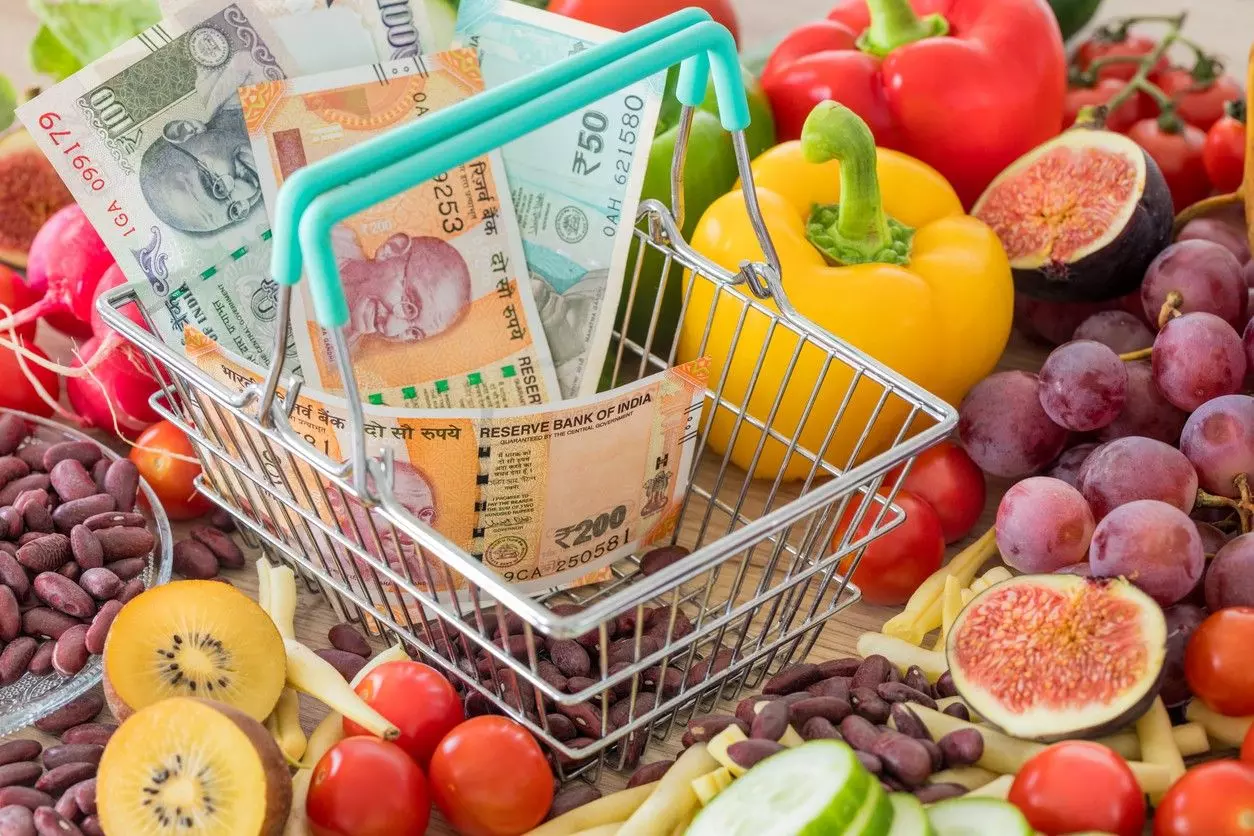
The selection of items in the CPI basket is also in accordance with the Classification of Individual Consumption According to Purpose India developed and adopted in 2018 under the guidance of the United Nations Statistics Division. Photo: iStock
New CPI 2024: Weightage down for food, up for housing, health, telecom
The revamped index cuts food weightage to 36.8pc and adds digital services like OTT, reflecting a significant shift in household consumption patterns

In a major overhaul, the new 2024 series of Consumer Price Index (CPI), released on Thursday (February 12) to replace the 2012 one, has made significant changes in the weightage given to various items. These changes are based on the Household Consumption Expenditure Survey (HCES) of 2023-24.
Changes in item weightage
In terms of combined (rural plus urban) weightage, the most significant change has been in food and beverages, reduced from 42.6 per cent to 36.8 per cent in the 2024 series. Other items that have seen reduced weightage are: clothing and footwear (from 6.5 pc to 6.4 pc), recreation, sport and culture (from 1.547 pc to 1.516 pc) and education services (from 3.5 pc to 3.3 pc).
Also read: Should Gen Z and millennial Indians park their salaries in FDs?
Those which have seen their weightage rise are: paan, tobacco and intoxicants (from 2.38 pc to 2.9 pc), housing, water, electricity, gas and other fuels (from 16.9 pc to 17.7 pc), furnishing, household equipment and routine maintenance (from 3.7 pc to 4.5 pc), health (from 5.9 pc to 6.1 pc), transport (from 6.4 pc to 8.8 pc), information and communication (from 3.3 pc to 3.6 pc), restaurants and accommodation services (from 3.2 pc to 3.3 pc) and personal care, social protection and miscellaneous goods and services (from four pc to five pc).
The total number of weighted items has increased from 299 to 358, and within it, goods items from 259 to 308 and services items from 40 to 50, underscoring the changing household expenditures.
These are in line with an expert group’s recommendations made in January, guided by the Household Consumption Expenditure Survey (HCES) of 2023-24. The new series also adds a few items and removes some others because of the changing household expenditures.
Additions and deletions of items
The new items added in the CPI basket are: rural housing rent, online media service provider/streaming services (OTT subscriptions), value-added dairy products, barley and its products, pen-drive and external hard disk, attendant, babysitter and exercise equipment.
Also read: Is NITI Ayog overly optimistic about Viksit Bharat and Net Zero goals?
The items deleted are: VCR/VCD/DVD player and hiring charges, radio, tape recorder, second-hand clothing, CD/DVD audio/video cassettes and coir/rope.
Changes in methodology, data collection
It isn’t the HCES of 2023-24 alone that guides the new CPI series.
The selection of items in the CPI basket is also in accordance with the Classification of Individual Consumption According to Purpose (COICOP) India, developed and adopted in 2018 under the guidance of the United Nations Statistics Division (UNSD), to align the basket with the international classification of household expenditure.
The COICOP provides a framework of homogeneous categories of goods and services from the point of view of their usage by households.
The other big change in methodology is excluding free social transfers — like PDS supply, free electricity up to a specified limit, free education, free healthcare services or other goods and services provided without charge — in keeping with the International Monetary Fund (IMF) manual on CPI.
Also read: Praveen Chakravarty slams Budget 2026, says it ignores jobs, state debt | Interview
The new series has expanded data coverage, using 1,465 rural markets and 1,395 urban markets across 434 towns. In addition, 12 online markets are covered across 12 towns having a population of more than 25 lakh. It also uses alternative data sources such as administrative data and e-commerce/online price data.
Inflation in January 2026
As per the new series of base year 2024, the headline inflation (CPI) for January 2026 is 2.75 per cent, and food inflation (CFPI) is 2.13. In the old 2012 CPI series, the CPI for December 2025 was 1.3 per cent and -1.85 per cent, respectively.
The top five items seeing high inflation are: silver jewellery (159.7 pc), tomato (64.8 pc), coconut (47.2 pc), gold/diamond/platinum jewellery (46.8 pc) and coconut oil (40.4 pc).
The five top items seeing low inflation are: garlic (-53 pc), onion (-29.3 pc), potato (-29 pc), arhar, tur (-24.9 pc) and peas (-15.6 pc).
Why CPI matters
The inflation data (CPI) has multiple policy utilisations. It is used by the Reserve Bank of India for monetary policy decisions and to monitor price stability; used for designing policy and social sector welfare schemes; used as a deflator to adjust nominal Gross Domestic Product (GDP) to real GDP to capture ‘real’ growth and for revising wages, updating tax brackets, adjusting social security payments, etc.
Also read: 16th FC awards: Southern states gain, northern backward states lose with formula tweaks
With the reduced weightage for food and beverages, the inflation numbers would be less volatile and more predictable.
It is for these reasons that the Centre should have changed the base year long back. The National Statistical Commission (NSC) recommended revising the base year of all economic indices every five years to capture the fast-changing dynamics.
Also read: Can Budget fix the damage trade protectionism has done to India’s exports?
PC Mohanan, former acting chairman of the NSC, says the Centre should have revised the CPI base year after the HCES of 2017-18 was ready to be published in early 2019, but it was junked for showing household consumption expenditures falling (over the HCES of 2011-12), indicating rising poverty.
The GDP and IIP (Index of Industrial Production) base years are also over a decade old. These are also scheduled to be rebased soon.