



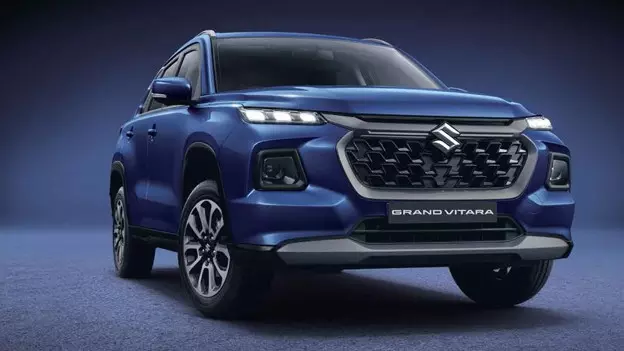
Maruti Suzuki has strongly contested the consumer court's findings, maintaining that the product itself is free from manufacturing defects
Maruti Suzuki vows to challenge consumer court order in Grand Vitara case, blames E20 fuel quality
After a Raipur consumer court ordered a ₹20.50 lakh refund or replacement in a Grand Vitara case, automaker fights back, blaming external fuel quality rather than vehicle engineering

Maruti Suzuki India has decided to appeal against a consumer court ruling, which ordered the automaker to replace a Grand Vitara Strong Hybrid over performance issues allegedly tied to E20 (20 per cent ethanol-blended) fuel.
The company, which vowed to appeal to a higher court, has said in a statement that external fuel quality rather than engineering was the reason for the non-performance of the car.
The case is being earmarked as India's first known consumer dispute directly centered on the use of E20 petrol, which is under intense scrutiny as E20 has become the default fuel at pumps nationwide. According to reports, motorists are demanding alternatives due to complaints of lower mileage, poor engine performance, and corrosion.
What is the case?
The case stems from a complaint filed by Raipur resident Dr Premraj Debta, who purchased a Grand Vitara Strong Hybrid Zeta+ in June 2024. The vehicle itself was manufactured in January 2023. Within just five months of ownership, the premium hybrid SUV reportedly suffered from persistent performance issues and repeated mid-road stalling.
According to Dr Debta's complaint, authorised service centers repeatedly detected fuel system contamination and cleaned out the SUV's fuel tank, but the stalling problems returned each time.
Also read: BJP-NDA supporters reject E20: 'Government should listen to people's feedback'
A fuel sample extracted from the vehicle was sent to a government-recognised laboratory for testing. The analysis revealed the presence of a "white, curd-like substance" that was formally identified as ethanol.
Moreover, Dr Debta claimed that Maruti Suzuki and its dealership failed to inform him at the time of purchase that the January 2023-manufactured vehicle might not be fully compatible with the newer E20 petrol blend.
Consumer court ruling
After reviewing the technical documents and hearing arguments from both sides, the Raipur District Consumer Disputes Redressal Commission ruled that the vehicle suffered from inherent, unresolved defects.
The commission noted that multiple repair attempts by authorised mechanics had completely failed to rectify the underlying issue. Furthermore, the panel highlighted a crucial systemic reality for Indian motorists: because E20 petrol has now become the standard, commonly available fuel at commercial filling stations, car owners have no practical alternative but to use it.
Holding Maruti Suzuki and its dealership liable, the Raipur Consumer Commission issued a strict directive to resolve the dispute within 45 days.
Also read: Policy over choice? Experts flag consumer risks in E20 fuel rollout | AI With Sanket
The order mandated that Maruti must either replace the SUV with a brand-new, fully E20-compatible vehicle or refund the entire acquisition cost of ₹20.50 lakh (covering the vehicle price, RTO registration fees, and insurance). The panel also awarded ₹1 lakh to the complainant for mental harassment and agony. The joint parties must pay ₹10,000 to cover the customer's litigation expenses.
Maruti Suzuki vows to appeal
Maruti Suzuki has strongly contested the consumer court's findings, maintaining that the product itself is free from manufacturing defects.
In an official statement, the automotive giant clarified its stance: “The car in this case was an E20 compatible car, fully equipped to handle E20 fuel and so disclosed in the owner's manual. There is evidence of contamination in the fuel collected from the customer's vehicle. Several other relevant facts have also not been reflected in the order.”
Reaffirming its position that external fuel quality, rather than engineering, caused the failure, the company added that it will "take necessary steps to challenge the impugned order before appropriate higher forum in accordance with law."