


From Noida to TN, why are workers striking across India? Here's what they want
From North to South, workers demand better wages, overtime pay, and job security as rising living costs and ambiguous labour codes fuel nationwide protests

From the industrial hubs of Noida to the manufacturing clusters of Tamil Nadu, from factory floors in Bihar, Uttarakhand to Bhiwadi in Rajasthan, a wave of industrial unrest is sweeping across the country.
Factory workers, private company employees, and the invisible army of gig workers have in the past few months taken to the streets driven by the deepening frustration over rising cost of living and stagnant wages.
Though reports flagged the 35 per cent minimum wage hike in Haryana on April 9, after workers’ protest in the industrial hub of Manesar as the cause of the massive strike in neighbouring Nodia, and now in Uttarakhand, the truth is that the signs of brewing industrial unrest started earlier.
Cost of living crisis
On February 2, 2026 itself, contractual workers at the IOCL Barauni refinery in Bihar staged multiple protests over long working hours, unpaid overtime, and poor conditions. They demanded fixed 8-hour workdays, payment for overtime, and social security benefits (PF/ESIC). This triggered widespread unrest at industrial sites in Panipat and Surat as well.
On February 27, contract workers at an AM/NS plant in Surat, Gujarat, clashed with police demanding 8-hour shifts and timely wage payments. These protests reflected growing discontent among industrial workers, particularly those from Bihar, over labour contract systems that often enforce 12-hour shifts.
The "cost of living crisis" was the common thread across the recent protests, reflecting the widening gap between wages and the cost of basic necessities.
Factory workers have been hit hard as food prices at local eateries have surged in recent weeks, driven by disrupted gas supplies. Many have been forced to return to their villages. Unfair practices like not paying for overtime are common, according to the striking workers. Factory worker Soni Singh told PTI that his payslip does not reflect the hours he puts in. He typically works 12 to 14 hours a day, but is paid overtime for only three hours beyond his eight-hour shift. His monthly income is about Rs 13,000 rupees.
At the heart of these protests—and others across the region—is this: the sharp rise in living costs amid the ongoing West Asia conflict.
TN workers on strike
Meanwhile, on February 12, workers across Tamil Nadu held a nationwide general strike, as part of a country-wide "Bharat Bandh" to protest against the central government's "anti-worker" and "pro-corporate" policies. The primary demand was the immediate repeal of the four new labour codes, which unions argued dilute worker protections, reduce wages, restrict the right to strike, and make hiring/firing easier.
The Centre of Indian Trade Unions (CITU) said the strike is being organised jointly by workers and farmers’ organisations to fight against the four labour codes which will weaken labour protections, dilute social security measures, and favour corporate interests. They also opposed the proposed VB-G RAM G scheme, claiming it will undermine rural employment.
Noida protest
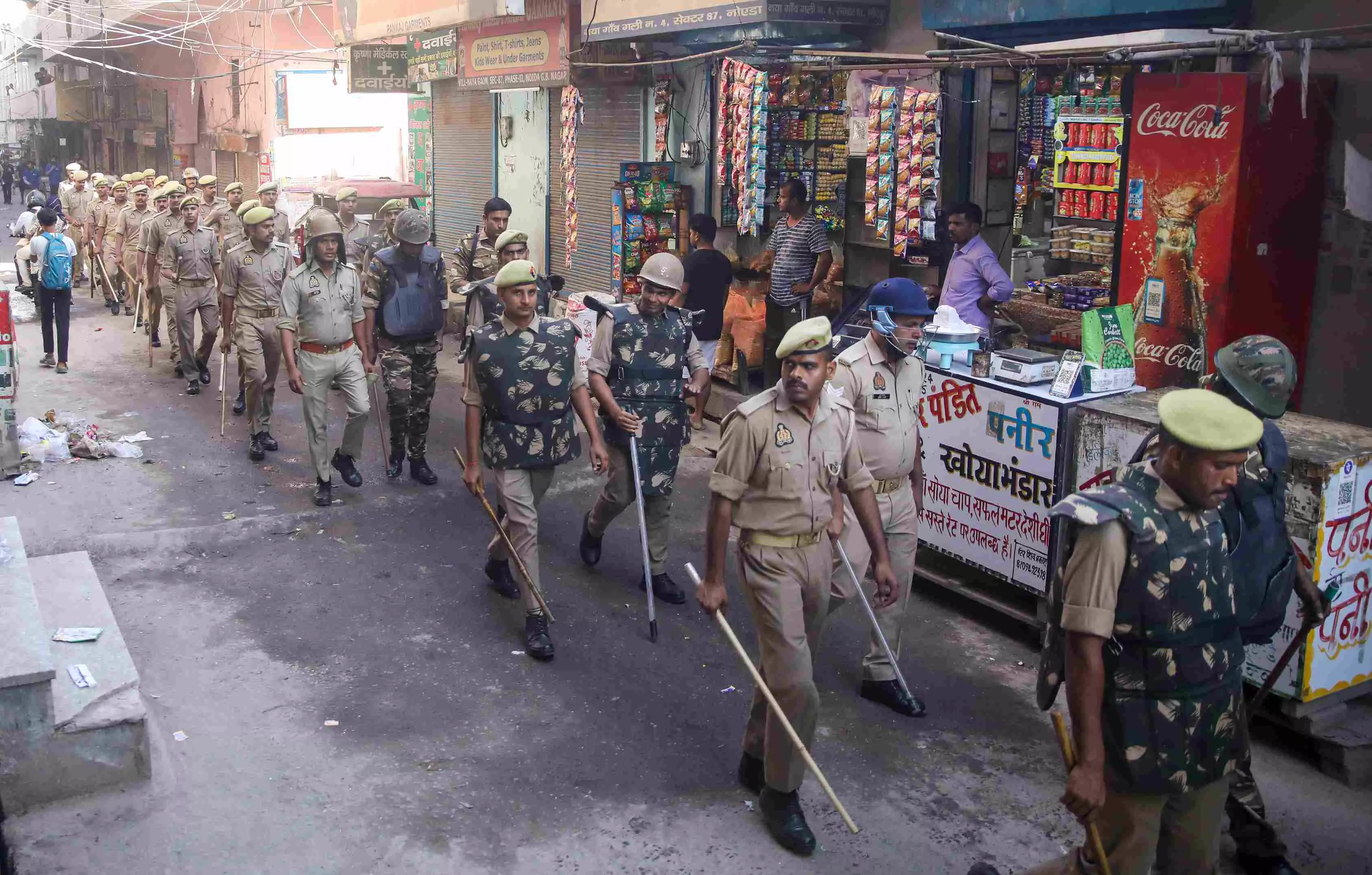
However, in April, when thousands of factory workers brought traffic to a standstill in Noida, near the capital, it made national news.
Non-unionised contract labourers, who are migrant labour, who assemble the country's auto parts, stitch its garments, and solder its electronics, earning between ₹10,000 and ₹15,000 month and living hand-to-mouth, brought the capital's satellite city to a standstill. The protest was instigated by a 35 per cent hike in minimum wages in neighbouring Haryana.
Also read: Noida Ground Report: What workers say amid uneasy calm
Haryana raised the minimum wage for unskilled workers to $165 per month, from roughly $120, effective April 1, a move that helps workers but will raise cost pressures for India’s auto industry at a time of rising input prices and supply chain disruptions. That move was made only after clashes broke out between the police and workers in Manesar near New Delhi and home to companies like Maruti Suzuki and hundreds of ancillary units. In Rajasthan’s Bhiwadi, hundreds of workers gathered outside a factory unit on April 13, raising similar demands.
So, why are industrial workers protesting in different parts of India?
Base wage unchanged
Apart from rising living costs, the strain has been worsened by delays in revising the base minimum wage, one of the two components that determine monthly minimum pay.
India’s minimum wage system has two parts: a base wage, revised every five years, and a variable dearness allowance, adjusted twice a year using the CPI-IW. Between 2021 and 2026, the CPI-IW rose nearly 25 per cent. While states updated the inflation-linked allowance, many delayed revising the base wage, leaving overall wage growth inadequate.
In India, minimum wages are set by individual states and vary by skill level and location, meaning workers doing similar jobs can earn very different wages—even within the same area. In Noida, one of the country’s key manufacturing hubs, these disparities have fueled growing frustration among workers.
Demand for minimum wage
In Uttarkhand's Motahaldu, nearly 500 workers demanded a minimum wage of ₹20,000 and an eight-hour shift, accusing management of forcing overtime without pay. They allege economic exploitation, arbitrary dismissals, and unsafe transport facilities.
Female employees reported “inhumane treatment,” citing restrictions on water and washroom breaks and verbal abuse. Protesters also called for reinstatement of terminated colleagues, saying the firings have created deep job insecurity.
Also read: Karnataka govt to strictly implement paid menstrual leave policy after HC directive
Minimum wages are to be paid for all employees across both organised and unorganised sectors. But since over 90 per cent of India's workforce operates in the informal sector, the statutory right to minimum wage remains non-binding on paper and is routinely ignored.
Ambiguity over 4 labour codes
There are also ambiguities in the four labour codes and delayed rule implementation have created confusion over wages, working hours, and legal protections. Protests were also partially fueled by a false expectation that the new Labour Codes guaranteed a flat Rs 20,000 minimum wage, a rumour stemming from a misread Central government notification.
The new Occupational Safety, Health and Working Conditions (OSH) Code, 2020 prescribes a 48-hour work week, it does not clearly define daily working hours, rest intervals, or spread-over limits, leading to confusion. This has allowed some employers to exploit draft provisions by enforcing 12-hour shifts under the guise of a 4-day workweek, often without adequate overtime compensation.
There is growing job insecurity and exploitation, including contract employment, gig worker precarity, and longer working hours.
Are workers justified in their demands?
Experts say the issue is not just low pay, but how inconsistently labour rules are enforced.
For example, take the National Floor Level Minimum Wage (NFLMW) in India, which is a non-statutory, recommended minimum pay set by the Central Government, which is currently ₹176–₹178 per day. No state should set its minimum wage below that.
It aims to reduce regional wage disparities, ensure a basic standard of living, and is meant to be updated periodically based on cost-of-living adjustments. This amount has not been revised for many years. However the minimum wage is poorly enforced by states and their indifference towards it has meant a serious loss of welfare for millions of workers. This should be made binding and revised dynamically in line with the Consumer Price Index (CPI). It must be set at a balanced level—high enough to safeguard workers, yet sustainable enough for employers to absorb without triggering job cuts.
Also, the new Occupational Safety, Health and Working Conditions (OSH) Code, 2020 sets a 48-hour work week but it leaves daily hours, rest breaks, and spread-over limits undefined. This ambiguity has allowed some employers to impose 12-hour shifts under a four-day week, often without proper overtime pay.
The government also must actively revive the Indian Labour Conference, the apex tripartite consultative committee in India under the Ministry of Labour & Employment, to build consensus regarding the rules of the four labour codes.
Without a concrete focus on job security, gig worker protections, and plugging enforcement loopholes, India's labour codes risk becoming a "paper tiger"—robust in theory but toothless in the face of industrial reality. For India, the challenge is no longer just about the pace of expansion, but the quality of it.
The goal must be a sustainable equilibrium—where economic growth does not come at the expense of the workforce’s basic rights and well-being.