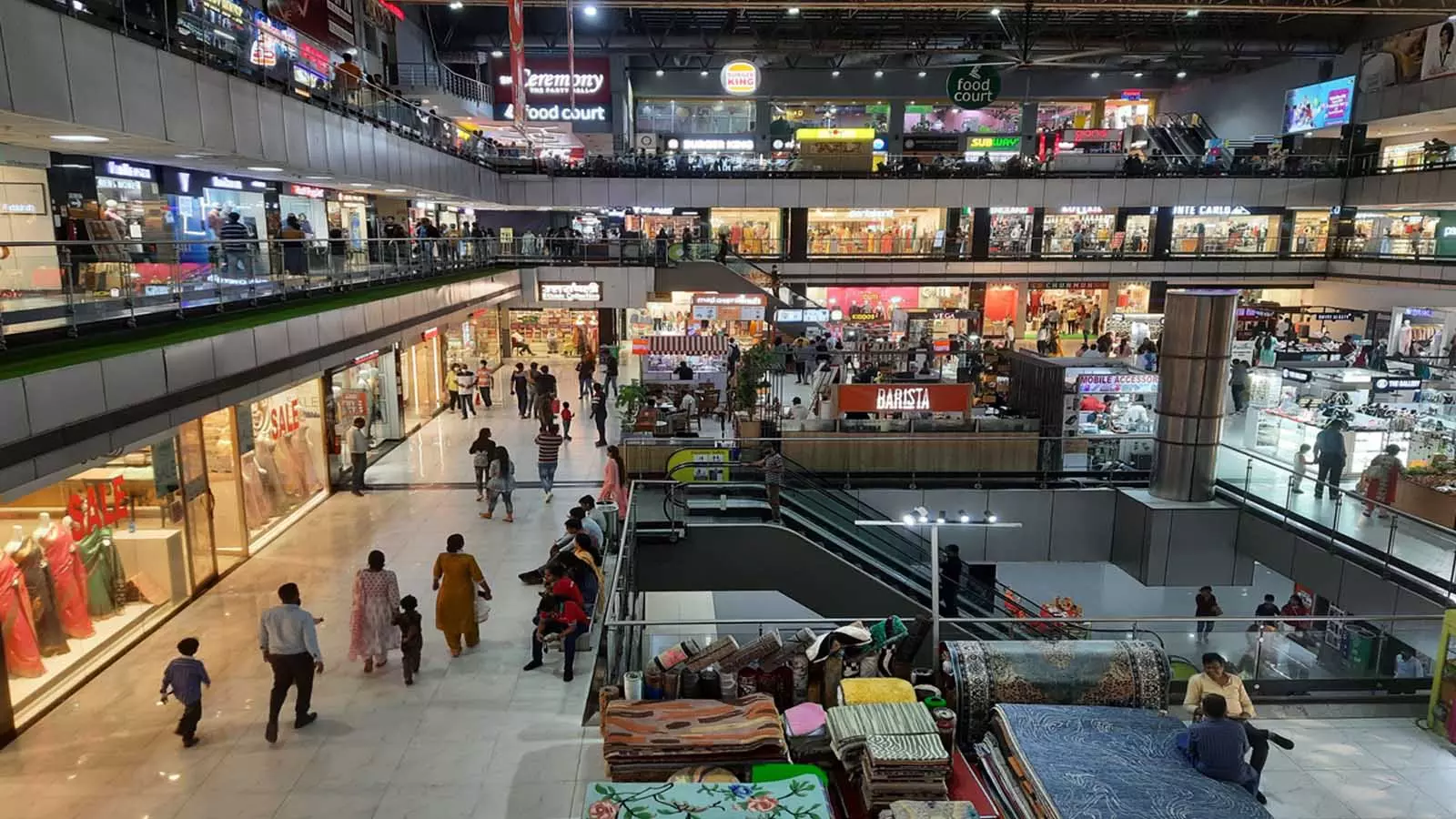
India’s mall market shifts from expansion to experience-led destinations
Falling mall vacancies and strong leasing point to a tighter market, but city-level divergences underline growing importance of supply discipline, asset quality, and consumer experience

India’s organised retail market is entering a tighter but increasingly differentiated phase, with falling mall vacancies, strong leasing demand, and a shift towards larger, experience-led retail destinations.
Yet the recovery is not uniform across cities: while Mumbai Metropolitan Region (MMR) is seeing tight Grade A mall occupancy amid strong leasing and no new supply, Delhi-NCR, with the largest Grade A mall stock and the bulk of new mall supply, has the highest vacancy among the seven major markets.
Two recent industry reports — Anarock Research & Advisory’s Retail Real Estate Monitor and CRE Matrix’s India Real Estate Horizons: Retail 2026 — point to the same broad trend from different datasets: India's retail market is moving from a phase of simply adding space to one increasingly defined by supply discipline, tenant mix, asset quality, and consumer experience.
Grade A mall vacancy falls to 5-year low
Anarock's data shows Grade A mall vacancy across India's top seven cities falling to 5 per cent in H1 2026, from more than 7.5 per cent at the end of 2025 and 15.5 per cent in 2021. The report describes this as the lowest vacancy level in the last five years.
The city-level numbers, however, reveal a wide divergence.
Kolkata recorded the lowest vacancy at 1.3 per cent, followed by Pune at 3.5 per cent. Bengaluru, MMR, and Hyderabad were each at 4 per cent, Chennai at 6 per cent, and Delhi-NCR at 7 per cent.
Also Read: 64 ghost malls are now present in 8 cities in 2023
The spread from 1.3 per cent in Kolkata to 7 per cent in NCR means that vacancy levels differ by more than five times across the seven markets.
Anarock says six of the seven cities recorded a further 60-basis-point decline in vacancy quarter-on-quarter. Chennai was the exception, with vacancy edging up marginally in Q2 2026.
The data suggests that the tightening in mall occupancy is broad-based, but the underlying reasons differ by city.
MMR combines strong leasing with no new mall supply
MMR offers the clearest example of demand meeting constrained supply.
Grade A mall vacancy in the region stood at 4 per cent in H1 2026. At the same time, MMR recorded 0.65 million sq ft of leasing in Q2 2026, the highest among the cities tracked by Anarock.
Crucially, there was no new mall supply in MMR during Q2 2026.
“MMR’s 4 per cent vacancy in H1 2026 came without a single square foot of new mall supply hitting the market in Q2 2026 even as MMR, at 0.65 Mn sq ft, saw the highest leasing volume of all tracked cities,” said Anuj Kejriwal, CEO-Retail & CEO-Europe, Middle East & Africa, ANAROCK Group.
Also Read: Lulu Mall in Vijayawada: Andhra govt cancels land allotment amid controversy
Entertainment, fashion, and apparel led MMR's leasing, followed by food & beverage (F&B). Malls also accounted for a larger share of leasing than high streets.
The region's rental market showed strength as well. According to Anarock, Linking Road recorded a 20 per cent year-on-year rental increase, with monthly rents of Rs 1,000-1,500 per sq ft — the highest single-corridor rental growth cited in the report.
NCR has largest stock and highest vacancy
Delhi-NCR presents the opposite supply equation.
Anarock puts the region's Grade A mall stock at approximately 19.42 million sq ft, the highest among the seven markets. MMR follows with 14.81 million sq ft.
NCR recorded the highest Grade A mall vacancy at 7 per cent.
The market also received approximately 0.90 million sq ft of new mall supply in Q2 2026, the highest among the seven cities. Pune was the only other market to receive new mall supply, at around 0.20 million sq ft.
NCR's quarterly leasing volume, at 0.20 million sq ft, was around one-third of MMR's 0.65 million sq ft.
Also Read: Retail sales in malls to grow 29% annually to reach $39 bn by FY28
Gurugram accounted for the largest share of NCR leasing, followed by Delhi and Noida. Malls contributed more than 60 per cent of quarterly activity, while fashion, F&B, and departmental stores were among the leading categories driving absorption.
Kejriwal attributes the difference between MMR and NCR partly to their respective Grade A mall stock.
“More than seen in recent years, organised retail across cities is being shaped by different supply pipelines, tenant mixes, and demand drivers,” he said. “The current available Grade A mall stock in MMR and NCR explains why these two largest markets posted a 3-percentage-point vacancy gap.”
Larger organised retail ecosystem
The CRE Matrix report broadens the picture beyond Grade A malls.
Across 12 tracked Indian markets, organised retail stock stands at 186.2 million sq ft, comprising 114.3 msf of shopping malls, 51.7 msf of Office-Led Amenity Retail, and 20.2 msf of high streets.
Bengaluru has the largest overall organised retail stock at 29.2 msf, followed by Gurugram at 27.4 msf, Hyderabad at 24.8 msf, and Mumbai at 23.8 msf.
This dataset is broader than Anarock's seven-city Grade A mall analysis.
Therefore, the two sets of vacancy and stock figures should not be directly combined. Instead, they provide complementary views of the market: Anarock focuses on Grade A mall performance across seven major cities, while CRE Matrix looks at the wider organised retail ecosystem across 12 markets.
Next mall cycle set to be bigger
One of the strongest common themes in the two reports is the changing nature of retail supply.
CRE Matrix estimates 40.4 msf of upcoming shopping mall supply through 2030, with Hyderabad and Gurugram together accounting for 51 per cent of the identified pipeline.
The average size of new shopping malls is projected to rise sharply — from 0.25 msf in the pre-2000 era to 0.59 msf during 2026-30.
Also Read: Report forecasts retail market to reach USD 2 trillion by 2032
CRE Matrix says the shift points towards larger, destination-led assets capable of supporting a wider mix of fashion, dining, entertainment, leisure, and wellness.
That is significant in the context of Anarock's leasing data. The markets where malls are seeing demand are increasingly being driven by categories that depend on footfall, dwell time, and consumer experience rather than simply conventional retail transactions.
Experience-led retail gains ground
The tenant mix has changed substantially over the past decade.
CRE Matrix estimates that experience-led categories — including fashion, F&B, entertainment, leisure, and wellness — accounted for 72 per cent of mall leasing, compared with 54 per cent a decade earlier. Within this, Apparel & Fashion increased its share from 25 per cent to 35 per cent, while F&B rose from 11 per cent to 15 per cent.
At the same time, Department Stores & MBR and Essentials & Grocery together declined from 31 per cent to 11 per cent of leasing demand.
This suggests that the role of the mall is evolving. Traditional anchors remain part of the retail ecosystem, but a larger proportion of leasing is being allocated to categories designed to encourage visits, engagement, and longer stays.
Office-led retail becomes a third pillar
The CRE Matrix report also highlights the rise of Office-Led Amenity Retail, which has reached 51.7 msf across the tracked markets, with a record 15.4 msf being added between 2021 and 2025.
Gurugram leads this segment with 10 msf, followed by Mumbai at 8.4 msf, Pune at 7.4 msf, and Bengaluru at 7.1 msf.
Also Read: Lulu Group to invest ₹3,000 cr to set up India's biggest mall at Ahmedabad
The growth reflects the increasing overlap between workplaces and consumption. Office developments are incorporating restaurants, cafés, convenience retail, fitness, and other consumer services, creating an organised retail format distinct from conventional shopping malls.
Retail markets becoming city-specific
The two reports also highlight why headline national numbers can mask significant differences between markets.
Kolkata's 1.3 per cent Grade A mall vacancy came without new mall supply, while Pune's 3.5 per cent vacancy was accompanied by 0.20 msf of new supply and 0.50 msf of leasing in Q2.
Bengaluru and Hyderabad both recorded 4 per cent vacancy, but their leasing drivers differed. Bengaluru's demand was led by high-street fashion, accessories and furniture, while Hyderabad's was driven by fashion and apparel and F&B.
Chennai had 6 per cent vacancy and the lowest quarterly leasing volume at 0.06 msf, although Anarock reported strong rental growth on Anna Nagar and Velachery high streets.
CRE Matrix similarly finds substantial differences in rents and vacancy across markets. In its 12-market dataset, shopping mall rents range from Rs 140 per sq ft per month in Ghaziabad to Rs 438 in Mumbai, while Grade A mall vacancy ranges from 1 per cent in Thane to 13.6 per cent in Gurugram.
Market moving from expansion to differentiation
Taken together, Anarock and CRE Matrix show an Indian retail market that is expanding, but not uniformly.
The immediate picture is one of tightening Grade A mall vacancy and strong leasing demand, particularly where new supply remains limited. The medium-term picture is one of larger malls, concentrated development pipelines, and a greater emphasis on experience-led categories.
The challenge for the next cycle will therefore not simply be to add retail space. The more consequential question will be whether new supply is aligned with the right catchments, tenant categories, and consumer demand.
Also Read: Why Vijay govt’s move to empower CMDA must come with transparency checks
For NCR, the 7 per cent vacancy alongside 19.42 msf of Grade A stock and 0.90 msf of new Q2 supply illustrates the importance of absorption relative to additions. MMR, meanwhile, demonstrates what happens when leasing demand meets a market with no new mall supply in the quarter.
The common thread is increasingly clear: India's retail real estate market is becoming larger, but also more selective.
As the next 40.4 msf of mall supply takes shape, the market will increasingly be differentiated not by the amount of space created, but by the quality of the asset, its catchment, its tenant mix, and its ability to function as a destination for consumers.