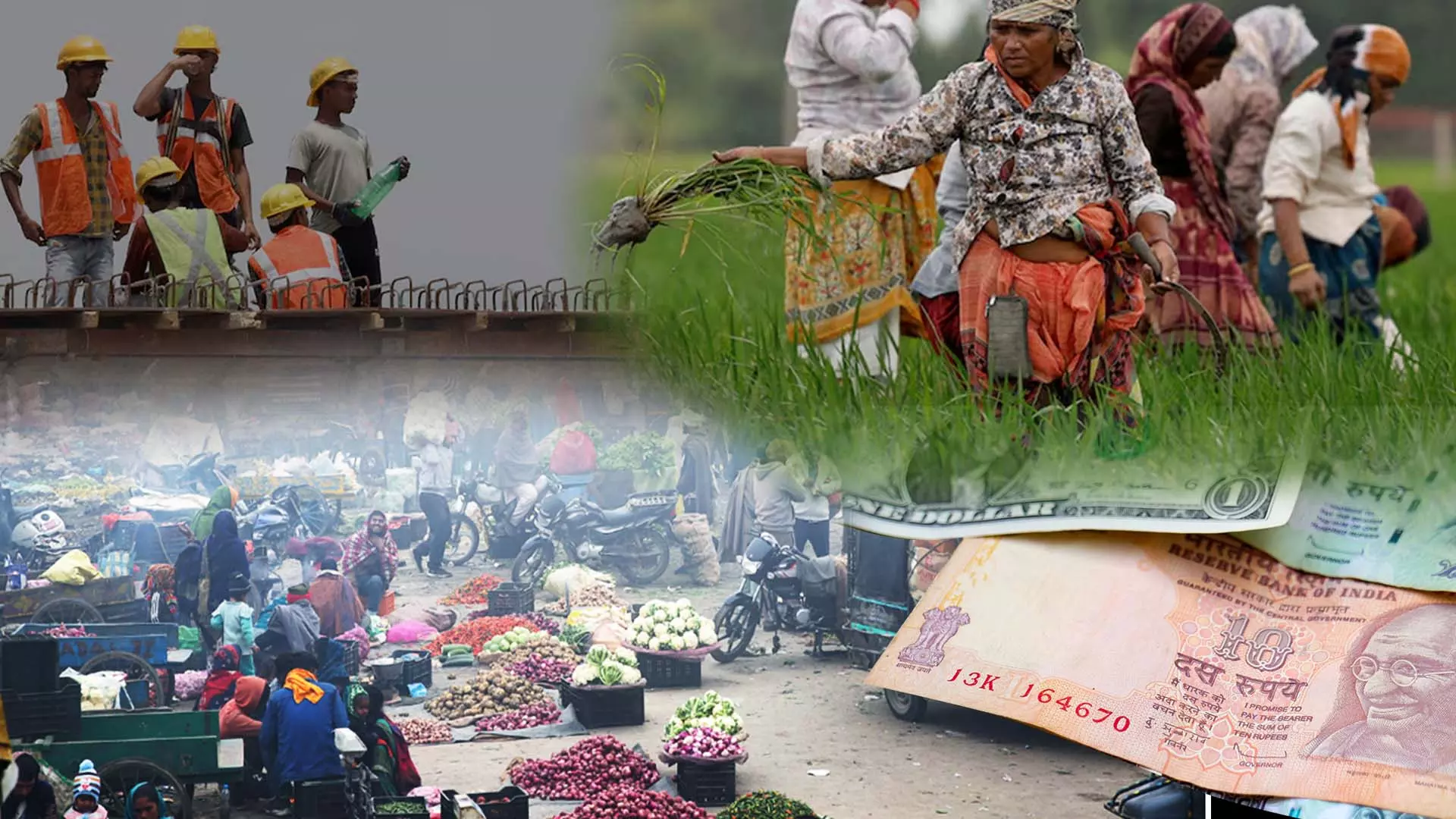
India's paradox: Rising economic indicators vs falling standard of living
2026 unlikely to be better, with no indication of quality jobs or rising wages; MGNREGA, a safety net that supports 80-90 million people, has been weakened, too

As 2025 comes to an end, India stands out as one of the world’s fastest-growing economies, with government data showing a rebound in growth. Yet, behind the strong GDP numbers, many Indians continue to struggle with rising expenses, stagnant incomes, and growing dependence on state support.
This contradiction raises a critical question. If the economy is performing well, why are elections being won through cash handouts and subsidies, and why are households finding it difficult to make ends meet?
An examination of wages, spending, debt, and jobs in 2025 suggests that headline growth figures do not fully reflect the lived economic reality of millions of Indians.
Cash handouts
In November 2025, just days before the Model Code of Conduct came into force, Bihar began distributing Rs 10,000 in cash to women, a scheme that continued through the election period. Around 15.1 million women received the money, followed by a record turnout of women voters.
Similar women-focused cash schemes have played a role in electoral victories in Maharashtra, Assam, and other states. Across India, millions now depend on cash transfers, free food grains, and subsidies to manage daily expenses.
The Federal's Business Editor Prasanna Mohanty pointed to the scale of state support. “More than 80 crore Indians get free ration, more than 100 million get PM Kisan Rs 6,000. Now, increasingly, 16 states are giving cash handouts to women,” he said. “What the GDP numbers show are not the right ones. The actual financial health has gone down.”
Wages stagnate
While growth numbers remained strong on paper, household incomes failed to keep pace with the cost of living. One of the most striking features of 2025 was extremely low inflation, which initially appeared positive but reflected weak consumer demand.
Nominal wages rose by only about 2 per cent, while real wage growth hovered close to zero. This meant incomes stagnated even as everyday expenses continued to rise.
Mohanty explained the concern. “Low inflation, particularly when it falls below 2 per cent, is a red flag,” he said. Citing recent SBI research, he added that real wage growth had fallen to around 0.5 per cent, leading to weak consumption and production.
Rising debt
With incomes stalled, families increasingly turned to borrowing. Household debt climbed to one of the highest levels seen in recent years, while net household savings declined as people dipped into assets such as gold and long-term savings.
This trend indicated that many households were no longer saving for the future but borrowing to manage present needs.
According to Prasanna Mohanty, “The latest RBI data shows that household debts have gone up to 41 percent of GDP. Financial health of households is actually declining, that is why debts are rising and total assets are falling.”
Job quality
Employment numbers did rise in 2025, but job quality worsened. Contractual and informal employment reached record levels, particularly in manufacturing, with many new jobs offering low wages and little or no social protection.
Prasanna Mohanty said data from organised manufacturing showed contractual work rising to a 27-year high of 42 percent. “This means low wages, no social security, no job security,” he said, noting that wage growth remained around 0.5 percent and that nearly 20 percent of workers were unpaid.
Rupee pressure
The rupee weakened sharply in 2025, crossing the 90-rupees-per-dollar mark multiple times. This made imports costlier and quietly pushed up prices of fuel, electronics, and other consumer goods.
At the same time, stock market returns, an important income source for many middle-class households, remained weaker than long-term averages.
“When the rupee falls, foreign investors’ returns go down, so they pull out more money,” Prasanna Mohanty said, adding that domestic investment also remained far below levels seen over a decade ago.
As concerns shift to 2026, economists point to the weakening of MNREGA, the rural employment guarantee scheme that has served as a safety net for nearly two decades.
Prasanna Mohanty warned that there was little indication of improvement. “There is no reason to believe that 2026 will be better because there is no indication of quality jobs or wages going up,” he said. He added that MNREGA supports 80 to 90 million individuals and that weakening this safety net could further reduce consumption and slow growth.
As 2025 closes, the numbers tell one story while daily life tells another. Growth returned, but wages stagnated. Jobs increased, but security declined. Millions relied on handouts to get through the year. The key question now is whether 2026 will bridge this gap or widen it further.
The content above has been transcribed from video using a fine-tuned AI model. To ensure accuracy, quality, and editorial integrity, we employ a Human-In-The-Loop (HITL) process. While AI assists in creating the initial draft, our experienced editorial team carefully reviews, edits, and refines the content before publication. At The Federal, we combine the efficiency of AI with the expertise of human editors to deliver reliable and insightful journalism.