



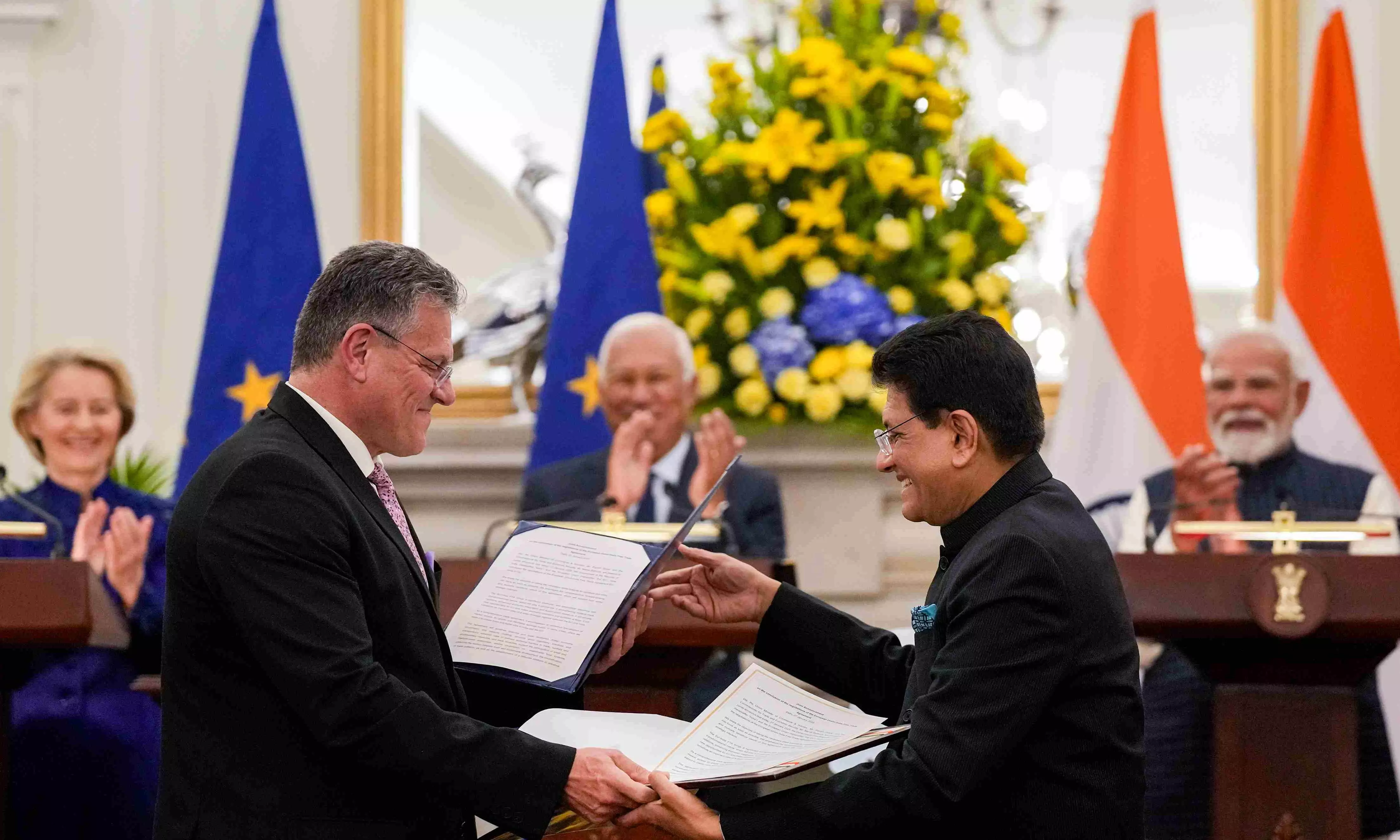
Union Minister of Commerce & Industry Piyush Goyal (right) and European Commissioner for Trade & Economic Security Maros Sefcovic exchange documents during a joint press statement after a meeting between Prime Minister Narendra Modi, European Council President Antonio Costa and European Commission President Ursula von der Leyen, at the Hyderabad House, in New Delhi on January 27. Photo: PTI
India-EU FTA credit positive, to boost manufacturing and exports: Moody’s
Rating agency says Tuesday's landmark trade deal will boost foreign investment and competitiveness, giving 93 per cent of Indian goods duty-free access to bloc

The India-EU free trade pact, signed on Tuesday (January 27), will be credit positive for India as lower tariffs and better market access will help attract foreign investment, boost manufacturing and improve export competitiveness of the labour intensive sector, Moody's Ratings said.
India and the European Union had announced the conclusion of negotiations for the Free Trade Agreement (FTA), described as 'mother of all deals', under which 93 per cent of Indian shipments will enjoy duty-free access to the 27-nation bloc, while import of luxury cars and wines from the EU will become less expensive.
India-EU trade relations
Concluded after nearly two decades of negotiations, the deal will create a combined market of about two billion people, spanning India - the world’s fourth-largest economy - and the European Union, the second-largest economic bloc.
Also read: Partnership or predation? How the India-EU FTA tilts the playing field
In a commentary, Moody's Ratings said India's conclusion of its trade negotiations with the EU reflects its continued efforts to selectively diversify trade relationships.
"When in effect, the FTA will be credit positive, with lower tariffs and better market access supporting India’s ambition to develop its manufacturing sector, attract foreign investment, and strengthen the export competitiveness of its labour intensive goods," Moody's said on Wednesday (January 28).
The free trade pact is expected to be formally signed and implemented later this year.
Market access
Moody's Ratings said lower tariffs on EU imports may also help ease costs, although such imports remain a smaller share of India’s overall import bill.
"European carmakers would gain easier access to the world’s third‑largest car market, allowing them to introduce more premium models under a calibrated liberalisation framework - an opportunity for EU brands but adding competition for Indian manufacturers," Moody's said.
Also read: India-EU FTA: Good beginning, but don’t count the chickens yet
The broader benefits of the FTA will hinge on progress in complementary areas such as improving business friendliness and streamlining regulations, it added. Once the agreement is implemented, except for auto and steel, almost all the Indian goods (over 93 per cent) from India will get zero-duty access in the European Union, while for the remaining over 6 per cent, Indian exporters will receive tariff reductions and quota-based duty concessions, including for products such as automobiles.
Tariffs on Indian goods
The average tariffs of the EU on Indian goods are already low at around 3.8 per cent and will be reduced to 0.1 per cent under the deal.
But in some sectors, the duties are high. These are marine (0-26 per cent); chemicals (up to 12.8 per cent); plastics and rubber (up to 6.5 per cent); leather and footwear (up to 17 per cent); textiles, apparel and clothing (up to 12 per cent); gems and jewellery (up to 4 per cent); railway components, aircraft parts, ships, boats (up to 7.7 per cent); furniture and light consumer goods (up to 10.5 per cent); toys (up to 4.7 per cent); and sports goods (up to 4.7 per cent).
Also read: India–EU FTA decoded: Trade expert Biswajit Dhar on winners, losers, and hidden risks
On all these items, the EU will eliminate duties for India.
Duty on EU goods
On the other hand, the EU will get duty-free access for over 90 per cent of its goods over a ten-year period in India. India will remove duties on only 30 per cent of European goods on the first day of implementation of the pact.
The main EU goods that will get duty concessions include automobiles, wines, spirits, beer, olive oil, kiwis and pears, fruit juices, processed foods like breads, pastries, biscuits, pasta, chocolate, pet food, sheep meat, sausages and other meat preparations.
These goods, at present, attract duties in the range of 33 per cent to 150 per cent.
Also read: India-EU FTA sends strong global cooperation message: European Commission chief