



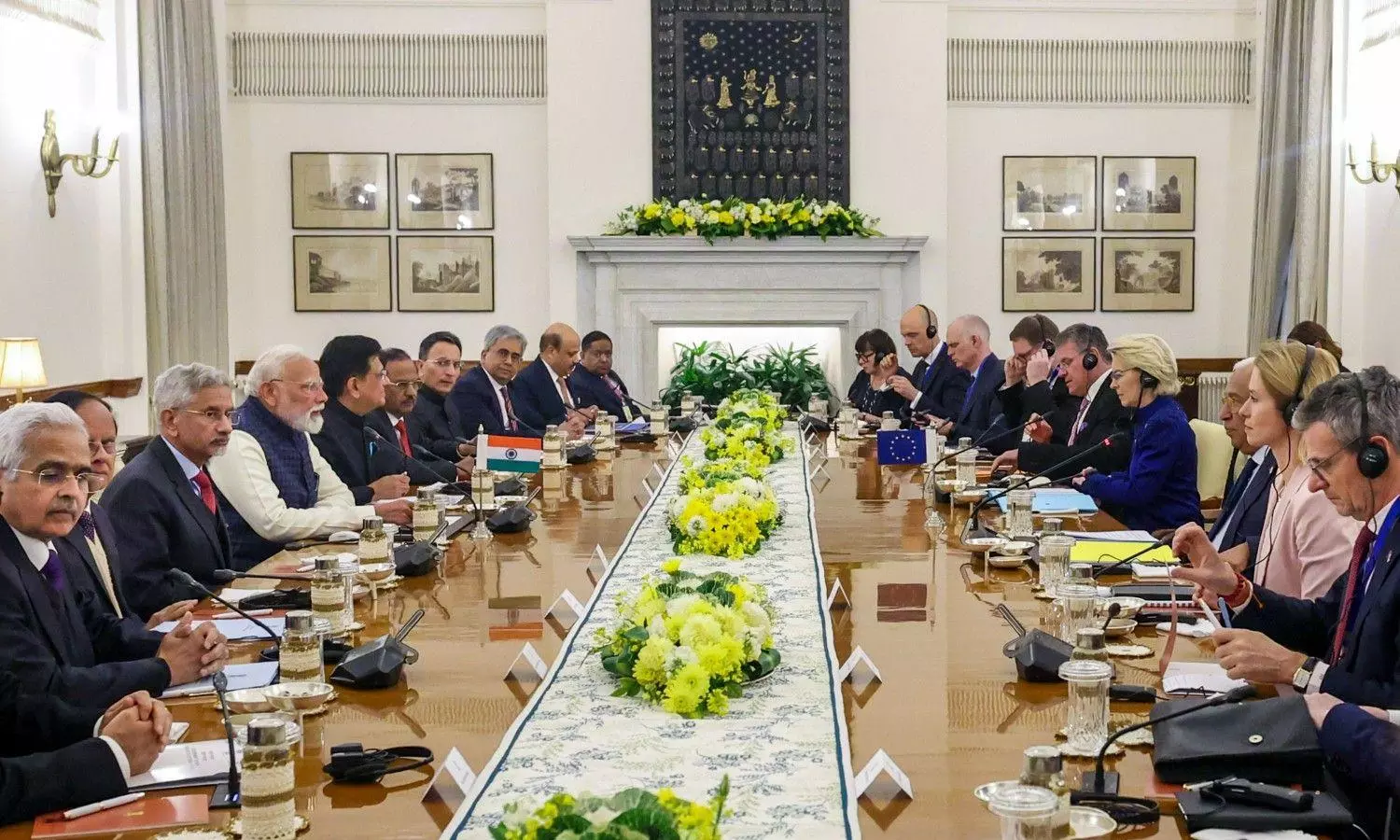
In this image received on January 27, Prime Minister Narendra Modi with European Council President Antonio Costa, European Commission President Ursula von der Leyen and other dignitaries during a delegation-level meeting, in New Delhi. (PMO via PTI Photo)
India-EU FTA: Tariffs on European cars to be gradually cut to 10 pc from 110 pc
India and Europe have concluded the "mother of all" trade deals, European Commission President Ursula von der Leyen said

Prime Minister Narendra Modi on Tuesday (January 27) announced that India and the European Union (EU) have reached a free trade agreement (FTA), saying it accounts for 25 per cent of global GDP and one-third of global trade.
India and Europe have concluded the "mother of all" trade deals, European Commission President Ursula von der Leyen said.
Also read: US Commerce Secretary slams India-EU trade deal over Russian oil purchases
"Europe and India are making history today. We have concluded the mother of all deals. We have created a free trade zone of two billion people, with both sides set to benefit," Von der Leyen said.
Tariffs on cars
As part of the FTA, India plans to gradually cut tariffs on cars imported from the EU to 10 per cent from 110 per cent for a yearly quota of 250,000 vehicles.
"India will grant the EU tariff reductions that none of its other trading partners have received. For example, tariffs on cars are gradually going down from 110% to as low as 10%, while they will be fully abolished for car parts after five to ten years. Tariffs ranging up to 44% on machinery, 22% on chemicals and 11% on pharmaceuticals will also be mostly eliminated," EU said in a statement.
The agreement removes or reduces often prohibitive tariffs (over 36 per cent on average) on EU exports of agri-food products, opening a massive market to European farmers. For example, Indian tariffs on wines will be cut from 150 per cent to 75 per cent at entry into force and eventually to levels as low as 20 per cent, tariffs on olive oil will go down from 45 per cent to 0 per cent over five years, while processed agricultural products such as bread and confectionary will see tariffs of up to 50 per cent eliminated.
The 27-nation bloc said that sensitive European agricultural sectors will be fully protected, as products such as beef, chicken meat, rice and sugar are excluded from liberalisation in the agreement. All Indian imports will continue to have to respect the EU's strict health and food safety rules.
What Modi said
Earlier, Modi hosted Von der Leyen and European Council President Antonio Costa for summit talks in Delhi against the backdrop of new fissures in ties between Europe and the US.
People are discussing it as a "mother of all deals”, and this agreement has brought a lot of opportunities for 140 crore Indians and crores of Europeans, he said while addressing the Indian Energy Week virtually.
Modi congratulated all on the EU-India trade deal and said, "I am informing you about a big development...kal hee Bharat aur European Union ke beech ek bahut bada agreement hua hai (yesterday a very big agreement has been reached between India and the European Union).
"This is an excellent example of coordination between two economies of the world. This agreement represents 25 per cent of the global GDP and one third of the global trade," he said.
The EU and India had first launched negotiations for the free trade agreement in 2007, before the talks were suspended in 2013 due to a gap in ambition. The negotiations were relaunched in June 2022.
The EU, as a bloc, is India's largest trading partner in goods. For the financial year 2024-25, India's total trade in goods with the EU was worth about USD 136 billion, with exports around USD 76 billion and imports at USD 60 billion.