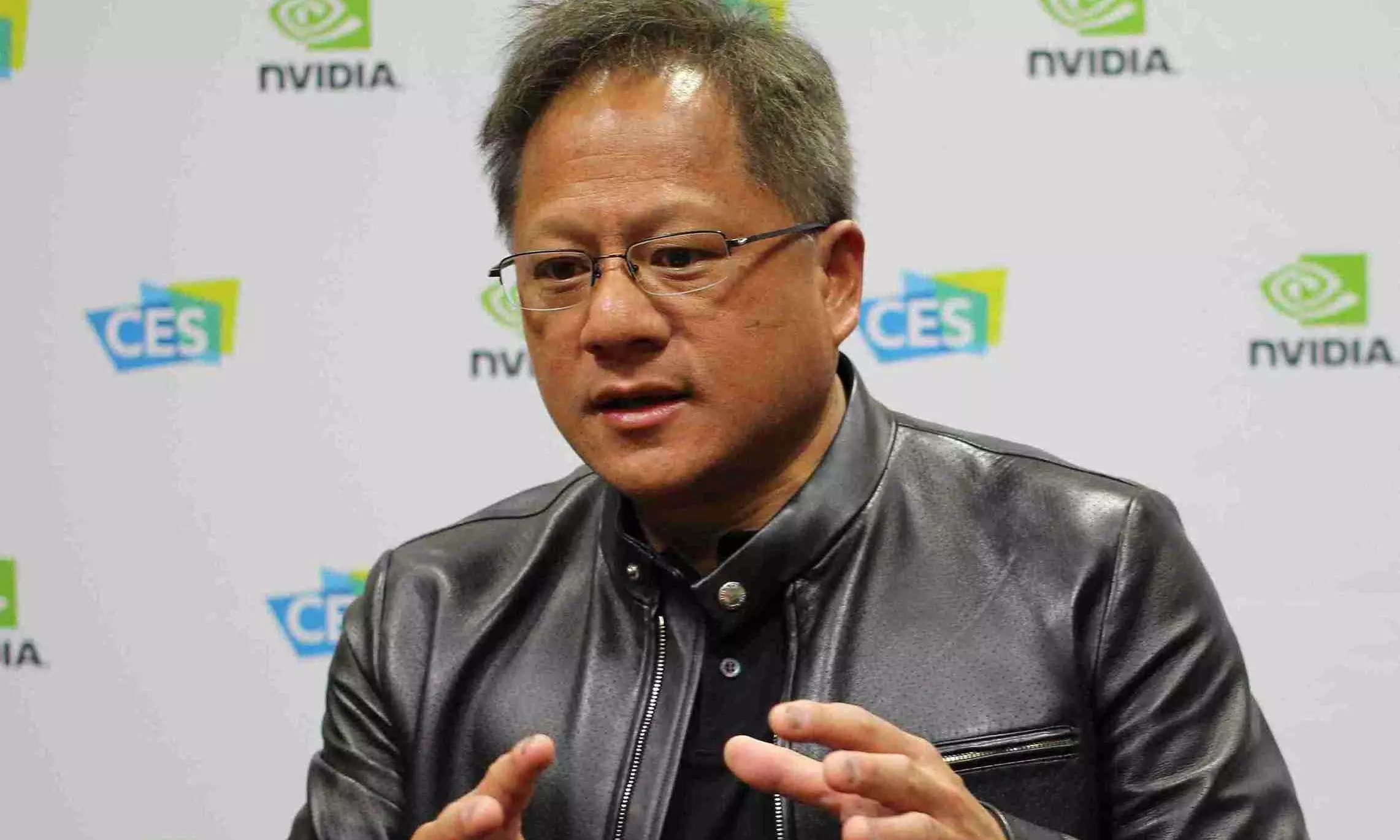
Huang under probe: What next for Nvidia and its investors?
An alleged intelligence link, scrutiny over $7.5 billion in AI-chip shipments, and a shareholder lawsuit thrust Nvidia and Jensen Huang into a geopolitical storm

Nvidia, the world’s leading artificial intelligence chipmaker, has found itself at the centre of a controversy that brings together corporate governance, alleged foreign intelligence activity and the intensifying technology rivalry between the United States and China.
The controversy centres on the company’s chief executive, Jensen Huang, whose reported relationship with a Chinese businesswoman has attracted the attention of US authorities. The issue has taken on greater significance following allegations that companies connected to the woman helped facilitate billions of dollars in Nvidia chip shipments to Chinese businesses, potentially raising questions about American export restrictions.
The developments have prompted Nvidia’s board to launch an independent investigation, drawn the attention of the Federal Bureau of Investigation (FBI) and triggered calls from US lawmakers for greater scrutiny of the company’s international business relationships.
Also read: Nvidia stock slides on CEO probe while Wall Street rallies on without it
Adding to the pressure, Nvidia and Huang are now facing a shareholder lawsuit alleging that investors were misled about information that could affect the company’s reputation and business prospects.
While the allegations remain under investigation, the controversy has raised a fundamental question: Could the world’s most influential AI chipmaker have been exposed to a foreign intelligence operation while operating within an increasingly sensitive global semiconductor supply chain?
Here is what is known so far.
What is the Nvidia controversy?
The controversy emerged following reports about Jensen Huang’s alleged relationship with Alice Huang, a Chinese businesswoman and former executive of Singapore-based cloud computing company Megaspeed International. The two are not related.
According to a report by The New York Times, US authorities concluded that Alice Huang was an asset of Chinese intelligence and had passed information to Beijing while developing a close relationship with the Nvidia chief executive. China has rejected the allegations.
Huang acknowledged in a communication to Nvidia employees that he had been unfaithful to his wife, without providing details of the relationship. The admission brought further attention to the issue, although the central concern for the company and US authorities is whether the relationship created any national security or corporate security risks.
Nvidia’s board announced on November 8 that it was initiating an independent investigation into reports that its founder and CEO had been targeted by a foreign intelligence operation.
The investigation will be overseen by independent directors with assistance from external legal counsel.
In its official statement, Nvidia’s board said it had no reason to believe that the company’s trade secrets or US national security interests had been compromised. Huang has committed to cooperating with the review.
Who is Alice Huang and what is her connection to Nvidia?
Alice Huang, also known as Huang Le, built her career in China’s financial sector before becoming involved in the semiconductor and cloud computing business.
According to a Reuters investigation, she held senior positions at Shanghai Hexi Investment Management before becoming the controlling shareholder of Singapore-based Megaspeed International in March 2023.
Megaspeed provides cloud computing services and is listed by Nvidia as an official cloud partner in the Asia-Pacific region.
Also read: Gaming chips to AI dominance: What Huang built, and what Nvidia now risks losing
Cloud partners are important to Nvidia because they purchase and deploy its processors in data centres, allowing customers to access computing capacity without necessarily purchasing the hardware themselves.
Megaspeed attracted scrutiny in October 2025 after The New York Times reported that US authorities were investigating whether it had helped Chinese customers obtain advanced Nvidia processors restricted under American export controls.
Reuters reviewed shipping records showing that Megaspeed’s Indonesian subsidiary imported Nvidia hardware, including H100 processors and related components, between 2024 and 2026.
However, shipments to Indonesia do not, by themselves, establish that export-control rules were violated.
The $7.5-billion Nvidia chip shipment allegations
The most significant commercial dimension of the controversy emerged on November 10.
Technology publication The Information reported that Alice Huang, along with her husband and sister, had built a network of companies across China and Singapore to acquire Nvidia processors for Chinese customers.
Citing two people familiar with her, the publication alleged that the network facilitated at least $7.5 billion in Nvidia chip shipments to Chinese businesses.
The report put the number of processors involved at approximately 240,000, including H100, H200 and some A100 chips.
According to the report, the network centred on Shanghai Century Litong, a Chinese company that obtained preferred cloud partner status with Nvidia by October 2023, giving it priority access to processors.
When orders for chips subject to US export restrictions encountered difficulties, Alice Huang reportedly used her relationships with Nvidia and its distributors to help secure supplies.
The report said the computing capacity was subsequently used by Chinese technology companies, including Alibaba and Tencent, as well as smaller AI developers.
Singapore-based Megaspeed and its regional business connections also featured in the reported supply network.
However, the figures and alleged connections do not establish that Nvidia knowingly authorised illegal shipments or that Jensen Huang personally participated in any export-control violation.
Why does the US restrict Nvidia chip exports to China?
To understand the seriousness of the allegations, it is important to understand the strategic importance of Nvidia’s products.
Nvidia designs graphics processing units, commonly known as GPUs. These processors can perform large numbers of calculations simultaneously, making them particularly effective for training and operating artificial intelligence models.
Its H100 and H200 processors are among the company’s important data-centre products.
Also read: Nvidia opens probe into CEO Jensen Huang’s ‘affair’ with Chinese spy
Advanced AI computing has applications beyond commercial technology. It can also support military research, intelligence analysis, surveillance and other strategically sensitive activities.
The US government has, therefore, imposed restrictions on the export of certain advanced semiconductor products and related technologies to China.
Washington’s objective is to prevent China from gaining access to computing capabilities that could accelerate its military modernisation and strategic AI development.
The restrictions have created a difficult commercial environment for Nvidia, which has historically sought to serve customers across major international technology markets.
The reported movement of restricted processors through intermediaries has consequently become a matter of national security interest.
What is the FBI investigating?
US President Donald Trump said on November 9 that the FBI was looking into the matter involving Huang and Alice.
Trump reportedly said he had spoken to the Nvidia CEO, who told him he had no knowledge that the woman was allegedly a Chinese intelligence operative.
The FBI’s reported involvement adds a federal investigative dimension to the controversy. However, the precise scope and status of its examination have not been publicly established in detail.
China has rejected the espionage allegations, describing them as unsubstantiated.
The issue has also prompted US lawmakers to seek explanations from Nvidia about its security procedures and relationships with overseas business partners.
On November 5, Republican lawmakers Brian Mast, John Moolenaar and Eric Crawford requested a closed-door briefing from Huang, scheduled for November 18.
They cited concerns about China’s potential access to sensitive American technology and asked for information about Nvidia’s safeguards against foreign intelligence activity.
Nvidia has maintained that its CEO meets thousands of customer executives annually and that ordinary business interactions do not involve the disclosure of sensitive trade secrets or national security information.
Nvidia faces shareholder lawsuit
The controversy escalated further on November 9 when Nvidia and Jensen Huang were sued in a proposed shareholder class action in federal court in San Jose, California.
According to Reuters, the complaint alleges that the company and its CEO misled shareholders by failing to disclose information concerning Huang’s reported relationship with Alice Huang and the potential national security implications.
The plaintiffs argue that the developments could damage Nvidia’s reputation and affect its business prospects.
Also read: Nvidia unveils N1X chip for Windows PCs, takes on Intel, AMD and Qualcomm
The lawsuit seeks unspecified damages.
It is important to distinguish the claims in the complaint from established legal findings. The filing does not establish that Nvidia committed fraud or that Huang knowingly participated in any intelligence operation.
Nevertheless, the lawsuit introduces another challenge for Nvidia, potentially extending the controversy from regulatory and reputational scrutiny into shareholder litigation.
How has the controversy affected Nvidia shares?
Investors have also reacted to the growing uncertainty.
Nvidia shares fell 4.3% on November 9, closing at $178.67, according to Reuters. The decline reduced the company’s market capitalisation by approximately $190 billion.
The stock movement came after the company’s announcement of an independent investigation and amid reports of potential national security concerns.
Investors are likely to remain focused on three issues: whether the investigation identifies any compromise of sensitive information, whether US authorities introduce additional restrictions and whether the controversy affects Huang’s leadership or the company’s international business relationships.
However, the share-price decline should not be attributed entirely to the allegations without considering broader market conditions.
What happens next for Nvidia?
The immediate focus will be on the findings of Nvidia’s independent investigation and any further information released by US authorities.
The November 18 congressional briefing requested by Republican lawmakers could provide another opportunity for the company to explain its international business relationships and security procedures.
The shareholder lawsuit will also require a legal response, while the reported chip distribution network is likely to attract continued scrutiny.
Also read: Who is Alice Huang, Chinese woman accused of honey-trapping Nvidia CEO Jensen Huang?
For Nvidia, the challenge is to demonstrate that its distribution arrangements are compliant with export regulations and that its sensitive corporate information remains protected.
The company must also reassure investors that the controversy will not undermine its leadership position in the global AI industry.
The bigger picture: Nvidia caught in the US-China AI race
The controversy illustrates how the global semiconductor business has become increasingly intertwined with geopolitics.
Nvidia is no longer simply a chip designer serving technology companies. Its processors have become essential infrastructure for the development of advanced artificial intelligence, giving the company an unusually important position in the competition between Washington and Beijing.
The United States wants to maintain its technological advantage by limiting China’s access to the most advanced computing systems. China, meanwhile, is investing heavily in domestic semiconductor capabilities to reduce its dependence on American suppliers.
For Nvidia, these competing priorities create a complicated business environment. It must operate across global markets while complying with export restrictions and addressing growing scrutiny of its international partners.
The latest controversy has brought these challenges into sharp focus.
At present, there is no established public finding that Jensen Huang knowingly assisted a foreign intelligence operation or that Nvidia deliberately violated US export controls. Those questions remain subject to investigation and legal scrutiny.
But the episode has already demonstrated the extent to which corporate governance, executive relationships and semiconductor supply chains can become matters of national security.
For Nvidia and its investors, the next phase will be determined not by the allegations alone, but by what the investigations and subsequent legal proceedings establish.