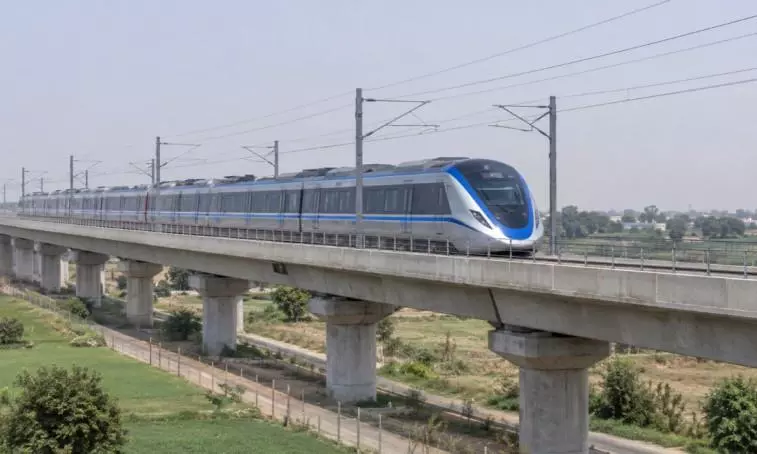
How Delhi-Panipat-Karnal Namo Bharat corridor could reshape NCR property market
Proposed 136.3-km corridor could expand residential catchments across Haryana and NCR, improve access to employment hubs, create fresh real estate opportunities

The proposed Delhi-Panipat-Karnal Namo Bharat corridor is drawing attention not only for its potential to shorten journeys across North India’s busiest economic belt, but also for the way it could influence the next phase of urban and real estate growth in the National Capital Region (NCR).
Planned along the National Highway 44 axis, the 136.3-km corridor is intended to connect Delhi with Sonipat, Panipat and Karnal. The project is estimated to cost about Rs 33,051 crore, with a target of completion by 2030, according to media reports. The proposed service is expected to bring the Delhi-Panipat journey (~90 km) closer to an hour and the Delhi-Karnal trip (~123 km) to around 90 minutes.
The corridor should also be viewed as part of a wider regional network. Interchanges at Sarai Kale Khan and Kashmere Gate are intended to connect passengers with rail, bus and Metro services. In Haryana, links with industrial areas and road infrastructure could improve access to jobs and markets. The quality of these connections will determine how widely the benefits are distributed locally.
How the corridor could reshape NCR's property market
For the property market, the corridor could make locations farther from Delhi more attractive to people working in the capital and other NCR centres. Faster public transport can change the trade-off between workplace proximity, housing costs and living space, while making corridor locations more relevant to employers and service businesses.
Growth is unlikely to be uniform. Areas close to stations, employment clusters and supporting roads may be better placed to attract demand. Schools, healthcare, retail, public spaces and last-mile transport will determine whether new catchments become liveable neighbourhoods or speculative propositions.
Also read: India’s real estate market heads into 2027 with strong demand for premium housing
Robin Mangla, President of M3M India, said the corridor could help integrate economic centres across the NCR and Haryana, gradually expanding the residential catchment for premium and luxury housing. He said improved access to employment and commercial hubs would give homebuyers greater commuting flexibility and convenience, while creating opportunities for developers to plan destinations around changing preferences. In the premium segment, he added, accessibility would need to be matched by quality and lifestyle offerings.
TOD policy could guide development around stations
In September 2026, Haryana brought the route within its Transit-Oriented Development (TOD) policy, which encourages a mix of housing, workplaces and services around mass-transit nodes. With clear land-use rules and civic infrastructure, the framework could channel growth towards station areas.
Santosh Agarwal, Executive Director and CFO of Alpha Corp Development Limited, said the corridor, alongside expressways and other infrastructure, was improving the region’s accessibility and expanding its economic catchment. He said better links to emerging industrial and logistics hubs could support residential development beyond established urban pockets, with demand from both end-users and investors potentially strengthening as employment opportunities deepen. He expects the infrastructure pipeline to reshape the residential landscape across the Panipat-Karnal belt and open up new growth and investment opportunities.
Project execution remains key
That outlook will depend on execution. The National Capital Region Transport Corporation’s 2025-26 annual report said the revised detailed project report, incorporating the extension to Karnal and updated technical parameters, was awaiting approval from the Union government. It also noted that consultancy and enabling works had been awarded and were under way. However, preparatory work and inclusion under the TOD policy should not be mistaken for the commencement of full-scale construction or the start of commercial operations.
Also read: India's realty investment hits Rs 57,917 crore, but affordable housing lags
For developers, the corridor could broaden the geography for viable projects; for buyers, it may offer more choice between established NCR markets and emerging Haryana locations. But property appreciation is not guaranteed: Delivery timelines, station access, planning, utilities and the surrounding urban environment will shape outcomes.
The larger test for the Delhi-Panipat-Karnal Namo Bharat corridor, therefore, is whether faster regional mobility can be converted into balanced economic growth. If transport investment is supported by disciplined urban planning and job creation, the corridor could become more than a commuter link; it could help establish a connected network of residential and commercial centres across northern NCR.