







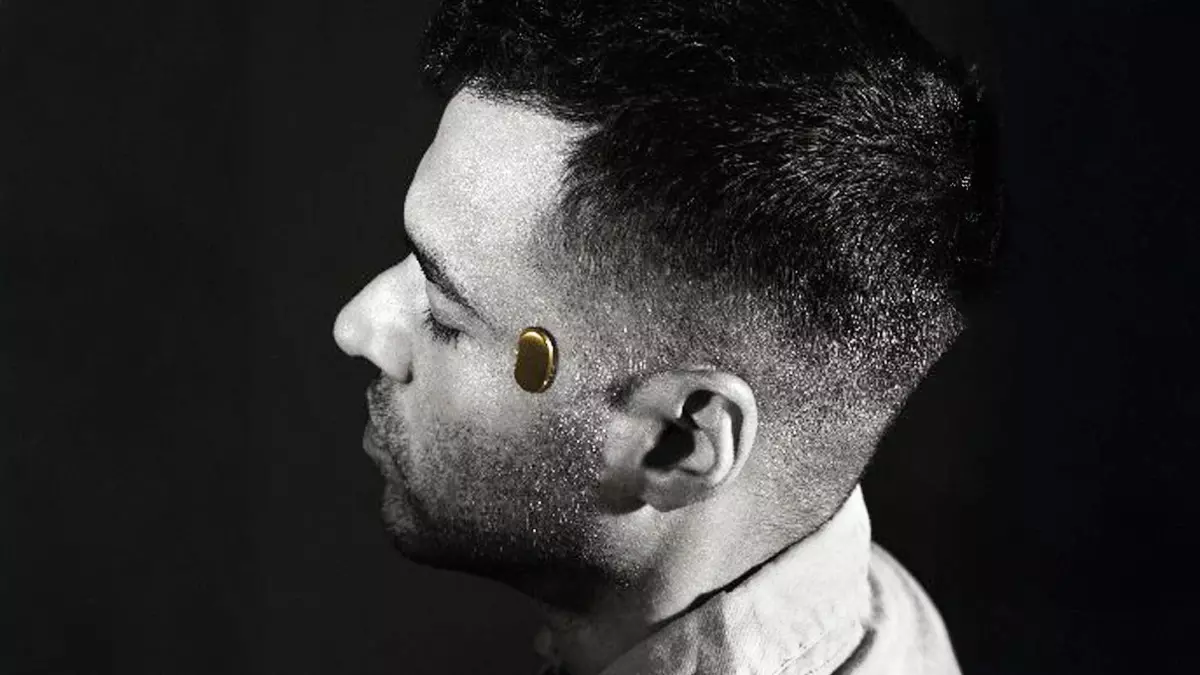
Deepinder Goyal wearing his Temple device. Photo: X/Deepinder Goyal
Why doctors are questioning Deepinder Goyal’s Rs 85,000 ‘Temple’ wearable
Goyal says Temple is a wellness gadget, not a medical device. Critics say its claims lack proof. Here is what we know

What is Temple?
Temple is a wearable device worn on the side of the forehead, near the temple. It uses light-based sensors to continuously track signals from the body.
Pre-orders opened in India on November 1, and deliveries are expected in about three months. For now, only a select group, including investors and people associated with Goyal, has early access. This includes high-profile athletes like PV Sindhu and Shubman Gill.
What does the device claim to measure?
It generates two main readings, both of which are the company’s own inventions:
BrainFlow: meant to track relative changes in blood circulation linked to the brain, continuously rather than through occasional clinic tests.
Entropy: a score from 1 to 250 showing how hard your body is working to keep itself going. Lower scores mean deeper rest, and higher scores mean more physiological strain. Sleep, exercise, stress, food, caffeine and meditation all affect it.
Goyal now calls Entropy the product’s main feature, and says BrainFlow was only the original reason for building the device.
What is the doctors’ main objection?
It comes down to anatomy. Temple uses a light-based technique called photoplethysmography (PPG), the same kind of sensor that reads your pulse in many smartwatches. Near the temple, it reads blood flow in the superficial temporal artery, which supplies the scalp and face.
Blood flow in the scalp can change with exercise or temperature without any change inside the brain. Doctors also say a single measurement spot may not represent the whole brain.
The loudest critic is hepatologist (liver specialist) Dr Cyriac Abby Philips, popularly known as TheLiverDoc. He has called the product a “scam” and accused the company of misleading buyers.
What evidence does Temple have?
Two preprints, both funded by the company. A preprint is a research paper shared publicly before it has been checked by independent experts. They report that BrainFlow tracks changes linked to brain circulation under controlled conditions.
Neither has been peer-reviewed, which means checked by outside experts, or independently replicated by other researchers.
What does Goyal say in response?
He has answered critics on X on several points.
On money and motive: Temple has spent USD 30 million, including USD 20 million of his own, and a 14-day no-questions-asked returns policy would expose a non-working product quickly. He argues a scam wouldn’t recover much of that cost from a few thousand sales. He also said sorry if the Rs 85,000 price upset people, adding that buyers can wait for user reviews before deciding.
On evidence: Wearable makers usually start with internal studies and publish validation later, he says, citing Whoop. He says Temple aims higher, with preprints followed by peer-reviewed work, and that buyers can wait for peer review.
On the science: The second preprint compared BrainFlow with a lab method called time-domain near-infrared spectroscopy, which can separate blood changes in the brain from those in the scalp. In a head-down tilt test, he says, BrainFlow matched the brain signal at 0.91 and the scalp signal at 0.49 (on a scale where 1 is a perfect match). His conclusion is that Temple “tracks the brain, much more than the scalp”.
He also cites a Doppler ultrasound study, which measures blood speed. When participants lay down, their heart rate fell and blood velocity in the brain’s arteries rose, and he says BrainFlow followed the Doppler. A device that only tracked heart rate would have missed this, he argues.
Is Temple a medical device?
No, says Goyal. He describes it as “a fitness tracker, and wellness device” and says it makes no medical claims and isn’t proven to diagnose or prevent disease.
He says the metrics still await clinical validation, meaning testing to show they are accurate and useful for health decisions. Any claim that needs regulatory clearance, he says, will come only after that clearance.
Has Goyal offered to prove it?
He has offered to loan devices to qualified researchers so they can test any Temple metric independently. He has also promised a note explaining how BrainFlow is calculated, including its limits.
Has the company paid for online support?
Goyal says he has never asked anyone to post online, for money or otherwise, and types his own posts. He says he has refused founder friends who urged him to hire an agency to manage the narrative.