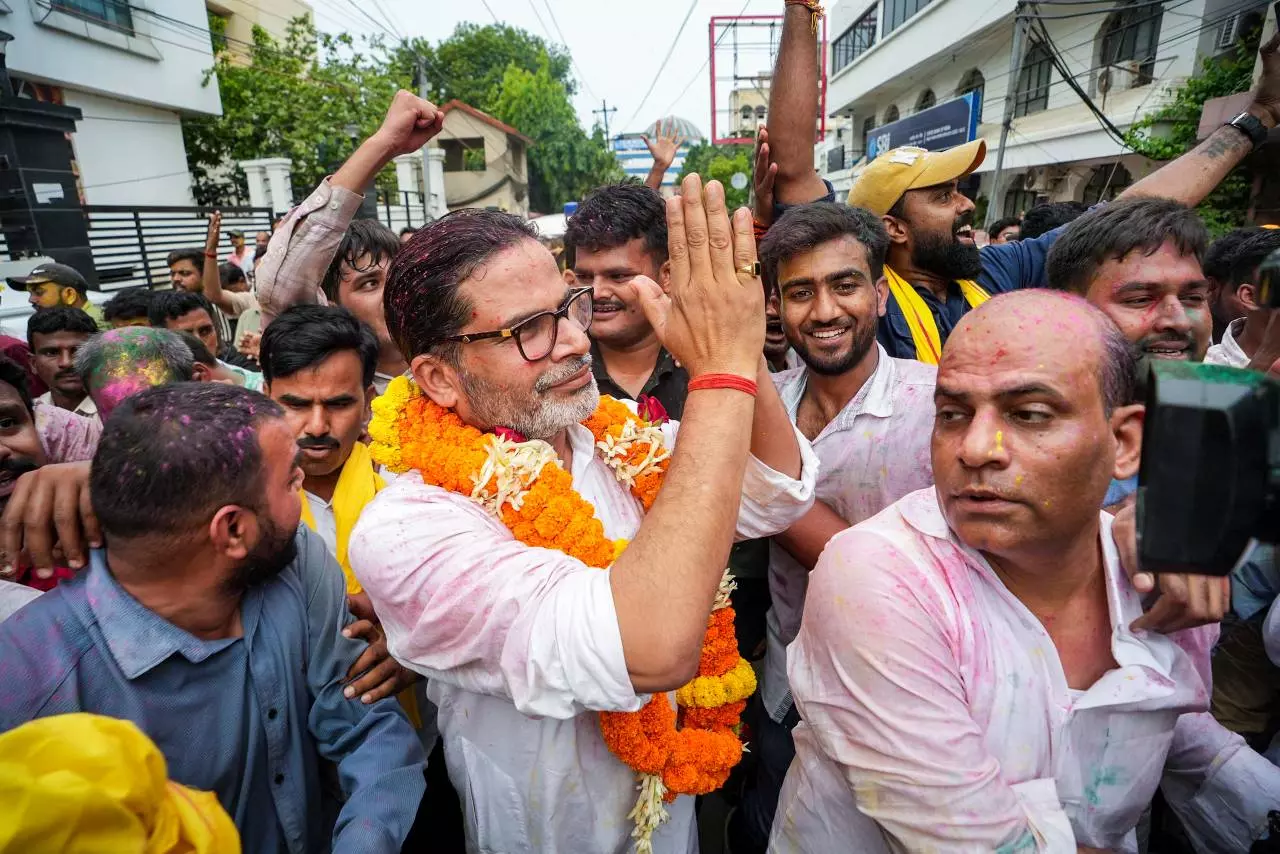
Beyond caste and Hindutva: Why Prashant Kishor’s Bankipur win is a big turning point
Kishor, who capitalised on youth anger around unemployment and inflation, broke Bihar’s well-entrenched politics of caste and religion by defeating BJP in its turf

It is no coincidence that celebrated election strategist and Jan Suraaj Party (JSP) chief Prashant Kishor’s historic victory in the ultra-urban Bankipur, held by BJP president Nitin Nabin and his father before him since 1995, comes on the back of a growing student unrest in Bihar.
In early 2024, the state saw railway aspirants protesting fiercely in Patna after massive cuts to nationwide locomotive pilot vacancies; in mid-2024, the Bihar Public Service Commission cancelled its TRE-3 teacher recruitment exam following paper leaks; in 2025, back-to-back rallies over state-level exam delays and logistical mismanagement ended in heavy-handed baton charges by the police.
Also read: Bypolls: Prashant Kishor wins Bankipur, ends BJP's 31-year rule; Congress bags Datia
The anger grew, transforming regional frustration into widespread statewide shutdowns when the national exam paper leak scandals broke.
Kishor’s win breaks age-old pattern
Indeed, a key reason Kishor has been able to unseat the BJP in a long-held ultra-urban seat – one which even the Rashtriya Janata Dal (RJD) in its heyday failed to win -- is that he was able to play to the sentiment of the times.
And, in doing so, he has sent out a powerful message: the state’s well-entrenched politics of caste and religion can be breached. In fact, some Bihar watchers are even going so far as to say that Kishor’s victory portends a tectonic change both in the substance and pattern of the state’s bipolar politics seen over the last three decades.
Occurring alongside widespread Gen Z and student protests, the electoral loss is a warning to the ruling BJP-led alliance that its divisive Hindutva rhetoric is failing to mask anxieties surrounding unemployment and inflation.
“Till this election, Bihar had been locked in a battle of identity politics. Prashant Kishor’s victory has broken that cycle,” Dr Shambhu Srivastava, a veteran socialist leader, who was a student leader in the JP movement, and former Bihar chief minister Nitish Kumar’s college roommate, told The Federal.
Upper castes, Muslims invest faith
Traditionally, the BJP has relied on the upper castes, who have been inimical to Lalu Prasad Yadav’s RJD, and the Most Backward Caste (MBC) votes that its ally, the Janata Dal United or JD(U)’s Nitish Kumar brought with him, while consolidating as much of the Hindu base as was possible by playing the Hindutva card.
Also read: Bankipur verdict ‘wake-up call' for Modi, says Prashant Kishor after win in BJP fortress
This time, Kishor, a Brahmin himself, has managed to take away most of the upper caste vote. This poses a more serious threat to the BJP than the RJD losing some of its minority vote to the JSP: for one, the RJD has never won this seat, and so many Muslims in this constituency, faced with a secular – and winning – option in Kishor, cast their votes in his favour.
Hyper-local campaign Vs Hindutva politics
Indeed, Kishor's victory demonstrates that a highly organised, hyper-local, issue-based citizen platform can successfully upstage the well-funded party machine of the BJP. Losing a seat like Bankipur, tightly held since 1995, proves that the BJP can no longer rely purely on historical voter loyalty or polarised messaging.
Occurring alongside widespread Gen Z and student protests, the loss is a warning to the ruling BJP-led alliance that its divisive Hindutva rhetoric is failing to mask anxieties surrounding unemployment and inflation. JSP’s maiden win also proves that a non-traditional political platform can win by focusing on real-world issues instead of old identity fault lines.
Also read: Explained: What awaits Prashant Kishor in Bihar?
By transforming himself from a backroom boy to an elected lawmaker, Kishor has proved that his ground strategy can work in public view. He centred his messaging on unemployment and migration. His win taps into a massive pool of frustrated young voters tired of empty promises. It comes as a warning to all major parties in Bihar that they can no longer take urban and semi-urban segments for granted, where actual economic delivery is prized over rhetoric.
Perfect timing
Kishor’s victory also comes at an opportune moment. One, the three men who dominated the state’s politics for the last three-and-a-half decades are no longer there. Former chief minister Lalu Prasad Yadav is out on bail, but is no longer in good health. Lok Jan Shakti Party (LJP) leader Ram Vilas Paswan, who served six prime ministers as a Cabinet minister, died in October 2020. And Nitish Kumar, a shadow of his former self, who spent the last few years battling to retain his political relevance, stepped down from the chief ministership – and active politics – in April this year.
Also read: Why did BJP lose Bankipur and Datia bypolls? What analysts say
Lalu Prasad Yadav’s son, Tejashwi Yadav, has been in politics since 2010; he even served as the deputy chief minister under Nitish Kumar briefly. Ram Vilas Paswan’s son, Chirag Paswan, has been in politics since 2014; he was a Union minister in Narendra Modi’s government. And Nitish Kumar’s son, Nishant Kumar, a software engineer who resisted joining politics for many years, succumbed recently and is now Bihar’s health minister. While the latter is still untested, the other two have been in active politics for over a decade.
Burden of legacy
Their speeches over the years have made it clear that both Tejashwi and Chirag are hoping not just to consolidate their family legacies but also add to them. Tejashwi has described his father’s years in power as the era of “samajik nyay (social justice)”. His own task, he has said many times, will be to take that forward and work towards “aarthik nyay (economic justice)”. By talking of economic justice, he had hoped to expand his party’s base to include everyone who is poor, most of whom are non-Yadav OBCs and Dalits, while blunting the hostility of the upper castes.
In history, there is always a watershed moment. And Prashant Kishor appears to have been able to mark that, partly because he does not carry the baggage of a successful political parent and therefore, perhaps, carries more conviction.
Chirag, the young LJP (Ram Vilas) leader, on his part, has sought not just to address fellow Paswans, Bihar’s most powerful Dalit caste who account for 4 per cent of the vote. He, too, has emphasised development: he has often lamented at public meetings that while other states have moved ahead, Bihar is still struggling to get decent roads and basic infrastructure.
Also read: Bihar polls: How geological, cultural divides shape state’s economy and votes
Indeed, both men have focused on the youth vote, hoping that they will be able to slice through religious and caste barriers.
No baggage, more conviction
But, in history, there is always a watershed moment. And Prashant Kishor appears to have been able to mark that, partly because he does not carry the baggage of a successful political parent and therefore, perhaps, carries more conviction. Of course, whether he himself will be able to lead the change in Bihar or not is yet to be seen, as much will depend on his next move.
But when that transformation takes place, regardless of who benefits from it, he will at least have to be given the credit for breaking the cycle of caste and religious politics.
Lalu Prasad Yadav famously said that he may not have succeeded in giving the people of Bihar a “swarg” (heaven) but he had given them a “swar” (voice). That voice has been heard now.