Myanmar military shakeup as Min Aung Hlaing set to be President
As Min Aung Hlaing steps up to the presidency, a loyalist hardliner takes charge of Myanmar's Army, dimming hopes for peace and deepening a civil war with no end in sight

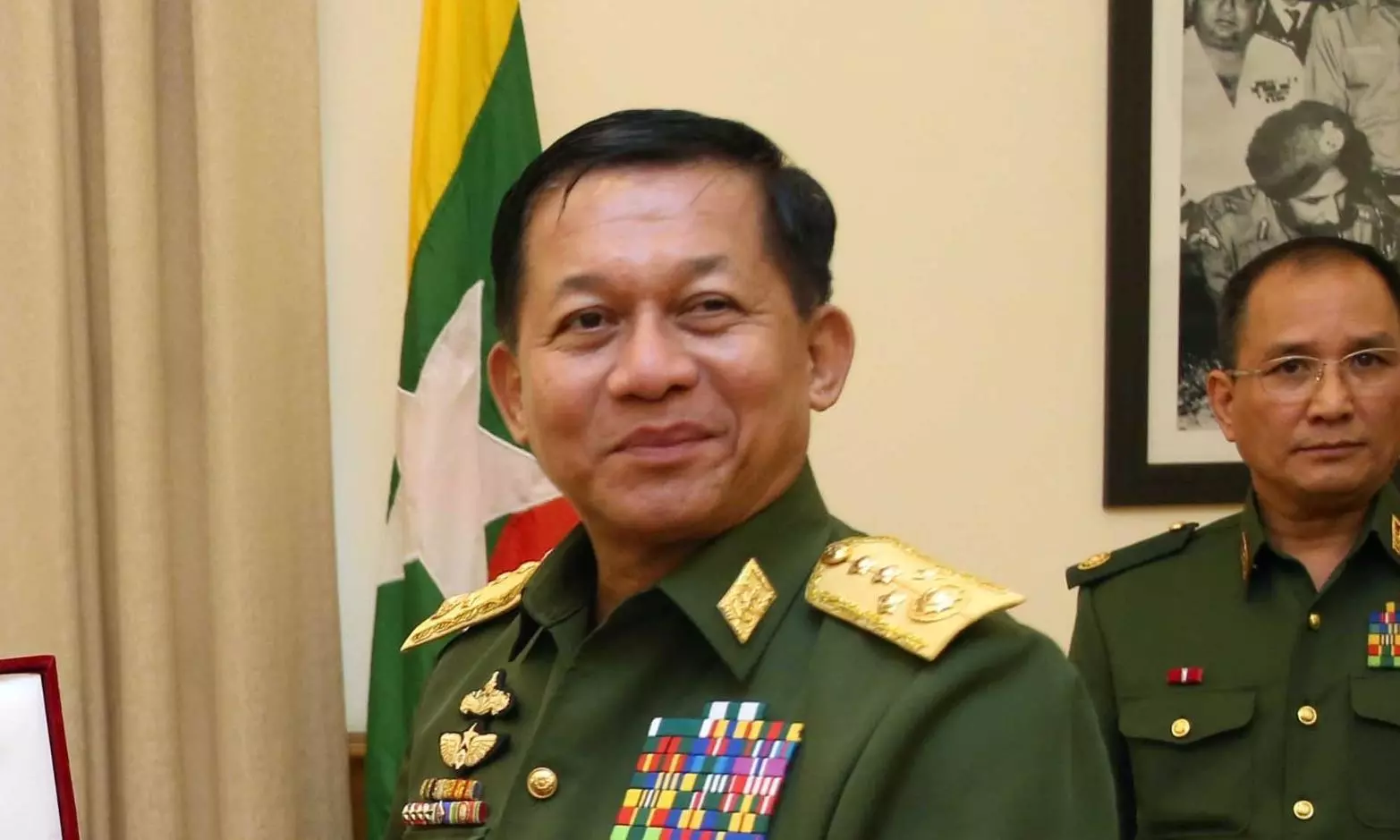
Myanmar's military supremo, Senior General Min Aung Hlaing, is set to take over as President, with a new military leadership put in place by him as he ascends to power.
On March 30, General Hlaing stepped down as Commander-in-Chief of the Defence Services to stand as a vice-presidential candidate, a mandatory move to formally assume the presidency.
This writer had predicted in February that General Hlaing was going to take over as President soon after the Myanmar parliamentary election, described as a sham, put in power the pro-military Union Solidarity & Development Party ( USDP).
Also read: Matthew VanDyke reveals US-based mastermind behind hiring mercenaries in Myanmar
It now becomes clear that Aung San Suu Kyi's refusal to back General Hlaing's bid for the presidency had led to the military coup in February 2021. Suu Kyi's National League for Democracy (NLD) had swept the Parliament polls in late 2021 and was all set to form the government for the second time.
That her mandate was more sweeping than in 2015 worried the Generals, because Suu Kyi appeared determined to amend key provisions in the 2008 Constitution that guaranteed the Army three key ministries and 25 per cent of the seats in Parliament.
Real reason behind 2021 coup
General Hlaing tried to arrive at a power-sharing deal that would make him President and allow the Army much influence in governance. When that did not work out, the Army staged the coup on the day the NLD government was scheduled to be sworn in. That ignited nationwide democratic resistance that the army tried to crush brutally, leading to a civil war that has ravaged Myanmar for the last five years.
General Oo is the chief of the all-powerful military intelligence and is considered the 'eyes and ears' of General Hlaing. He is known as the 'torture chief' in the Burmese military Tatmadaw, a ruthless officer but one with a poor professional standing
Now with the Burmese Army fighting with its backs to the wall, having lost control over much territory to multiple ethnic rebel armies and resistance groups swearing allegiance to the parallel National Unity Government ( NUG), many would have expected the new pro-junta government by the USDP to make peace overtures to the rebel groups and try end the bloody conflicts that has driven Myanmar to the edge.
But the changes in the military hierarchy following Gen Hlaing's stepping down as chief seem to have paved the way for hardliners who would like to continue the fighting.
Installing a loyalist
Those who expected the second most powerful man in the Myanmar military, Vice Senior-General Soe Win, to take over as Army Chief were shocked to find him purged. Others in the fray were considered too junior to challenge Soe Win, but on Monday (March 30), General Hlaing overlooked him and announced as his successor a staunch loyalist, General Ye Win Oo.
General Oo is the chief of the all-powerful military intelligence and is considered the 'eyes and ears' of General Hlaing. He is known as the 'torture chief' in the Burmese military Tatmadaw, a ruthless officer but one with a poor professional standing.
Also read: India backs 'Myanmar-led, Myanmar-owned' peace process: EAM Jaishankar
Soe Win was not even retained as Vice Chief--Lieutenant General Kyaw Swar Lin was named in his place. Myanmar media reports speculate that the 66-year-old Soe Win may be appointed to the newly formed Union Consultative Council, which is tasked with guiding and coordinating security, rule of law, foreign relations, the peace process and legislative issues.
For a while, General Hlaing has been visibly uncomfortable with Soe Win’s growing popularity with the military rank and file. Though at a recent gathering of Generals in Naypyitaw, General Hlaing hailed Soe Win as his “comrade-in-arms” for the past 15 years, he must have felt deeply embarrassed when military families and pro-military ultranationalists (including powerful monks) blamed Hlaing for the “humiliating defeats” in the civil war and asked him to step down by handing over command to Soe Win.
A party backed by the military is in power. But neither the USDP nor the Army seem interested in a political dialogue with the rebel armies that have seized huge swathes of territory from the army
Even as he is all set to assume the Presidency, Hlaing knows the Army is the real power behind the throne, so perhaps he wants to leave its command to a trusted loyalist. One retired Burmese general told this writer on condition of anonymity that Hlaing is 'worried about his own footsteps', meaning he fears a successor who might unleash a coup and bring down both the President and the Parliament. Soe Win's popularity in the Army worried him, so it is a "I go, you go" move by Hlaing.
Soe Win’s role in the Union Consultative Council, if he joins it, may be just symbolic, since the president is tasked with defining the council’s duties and powers.
No light at the end of the tunnel
Most Burma military watchers don't see any light at the end of the tunnel for Myanmar. The country's leading party NLD, is effectively banned and dissolved, like the Awami League in neighbouring Bangladesh, and its leader, Nobel laureate Aung San Suu Kyi, is locked up for life in prison.
A party backed by the military is in power. But neither the USDP nor the Army seem interested in a political dialogue with the rebel armies that have seized huge swathes of territory from the army. China has forced some of these rebel groups to make peace in the country's Northeast, but the other rebel groups have noticeably gained covert Western support with arms and mercenaries making their way into the conflict zones.
Neither the UN nor ASEAN have succeeded in getting the warring stakeholders to the table, making the peace process a non-starter. The future of Myanmar as a stable nation-state is at stake and the spectre of a Big Power rivalry looms large, as both China and the West eye Myanmar’s rich natural resources.
India seems to be losing the plot, as in much of the rest of its neighbourhood, having failed to play any meaningful role in the conflict mediation. Since some of India's most ambitious connectivity projects run through Myanmar, the festering conflicts can only add to unease in Delhi.