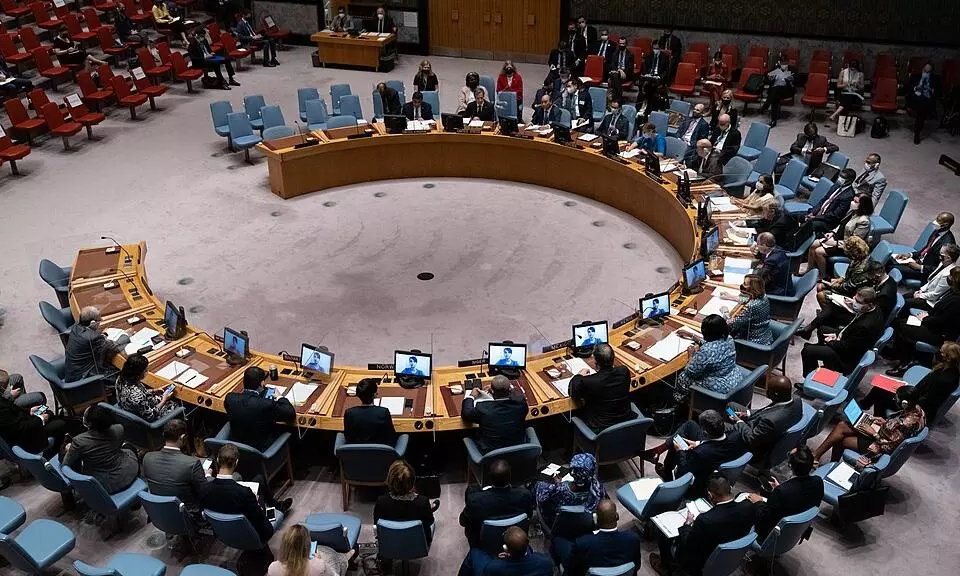
Every September, world leaders gather at the United Nations General Assembly, renewing calls to reform and expand the five-member Security Council. File photo: Wikimedia Commons
India wants a permanent UNSC seat; is it worth the effort?
With the Permanent Five still holding the real levers of power, expansion could make the Council more representative without making it more capable of action

It is now generally accepted that the United Nations Security Council (UNSC) has lost its relevance — it is held hostage to the interests, rivalries and ambitions of the world’s Great Powers. The US, Russia and China have made use of their veto to stop any move that goes against their strategic interests or those of their friends and allies. The gridlock has made the UNSC almost non-functional.
Yet every September, when world leaders make their annual pilgrimage to the UN General Assembly headquarters in New York, talks of reform and expanding the five-member Security Council inevitably take place. Diplomats hold closed-door meetings, and countries plan new strategies to enter the Permanent Five's charmed circle.
Despite constant reassurances that reform is necessary, little has changed since Boutros Boutros-Ghali called a special summit in 1992 to seek more equitable representation and an expanded Security Council membership.
Reform paralysis
Expansion may happen eventually, but there is no indication that new members will be granted veto powers. Countries are clamouring to join a club whose power is repeatedly paralysed by the very great-power politics they would be joining.
Will expanding the UNSC actually fix the problem, or simply expand the membership of a dysfunctional power structure?
Also read: Russia backs India’s permanent UNSC bid at UNGA
The question then arises: why should countries like India expend time and energy on an issue like this? Perhaps becoming a member of the UNSC may play well in domestic politics and give the impression that India has arrived on the global stage.
Narendra Modi loyalists will portray it as another feather in the cap of the Vishwaguru.
India's role
“Why should India want to be part of the UNSC when we do not take a stand on issues, beats me," former diplomat Dilip Sinha, who is familiar with the workings of the UN and has written a book on the UNSC functioning, told The Federal.
"India does not take a stand on any major issue, including large-scale human rights violations by countries, and keeps mum on the numerous conflicts in Africa. Except Pakistan, Hamas and recently the Houthis, India does not criticise. Both Hamas and Houthis are non-state actors,” Sinha added.
Countries are clamouring to join a club whose power is repeatedly paralysed by the very great-power politics they would be joining.
At the moment, the focus is on the race for non-permanent membership that comes up in June 2027. “We are trying to wrestle with Tajikistan over that? Why? It will only result in strained relations with an important Central Asian nation,” he further questioned.
India and Japan were in the race for the Asian non-permanent seat in 1996 for the 1997-1998 term. India was decisively defeated by Japan. The loss was a major diplomatic setback, and New Delhi took the defeat to heart. Since then, India has made sure that this is not repeated. India next became a member in 2011-12 and again in 2021-22.
Reform camps
The world wants UNSC reforms, but there is little agreement on how or when. The G-4, India, Japan, Germany and Brazil, want expansion of both permanent and non-permanent seats, arguing this would make the UN more representative, while leaving the contentious veto question aside.
Also read: Between Toffee and Coffee, a missed chance for India’s UNSC bid?
Others, including Turkey, Pakistan, South Korea, Argentina, Canada, Mexico and Italy, oppose expanding the P-5 and favour more non-permanent seats, knowing they have little chance of making the cut. The 54 African nations also want greater representation, including two permanent seats, but have yet to agree on which countries should fill them.
Global south
Despite its flaws, the UNSC remains a crucial arm of the United Nations. “It is important that India is represented. In 2026, the UNSC has no credibility without India and some of the middle powers from the Global South as permanent members,” TS Tirumurti, India’s former envoy to the UN, told The Federal.
On the criticism that the UNSC is paralysed, he said it is “a reflection of what is happening outside the UN as well. Like everything else, including global institutions, the UN is also eclipsed. So why blame the UN?”
The world wants UNSC reforms, but there is little agreement on how or when.
Taking an overall view, Tirumurti said that for the first time since the Cold War, there is a counterpoise to the Western view of the world order. “We may not subscribe to the Chinese vision of the world, but their challenge in the UNSC to a Western-dominated world order is not necessarily a bad thing for the Global South. It also gives India the manoeuvring space to play a geopolitical role and be proactive in international peace and security issues," he noted.
The UNSC will eventually have to expand, but a larger Council will not necessarily be a more effective one. The question is whether expanding a Council whose effectiveness is constrained by the veto power of the Permanent Five, will make the UN more capable of dealing with war and conflict or merely make its power structure more representative.