India faces rising heat as Dhaka unrest strains ties with Bangladesh
Anti-India protests, visa centre closures and calls to extradite Sheikh Hasina signal a sharp downturn in relations amid growing regional instability

India is grappling with a serious diplomatic challenge as relations with Bangladesh deteriorate sharply following violent protests in Dhaka and the killing of a student leader.
Anti-India demonstrations earlier this week forced New Delhi to shut two visa centres in Khulna and Rajshahi, citing security concerns. The closures followed the shooting and subsequent death of Sharif Osman Hadi, a key leader of Bangladesh’s student uprising.
Hadi, who was shot last week, died while undergoing treatment at a Singapore hospital. His shooting triggered the latest round of protests, first leading to the closure of India’s visa centre in Dhaka, which later reopened, and then those in Khulna and Rajshahi.
Violence erupts
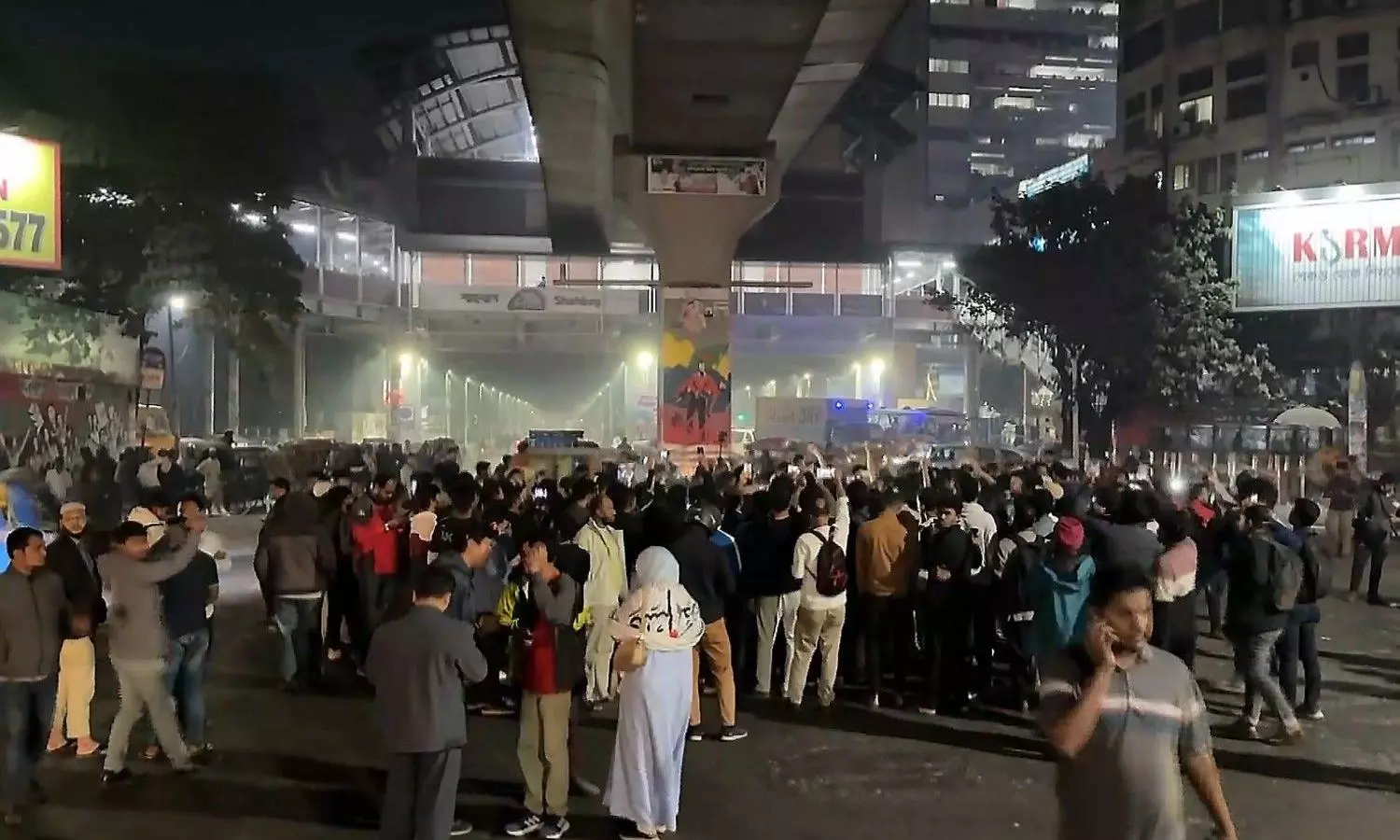
The death of Hadi has inflamed passions across Bangladesh. Thousands of protesters took to the streets of Dhaka, and reports said violence broke out across parts of the capital.
Several buildings, including those housing two of Bangladesh’s leading newspapers, were set on fire. The scale of unrest underlined the intensity of public anger following the killing.
According to reports, the protests quickly acquired a strong anti-India tone, further complicating New Delhi’s diplomatic position.
The unrest and visa closures are the latest signs of a steady decline in India-Bangladesh relations since the ouster of Sheikh Hasina as prime minister last August. Hasina fled into exile in dramatic circumstances and chose New Delhi as her sanctuary, reflecting the close ties her government maintained with India.
Rising threats
However, the interim student-backed regime led by Mohammed Yunus in Dhaka is now pressing India to hand over Hasina, a demand New Delhi has indicated it is unwilling to accept.
Student leaders and right-wing Islamic groups, including the Jamaat, have intensified pressure on India, calling for Hasina’s extradition.
According to a report, a student leader now associated with Bangladesh’s National Citizens Party warned that India’s Northeast could be isolated and that sanctuary could be provided to separatists.
Whether rhetoric or real intent, the warning reflected how far ties between New Delhi and Dhaka have fallen.
Regional implications
The turbulence has created an opening for Pakistan, which has sought to exploit strains between India and Bangladesh for decades.
For the first time since Bangladesh’s creation in 1971, relations with India appear to have deteriorated to this extent. A report quoting Congress MP Shashi Tharoor described the situation as India’s greatest strategic challenge in the region.
A parliamentary committee headed by Tharoor traced the unrest to the growing influence of Islamic radicals, alongside increased Chinese and Pakistani engagement after the collapse of the Awami League government.
Shifting alliances
Since Sheikh Hasina’s exit, Islamabad and the Yunus regime have displayed renewed warmth in their ties.
The evolving situation has raised the possibility of deeper cooperation between Bangladesh, Pakistan and Turkey, including potential military arrangements.
China, a major economic player in Bangladesh, has so far refrained from overt intervention but continues to closely monitor developments.
Limited options
New Delhi now faces limited diplomatic choices. Officials are working to arrest the slide in relations without compromising on their refusal to hand over Sheikh Hasina.
A Bangladeshi court has convicted the former prime minister of war crimes and sentenced her to death, a verdict the interim regime is using to press India.
In an interview, Hasina dismissed the ruling as a decision by a “kangaroo court” acting on behalf of an unelected interim government.
For India, however, the unfolding crisis threatens to reshape regional geopolitics in ways that could directly undermine its strategic interests.
The content above has been transcribed from video using a fine-tuned AI model. To ensure accuracy, quality, and editorial integrity, we employ a Human-In-The-Loop (HITL) process. While AI assists in creating the initial draft, our experienced editorial team carefully reviews, edits, and refines the content before publication. At The Federal, we combine the efficiency of AI with the expertise of human editors to deliver reliable and insightful journalism.