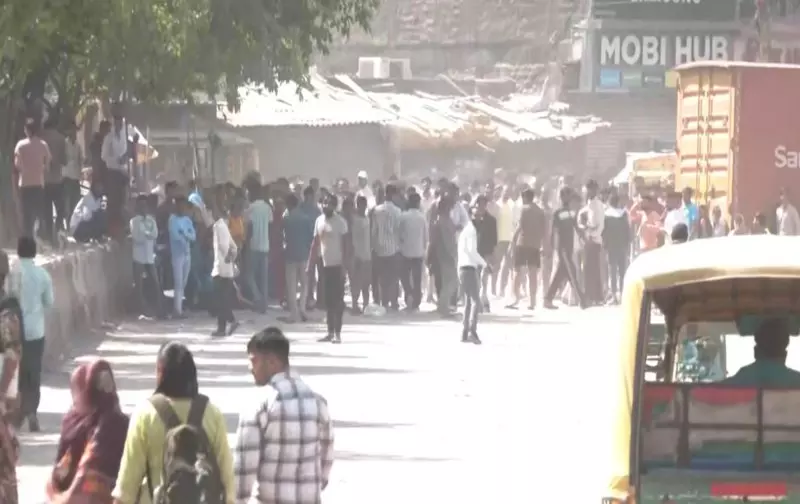
Energy, economy woes: Noida workers saw it coming, but no one listened
Workers in Noida raised alarms over fuel shortages and rising prices weeks before PM Modi’s austerity appeal amid the escalating Iran crisis

In retrospect, the strikes by workers in Delhi’s Noida suburb served as an early warning signal, highlighting the deteriorating energy and supply-side constraints within the economy amid the conflict in Iran.
But the alarm raised a month ago went unheeded till Prime Minister Narendra Modi made an urgent appeal for austerity in a speech in Hyderabad last Sunday (May 10) before a gathering of his party workers.
Workers’ anger spills over
In the middle of the last month, tens of thousands-strong crowd mainly drawn from Noida’s bustling industrial belt took to the streets demanding a wage hike through the revision of its minimum threshold set by the government to offset the rising daily bread and butter prices amid the war raging in a none-too-distant neighbourhood.
Also Read: PM Modi orders 50 per cent cut in convoy, BJP CMs follow suit amid West Asia crisis
Soon, informal domestic workers too joined the protests, and it not only spread but also degenerated into violence, arson, pitched battle with the police and arrests, deflecting the whole economy-related issue onto the realm of law and order or its breach.
LPG shortage at the core
The immediate provocation for the workers' rage was the scarcity, price hike, illicit marketing and torturous wait for cooking gas cylinders because of the war in Iran.
Also Read: PM’s appeal to avoid foreign trips to hit travel industry, boost domestic tourism: Experts
The government refuted this as the actual trigger behind the protests and sought to promote conspiracy theories. It blamed workers for raising false alarms and claimed to have adequate stocks of gas to supply for days or even weeks. It also offered easy access to gas in mini-cylinders for those who cannot afford full 14.5-kilogram regular gas bottles, which are commonly used for domestic consumption.
Politics misses the warning
Like the government, most Opposition parties also treated workers' worries as mere industrial relations issues, whereas these stemmed from war clouds thickening across West Asia and threatening to douse the kitchen flame far and wide.
Also Read: Why PM Modi's 'austerity' plea undermines India's stature on global stage
Both the government and the Opposition were caught up with elections in five States. If it did not suit the Centre’s ruling side to publicly admit the possibility of gloomy days ahead, as pointed out by the workers' consternation in Noida and other cities near New Delhi, the State parties challenging the BJP in elections kept themselves confined to either local, or State-specific issues, or at best to the revision of electoral rolls on the poll-eve by the Election Commission (EC).
Rahul’s warning, wider silence
Yet, Congress’ Leader of Opposition in the Lok Sabha, Rahul Gandhi, flagged government’s apathy to the possible fallout of US President Donald Trump’s tariff tricks on India’s domestic markets and workers by calling Narendra Modi a “compromised PM”. Rahul repeated the same refrain about Modi in the wake of the Iran war and the risks that this could throw up for India.
Also Read: Work from home again? Modi’s fuel-saving appeal draws smiles and frowns
But the opposition at large, and even Rahul’s colleagues in the Congress, were unfazed by growing signs of an impending fuel shortage, which could well entail an economic crisis, as if they too were compromised. And, thus, none listened to the outcry of Noida poor workers. Grim warning signs kept flashing, and parties cutting across ideologies and other myriad distinctions merrily pretended to be busy with brisk electioneering.
PM Modi’s austerity message
With the election fever gone following the declaration of results on May 4 the Prime Minister revealed the full extent of the possible toll that a world at multiple wars may wreak upon the economy back home.
He exhorted fiscal prudence and restraint through work from home wherever possible to cut down on travel and save fuel, use of public transport, avoidance of unnecessary foreign travel, shunning the urge to buy gold for a year at least, reduction of use of imported edible oil and other exotic items were Modi’s some other suggestions so as to save the depleting foreign exchange reserves because of the current war’s pushing up the oil and gas prices.
Missed signals and media noise
So, the list for observing strict austerity is comprehensive which Noida’s workers associations or their counterparts elsewhere cannot be expected to articulate as such. But the fact that the workers' protests took place for days within the earshot of Noida’s numerous TV channels indicates that the message that the harried labour force tried to convey was willy-nilly lost.
Also Read: Noida Ground Report: What workers say amid uneasy calm
Instead, the media bought conspiracy theories that could well have led to workers’ stir. Among other things, a Pakistan angle too crept in, making activists back workers to allege that this was used to vilify the workers and their unions.
But what was missed in the hubbub is that Pakistan was one of the first countries to implement a work-from-home policy for its office-goers to cope with the shrinking oil supply and soaring fuel costs as the war in Iran peaked.
Thus, warnings emanating from even nearer home too were conveniently ignored until the likelihood of a full-blown crisis was finally realised only as late as a few days ago and that too at the highest level of the Prime Minister of India. Were others napping, or daydreaming?