Emulating an icon without slipping into mimicry is no small feat, but Karthi manages it with restraint and conviction.
Vaa Vaathiyaar review: Karthi's film promises Big Bang, but settles for sparks
Karthi nearly carries the film by himself, most notably in his measured, non-mimetic portrayal of MGR.

Apart from moral ambivalence, the commonality of all Nalan Kumarasamy’s feature film protagonists is that they are aware of being so. Daas of Soodhu Kavvum can’t resist being a kidnapper. He understands the risks and therefore adopts a ‘middle path’ by finding non-violent ways to go about his business. Ka Ka Po’s Kathiravan is a paper tiger who has served time for crimes he never committed. He strives hard to let go of his past, which is not even his. Vaa Vaathiyaar’s Ramu is far stronger than these two, and far more convinced of his criminal ways too.
From dark comedy to optimistic superheroism
While all three are criminals in their own ways, we tend to like them. In Vaa Vaathiyaar, Ramu’s father even verbalises it: “He is a good guy only but has his ways.” Yet all three films end up being utterly different because of the journeys these protagonists take. Soodhu Kavvum remains a dark comedy because there is no redemption for Daas. When you realise that the title is just a statement and not part of the old Tamil proverb Dharmathi Vaazhvuthanai Soodhu Kavvum Aanal Dharmam Marubadiyum Vellum (though deceit may overpower a righteous life, righteousness will triumph again), you understand the film’s deeply pessimistic worldview. Soodhu just Kavvum there. Vaa Vaathiyaar, on the other hand, isn’t a dark comedy because it is more optimistic and actively fights for change.
What if Nalan’s Arumai Prakasam from Soodhu Kavvum had a heroic alter ego who decided to undo all the evils committed by his original self? That vague but compelling idea is essentially Vaa Vaathiyaar, an idea that never fully gets realised.
Also Read: Nalan Kumarasamy interview: 'Vaa Vaathiyaar is a hybrid masala film set in an imaginary world'
The film is set in the fictional city of Maasilaa — meaning unpolluted— but the irony is apparent. Though fictional, it mirrors reality closely. It begins with the death of then Chief Minister MGR, coinciding with the birth of Ramu (Karthi). Ramu’s grandfather, a die-hard MGR fan, believes his grandson is MGR reincarnated. Ramu does seem gifted — brilliant in studies, immensely lucky, almost supernatural. While his grandfather nudges him to walk the path of the Vaathiyaar — a term MGR was fondly known by — Ramu soon realises that honesty and incorruptibility don’t yield results.
There’s a lovely scene where he pastes a photo of Nambiar over MGR in his notebook, instantly reminding us of Nalan’s irreverent humour and of Arumai Prakasam. But the film doesn’t pursue that dark-comic tone. Instead, it establishes itself as a serious commercial drama. Ramu grows up to become a corrupt cop, while his grandfather remains proudly unaware, believing him to be an upright officer.
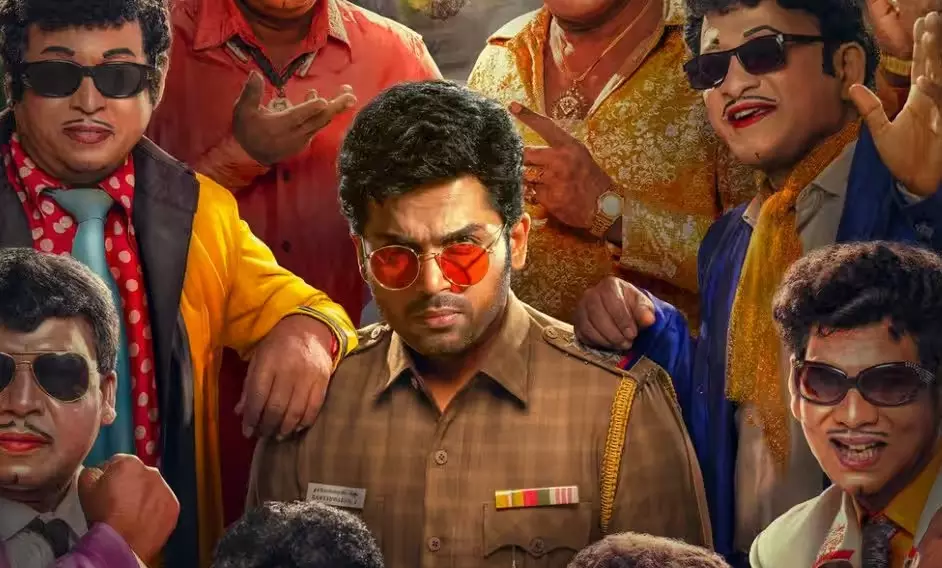
A telling visual metaphor plays out when Ramu hides his grandfather’s reading glasses, preventing him from reading a scathing suspension report. Juxtapose that with Ramu’s tinted sunglasses, and you get a clear sense of their opposing worldviews.
Ramu soon becomes an aide to conglomerate villain Periyasamy (Sathyaraj), who evokes the iconic Amaavasai from Amaidhi Padai. Periyasamy plans a brutal crackdown on protesters opposing a polluting industry, with the ruling government’s complicity. If this feels familiar, it is intentionally so. The plan is leaked by a hacktivist group called Manjal Mugam (Yellow Face), and Ramu plays a key role in helping the villains hunt them down.
Half measures
This coincides with Ramu’s grandfather realising that his grandson is the villain, not the hero. Ramu reaches a tipping point, unleashing the long-suppressed Ramachandran–MGR. At night, MGR takes over Ramu, undoing the damage done during the day. The film gradually turns into a superhero narrative, bearing more than a passing resemblance to Sivakarthikeyan’s Maaveeran, which dealt with the idea in more detail.
Here, the idea of turning MGR, a stand-in for the inner moral voice inside everyone, into a superhero—though it is not explored. The lack of that exploration reduces the film to just being another generic superhero movie. The film should have gotten into the moral debate. Instead, it functions on the periphery. Ramu’s ascent to superhero status is quick and uneventful because we don’t really witness his descent into devastating moral corruption.
Added to the woes is the futile attempt at world-building, which leaves you questioning its need. While the visual aesthetics of the film are refreshing, the film doesn’t really need the fictitious world it is set in. In fact, Soodhu Kavvum’s world comes across as more sprawling with its zany characters than this. A sense of such half measures prevails throughout the movie.
The first half moves with his trademark quirks and delightful touches. Ramu’s gift is established with nuance: a biker curses him as “Saavugraaki” (someone who asks for death), only to die moments later. Wu (Kirthi Shetty) is similarly introduced as a psychic with elegant subtlety. But these are only small flourishes that don't really matter when the film falters in things that matter.
A Big Bang that never happens
What saves the film is Karthi’s remarkable performance. He carries it almost single-handedly, especially while imitating MGR. Emulating an icon without slipping into mimicry is no small feat, and Karthi manages it with restraint and conviction—reflecting his consistent effort to choose unconventional roles.
But a hero could only do so much when there aren't enough pinches to keep the film going. While we wait for a thoughtful payoff, Vaa Vaathiyaar takes the safer route of a conventional commercial entertainer, feeling hurried in the process. We get a lengthy fight sequence that’s supposed to make up for a lacking third act. It would have, had the fight itself had some creativity imbued into it.
Also Read: Rahul Gandhi backs Vijay over Jana Nayagan delay: ‘Attack on Tamil culture’
A feeling that a grand vision was left unrealised and knowingly so lingers as you watch some key moments like the one where Ramu confronts his alter ego. When MGR tells Ramu, “I was planning to meet you in a better scenario, but…”, it almost sounds like Nalan speaking aloud. When Wu first meets Ramu, she hears his heart beat and asks, “Are you going to explode? There’s a Big Bang brewing inside you.” We expect exactly that—for the idea to explode into something truly mind-blowing and take us somewhere unexpected. Instead, Vaa Vaathiyaar feels like a sentence that starts with a bang, but never gets to the peak it aspired.