



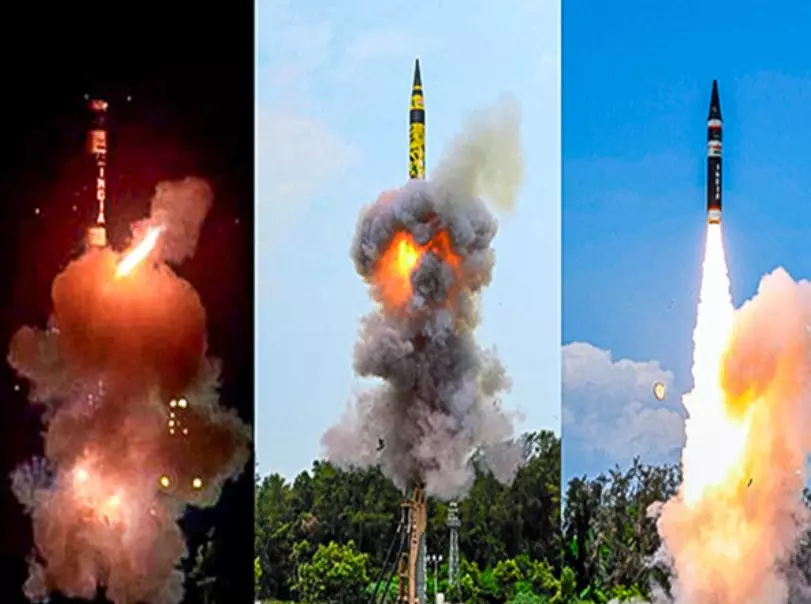
India continues to strengthen the sea-based component of its nuclear deterrent through the gradual expansion of its SSBN fleet. Screengrab: ANI
India deploys 12 nuclear warheads, signaling shift in nuclear readiness: Report
The Stockholm International Peace Research Institute highlights growth in India's SSBN fleet and nuclear arsenal

In a major shift with regard to the operational preparedness of its nuclear weapons, India has deployed 12 nuclear warheads, stated the Stockholm International Peace Research Institute (SIPRI). The report further stated that the move marks a significant departure from India’s policy of storing nuclear warheads and delivery systems separately.
Shift in deployment posture
SIPRI stated that India’s recent actions relating to its nuclear arsenal include a shift towards placing missiles in canisters and conducting sea-based deterrence patrols. This, stated the report, suggests that India could be heading in the direction of storing some of its warheads along with their launchers during peacetime.
Also Read: India’s nuclear triad goes deep as INS Aridhaman inducted but missiles yet to catch up
“It has long been assumed that India stores its nuclear warheads separately from its deployed launchers during peacetime,” stated the report.
“However, the country’s recent moves towards placing missiles in canisters and conducting sea-based deterrence patrols suggest that India could be shifting in the direction of mating some of its warheads with their launchers in peacetime,” it added.
Warhead numbers increase
According to SIPRI’s estimates as of January 2026, India may have started to deploy a small number of nuclear warheads on a single SSBN conducting occasional deterrence patrols.
Also Read: Integrated Rocket Force: India’s missing piece in conventional deterrence
According to SIPRI, there has been a small increase in the number of India’s nuclear warheads last year. "India was estimated to have a growing stockpile of about 190 nuclear weapons as of January 2026-a small increase from the previous year. These weapons were assigned to a maturing nuclear triad of aircraft, land-based missiles and SSBNs," stated the report.
"It has long been assumed that India stores its nuclear warheads separate from its deployed launchers during peacetime. However, the country's recent moves towards placing missiles in canisters and conducting sea-based deterrence patrols suggest that India could be shifting in the direction of mating some of its warheads with their launchers in peacetime," it added.
Expansion of SSBN fleet
India continues to strengthen the sea-based component of its nuclear deterrent through the gradual expansion of its fleet of nuclear-powered ballistic missile submarines (SSBNs), according to SIPRI. The report stated that the Indian Navy currently operates three SSBNs-INS Arihant, INS Arighaat and INS Aridhaman-with the latter reportedly entering service in April 2026.
Also Read: India’s fast breeder reactor at Kalpakkam achieves criticality, 'defining step', says PM Modi
The report further stated that a fourth SSBN, believed to be INS Arisudan, is expected to be commissioned in 2027, adding to India's growing undersea nuclear capability.
According to SIPRI, satellite imagery suggests that the Aridhaman and Arisudan are significantly larger than the first two submarines in the class. The two vessels are estimated to be between 16 and 18 metres longer and are fitted with eight missile launch tubes.
These submarines are equipped with "twice the number" of missile tubes carried by the Arihant and Arighaat, stated the report, indicating a potential increase in missile-carrying capacity as the programme evolves.
Future plans and nuclear doctrine
SIPRI further stated that India is also pursuing the development of a new generation of SSBNs under a programme known as S5. Once the project reaches completion, the report assessed that India could eventually operate between six and eight ballistic missile submarines simultaneously.
India continues to adhere to a "no first use" doctrine in relation to its nuclear weapons policy. Under this posture, the country maintains that it will not be the first to launch a nuclear strike.